
In a previous blog I had mentioned the National Commission on Energy Policy’s report Task Force on America’s Future Energy Jobs which focusses on the workforce issues facing the electric power industry at a time when it is facing challenges including diversifying energy sources to include distributed intermittent energy sources, replacing the existing grid with a more intelligent smart grid, and increasing energy demand at a time when there is widespread concern about the environment.
The Task Force identified the major workforce gaps facing the electric power industry including
- workforce retirements at existing facilities over the next ten years
- constructing new low-carbon generating assets and retrofitting existing generating assets over the next twenty years
- constructing new electric infrastructure and retrofitting existing assets (transmission lines, CO2 pipelines, local distribution systems)
- operating and maintaining new and retrofitted generating assets and supporting infrastructure
- energy efficiency in retrofitting the nation’s building stock
- smart grid technologies
 Replacing Retiring Electric Power Sector Workers
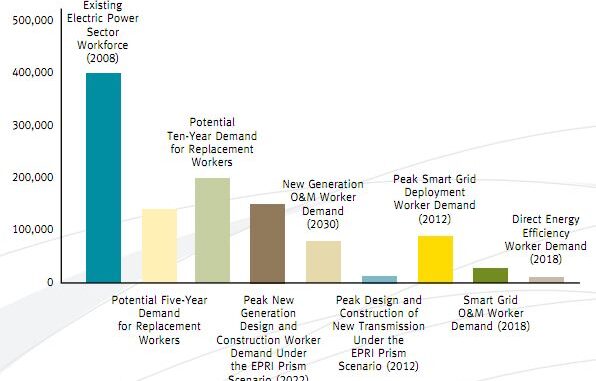
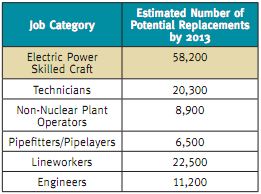
The U.S. electric power generation, transmission,and distribution industry employs about 400,000 people. It is estimated that 30–40 percent of these workers will be eligible to retire by 2013. Of the 120,000 to 160,000 electric power workers eligible for retirement, industry surveys suggest 11,200 will be engineers. The IEEE PES estimates that 7,000 engineers will be required over the next five years.
Workers to Design and Build New Electric Power Infrastructure
Using the EPRI Prism projection of renewable energy and smart grid, it is esimated that by 2022 the industry will need 150,000 professional and skilled craft workers to design and construct new electric sector infrastructure.
 Workers to Operate and Maintain New Electric Power Infrastructure
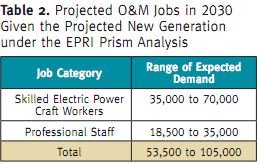
The number of additional workers that will be needed by 2030 is estimated to be 60,000.
Smart Grid Deployment
The deployment of smart grid technologies will require over 90,000 workers, of which it is projected that some 25 000 will come from retraining workers in existing poistions.
Running energy efficiency programs
Additional workers will be required to design, administer, promote and support energy efficiency programs. It is estimated that utility or third-party managed energy efficiency programs will require 11,000 employees per year through 2030. It is expected that program managers will use contractors to implement or deploy efficiency technologies and that contractors will significantly outnumber direct employees in energy efficiency programs.
Addressing the gaps
The future demand for electric power skilled labour and engineers exceeds the supply. The Task Force identified what it sees as the major inhibitors preventing a rapid ramp up in supply to meet the demand.
Grades K-12
Major issues identified include low high school graduation rates, lack of technical skills in graduates, and lack of industry-specific training for educators. The Task Force makes a number of recommnedations to address these issues.
Training and educating skilled craft workers
 Technical skills and training for skilled electric power trades can be acquired at community colleges, community-based organizations, apprenticeship programs, internal utility company training programs, and worker retraining programs, also often internal. But it appears that programs are only beginning to be ramped in the last two years. One of the reasons identified by the Task Force is the current system used by the Bureau of Labor Statistics (BLS) to estimate future industry demand that does not include estimates for replacing positions lost through retirement. The cost of education is another inhibitor and is the motivation behind the Center for Energy Workforce Development which has received a Bill and Melinda Gates Foundation award to train low-income young adults for energy jobs.
Training and educating power engineers
 Issues include the lack of math and science skills in the population of high school graduates and a need for new ways to encourage students to work in the electric power sector. In addition the cost of education in the United States can be a barrier to entry. The IEEE PES Scholarship Plus program, which not only offers funding but also hands-on internships prior to graduation and mentoring, is a response to the pressing need to attract more students into electric power engineering. The IEEE PES says it intends to ramp the program up to provide over 1000 scholarships per year.

Be the first to comment