
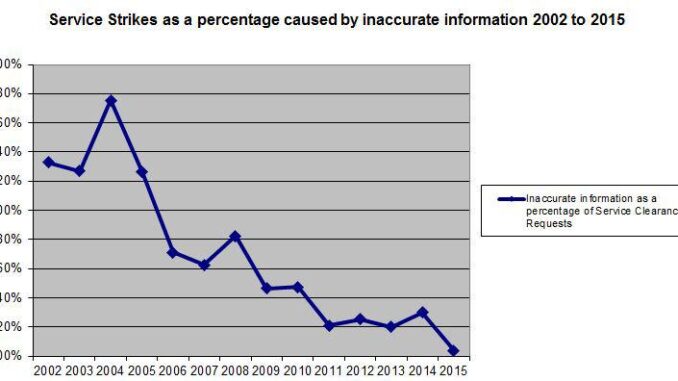
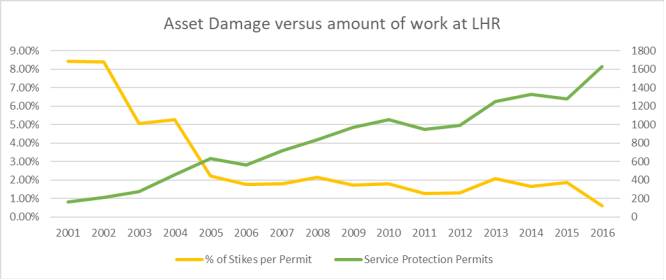
Are there things that an owner, agency or municipal government responsible for an airport, industrial campus, or town can do to reduce the risk of underground utility damage, the associated disruptions to operations and business and the attendant danger for construction workers and the public ? At this year’s Geo Business in London I had a chance to chat with Andy Rhoades, who was Head of Service Protection Knowledge & Information Management Technical Standards and Assurance at Heathrow Airports from 2001 to 2017. During the first ten years of Andy’s tenure at Heathrow the annual number of services strikes (underground utility damage) at Heathrow declined by a factor of six and has continued to decline even as the amount of construction has grown.
Airports are like cities except that they have a greater density of underground utilities and more types of underground equipment; communications cables, aeronautical ground lighting cables, gas mains, low voltage electric power cables, high voltage electric power cables, storm water mains, sanitary waste water mains, potable water mains, grey water mains, fuel mains, fire fighting water mains, and a variety of underground structures. In addition striking a main in an airport carries with it a larger risk than in an urban area because of the incoming and outgoing aircraft and the large number of people in a concentrated area. I have previously blogged about what Andy was doing at Heathrow based on his talk at Geospatial World Forum 2014.
Andy introduced a seven step process, from early design to handover, for excavations at Heathrow that continues to be followed at Heathrow. One of important features is the concept of exclusion zones. Based on PAS 128 quality levels, it details what type of excavation can be safety used within 0 to 3 meters of a utility. These include hand-digging (foot pressure only), powered hand tools, vacuum or hydraulic extraction, and powered excavation.
Another requirements is that all people involved in detecting and mapping underground infrastructure must be trained. Heathrow has helped to develop National Vocational Qualifications (NVQs) relevant to underground asset management. National Vocational Qualifications (NVQs) are work based awards in England, Wales and Northern Ireland that are achieved through assessment and training. To achieve an NVQ, candidates must prove that they have the competence to carry out their job to the required standard. NVQs are based on National Occupational Standards that describe the ‘competencies’ expected in any given job. In addition in the UK there is a formal structure Qualifications and Credit Framework (QCF). Training levels that Andy mentions are QCF Utility Mapping Technician, QCF Level 3 Utility Mapping Surveyor, and QCF Level 5 Senior Utility Mapping Surveyor.
Based on his experience at Heathrow, for his consulting practice Andy has produced two manuals that document his over 15 years of experience at Heathrow, and 9 years at Thames Water, Londons Water company. Services and Buried Infrastructure Protection Standard is a recommended standard for owners of large number of underground assets such as airports, towns, universities, industrial campuses, and other facilities. The second is a Clients Guide to Utility Survey that gives owners/clients a guide to what they should require from an underground utility survey. Between them these manuals contain a wealth of practical information for owners/clients who want to reduce the risk of underground utility damage during excavation. They also contain examples of what has happened if the guidelines are not followed, for example, air traffic control tower loss of communications, when a backhoe operator decided to take out a big concrete slab which happened to contain fiber cables carrying the airport’s communications. He also provides best practices for surveys in rural areas, suburban areas, busy urban areas and congested city areas and airports.
One of the very interesting sections in the Guide covers different technologies for underground utility detection including GPR, EML (Cat and Genny), Acoustic pipe locator, using a dye to trace drains, earth resistance, gyroscopic pipe locator, infrared imaging, magnetometry, metal detectors, RFID detectors, vibration acoustic. There are some good rules of thumb, for example, underground utilities can be detected through concrete, utilities can’t be detected through salty water (w/ electrolytes) with GPR, but can through fresh water (w/o electrolytes), and underground detection generally is not very accurate for depth without expert processing of raw data. That radio waves used in GPR travel at the speed of light through air, two thirds the speed of light in ground (average depending on ground make up), and one third the speed of light in water, can result in serious errors in reported depths of detected infrastructure.
He also discusses how the commonly used techniques GPR and EML can generate unreliable data including ghost utilities. EML in particular has problems when utilities are close to each other or cross each other. The result is that the reported location can be off and in the worst case, EML can report three utilities when in fact there are only two, or two where there is only one. EML can report an S shaped warp in a cable when it crosses another utility. He has a very detailed decision tree that can be followed to improve the confidence level in detected underground utilities by taking into account frequencies used, ground conditions, depth, separation between utilities, type of equipment (plastic, metal, PVC, optical cable, ceramic), water content, temperature and air content.
 Airports are worst cases because of the many different types and density of underground utilities. Recognizing that the reliability of underground utility detection and mapping is about 70% if using EML only, it is essential that anyone involved in owning, managing, locating, mapping and reducing the risk of utility damage during construction follow procedures like those defined by Andy at Heathrow and now through his own company Buried Asset Protection Ltd. [email protected].
Currently Andy is leading the update of the British quality standard for underground infrastructure PAS 128.

Be the first to comment