
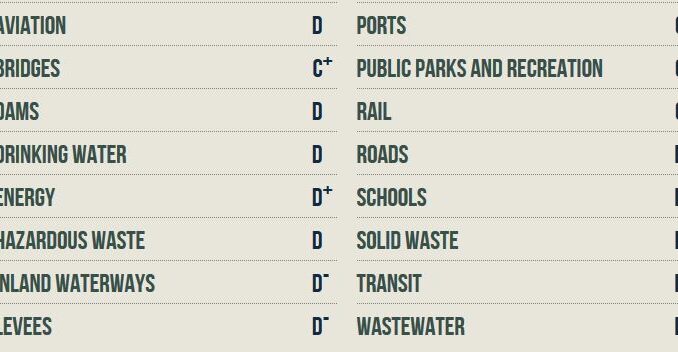
The state of U.S. public infrastructure was given a cumulative grade point average of D+ (poor) by the American Society of Civil Engineers (ASCE) in its 2013 infrastructure scorecard. A grade of D is defined as “in poor to fair condition and mostly below standard, with many elements approaching the end of their service life. A large portion of the system exhibits significant deterioration. Condition and capacity are of significant concern with strong risk of failure.” According the the World Economic Forum the quality of United States infrastructure is now ranked 19th among the World’s nations.
A symposium of public-private infrastructure industry leaders has agreed that the time has come to issue an experts’ consensus report on the seriousness of the state of the U.S. infrastructure and the pressing need for change. At At the National Press Club on June 26-27, a report Making the Grade was released by experts representing 45 different corporations, professional organizations, think tanks, financial advisers, academic institutions and others which presents a six-point plan to resuscitate U.S. infrastructure and revive the U.S.’s global competitiveness.
In the report infrastructure is defined as the basic public physical and organizational structures needed for society to function including drinking water, waste water, solid and hazardous waste disposal, telecommunications, energy, streets, roads, highways, bridges, transit, rail, aviation, schools, parks, levees, ports, and inland waterways.
The annual cost of the status quo, with increasing water main breaks, electricity failures and transportation delays, is estimated to increase to $1.2 trillion for U.S. businesses and $611 billion for all American households by 2020. Some of the issues highlighted in the report include
- 42 % of major U.S. urban highways are congested leading to $101 billion in lost worker productivity and fuel wasted idling in traffic every year. By 2020, it is estimated that the time stuck in traffic will triple increasing the risk of economic gridlock in the densest urban corridors.
- Every year that are 240,000 water main breaks in the U.S. Without extra investment to close the investment gap in water infrastructure, there is a risk of losing $416 billion from the U.S. gross domestic product (GDP).
 National six-point plan
- Make Infrastructure leadership a presidential and cabinet priority to convey and support the vision, arbitrate competing interests, and remove obstacles to success.
- Form U.S. infrastructure regions to integrated infrastructure agendas and efficiently allocate capital and natural resources.
- Establish a national infrastructure bank to accelerate projects that can align with the visions goals, i.e., innovation, and prudent use of capital, modernize project delivery methods, and societal benefit, among others,
- Sell opportunity bonds to raise more infrastructure capital to fulfill the generational obligation,
- Create a national infrastructure index that clearly articulates the current state, ambition, and the relative contribution of proposed projects and programs to encourage long-term, sustainable ROI through transparency.
- Engage the American people to build support for the importance of infrastructure policy.
Making the Grade Infrastructure Symposium 2013—Attending organizations
American Public Works Association
American Society of Civil Engineers
American Structurepoint
Anchin, Block, & Anchin
Arcadis
Arup
ASLA New York Chapter
Autodesk
Berger Group
BioCities
Black & Veatch
Brookings Institution
City of Boston, MA
Dewberry Companies
Ernst + Young
Forum for Urban Design
Genivar/WSP
Golder
Granite
Grimshaw Architects
Harrisburg Area Community College
HatchMottMacDonald
HDR
HNTB
Impact Infrastructure
Indiana University of Pennsylvania
Infrastructure USA
Institute for Large Scale Innovation
Institute for Sustainable Infrastructure
Jacobs
Jonathan Rose Companies
Kiewit
Malachite
Parsons Brinckerhoff
Polytechnic University of NYU
Riverkeeper
Skanska
Stantec
Syska + Hennesey
Tectonic Engineering
Transportation Issues Daily
NY Chapter Urban Land Institute
VHB (Vanasse Hangen Brustlin)
Weidlinger
Be the first to comment