
In the UK there is a major 10-year research initiative entitled Mapping the Underworld (MTU) that seeks to address the serious social, environmental and economic consequences arising from an inability to locate – accurately and comprehensively – buried utility service infrastructure without resorting to extensive excavations (potholing).
It is estimated that up to 4 million holes are dug in the UK road network each year in order to install or repair buried service pipes and cables. Failure to identify accurately the location of existing buried assets results in numerous practical problems, costs and dangers for utility owners, contractors and road users.
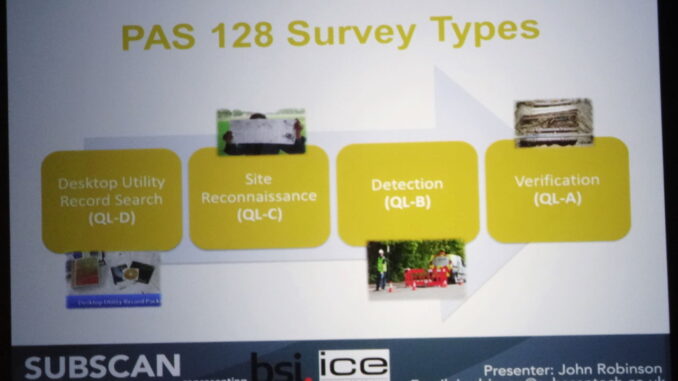
At the GEO Business 2014 conference in London, John Robinson of Subscan presented an overview of Publicly Available Specification (PAS) 128 developed under the auspices of the British Standards Institution (BSI) and sponsored by the Institution of Civil Engineers (ICE). This is not a British (BS, EN or ISO) standard, though ICE would probably like to see it become one in the future. The final version will be available June 30.
In the UK as in many jurisdictions there is not only a wide variation in the quality of location information about underground utility infrastructure, but there is no standard way to report the reliability of the location information about underground infrastructure. In the U.S. there is the ASCE standard (A,B,C,D) that is widely used for classifying location information about underground infrastructure according to its estimated reliability. I just blogged about a major national project in France aimed at classifying information about all of France’s underground utility infrastructure based on accuracy (A,B,C).
The proposed quality levels proposed in Britain have some similarities to both of these, but its focus is on process.
- QL D – Location of underground structures determined by a review of existing utility (paper) records
- QL C – A physical reconnaissance of the site has been performed identifying features of the network are visible above ground
- QL B – Remote detection technology such as electromagnetic or ground penetrating radar have been used to detect the location of the underground facilities. There is sub-classfication B1-B4 that specifies the estimated precision of the measurements. For example, B3 corresponds to +/- 0.5 meters.
- QL A – Verification, typically by potholing
PAS 128 is aimed at the practitioner, surveyors who make their living detecting and reporting the location of underground utilties for construction contractors and utilities. The primary objective is to reduce risk for construction contractors. In the UK, unlike the U.S. and Canada where we have one-call centres, if a utility is disrupted by a construction project, the liability lies entirely with the contractor.

Be the first to comment