
Utility construction is booming globally. Almost half a trillion annual investment in capital across all the main verticals, electric, natural gas and telecom has resulted in capital investment with construction with as high as 4% growth. On top of this in the U.S. there is the recent $1.2 trillion bipartisan infrastructure bill.
Utilities are facing business drivers that are motivating them to improve the productivity of their business processes and improve data quality especially the locational accuracy of assets to provide a near real-time digital twin of their assets. These drivers include an aging work force, the replacement of older workers by younger less experienced workers, a reliable near real-time GIS as the foundation for a smart grid, and a rapidly evolving utility business model that changes utility priorities.
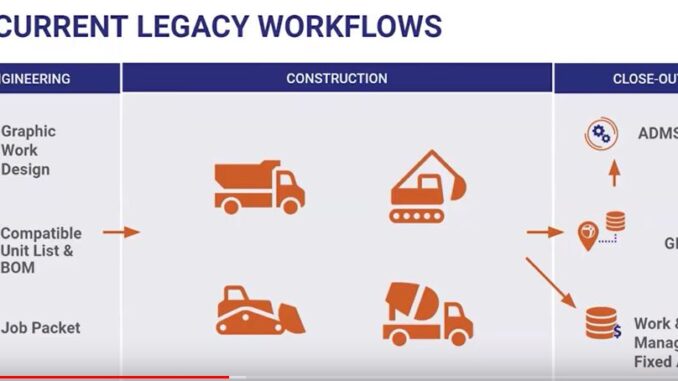
Current legacy workflows
The current construction workflow for utilities is a highly inefficient, manual process a lot of which hasn’t changed in 40 years. Actual construction, the middle and key part of this workflow, has remained a paper based process that has remained mostly unchanged for over 40 years now. Construction crews typically use paper job packets to locate the job site, and document any as-built changes to the job. They use the paper job packets, work order sketch, or any other piece of paper in the folder to record any required attribute information about the assets being installed. As construction activities increase and newer downstream analysis systems are brought online, such as an outage management system (OMS) system or an advanced distribution management system (ADMS), the data collection requirements grow, adding additional burdens on the construction crews. These crews work in difficult of conditions on difficult, time consuming tasks, but are still asked to record all of the required information on paper. The paperwork is prone to delays in processing at each stage of the workflow cycle. This antiquated paper-based collection of work order completion data results in mounds of paperwork from the field with all the attendant issues of hand written notes. The GIS analysts receiving these paper work packets have to try to sift out reliable data from these paper records. The result is that the data that actually gets into the GIS often is missing, inaccurate, or out of date. Backlogs of months are not uncommon.
Real time data collection enables digitizing the entire construction workflow
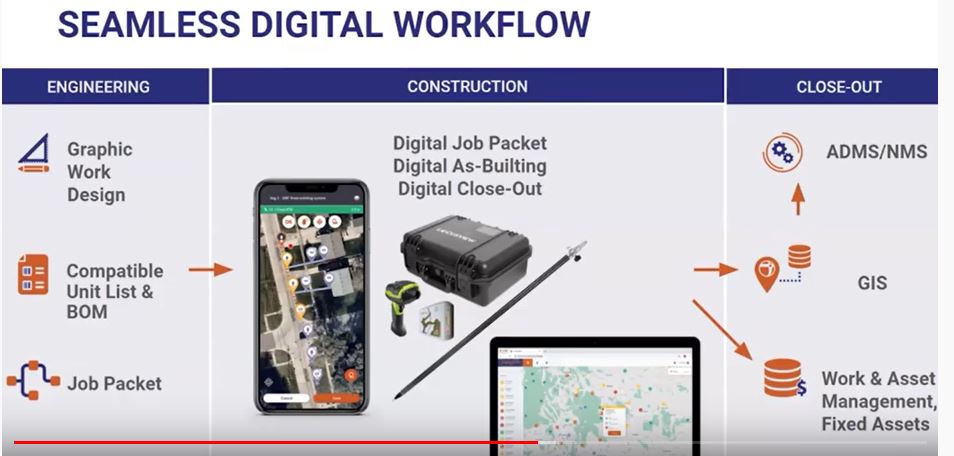 Locusview has developed a digital construction management platform that digitizes the entire workflow process. It is designed with the construction crews needs in mind, matches their workflows, and simplifies their data collection tasks. Work order data is collected via a mobile application using smart forms, high-accuracy GPS, and barcode scanners. Data can be immediately accessed by the back office staff, in real time. This two-way communication can be used to resolve design changes that require due to field conditions, thus reducing invoice and billing delays.
Locusview Mobile integrated with high-accuracy GNSS receivers and barcode scanners eliminates manual data entry. Data forms are displayed based on pre-configured industry-specific data model rules using complex conditionality alongside smart forms. Simultaneously back office managers use Locusview Web to gain real time field visibility, enabling project progress tracking, real time validations, contractor auditing, and smart alerts, ensuring compliance with safety, regulatory requirements and work processes since all stakeholders, field crews, contractors, supervisors, project managers, and inspectors are collaborating on the same job using a single platform. This fully digitized process reduces the time and effort typically required of construction crews to document their field activities, expedites and standardizes field data collection, and improves data integrity creating the foundation for a high fidelity digital twin.
A key metric we track is the as-built backlog. That’s the time it takes to enter as-built data into GIS after completion of construction. That’s only one part of closeout, but it’s an important part. Our customers are reporting a 70% reduction in their as-built backlogs. They are also reporting 20 % less time spent in the field. Furthermore they are seeing 50% cost savings in data collection because they’re enabling field crews, people that are already out in the field, to collect this high quality data with high-accuracy GNSS devices and barcode scanners avoiding the necessity of hiring outside survey crews. This translates into better capex efficiency, putting more assets in the ground per dollar of CAPEX spend and Increased customer service, something very important for competitive industries as telecom.
This simplified data collection process is designed to fully integrate with downstream utility applications as well. The job closeout process using Locusview has been reduced from 8 months to 3 days. As a concrete example a very manual piece of the closeout process, the material reconciliation piece, has been reduced from 7 hours to 12 minutes.
Real time data collection benefits all stakeholders
Many stakeholders are involved in the the complete construction work order cycle; contractors built the job, GIS analysts updated their maps based on as-builts submitted by the construction crew, operations imports the GIS data and operates their Outage Management System (OMS), planning and engineering use GIS and other asset information to plan for future growth. The work management system uses the data to initiate, manage and closeout the work order process for each job.
In addition there are a number of “forgotten” user personas that use and need accurate data from the field. The finance and corporate accounting groups rely on data in the system of record to be highly accurate and reflect the most current state of the utilities assets. Utilities go to the bond and stock markets on a regular basis to borrow funds to build and maintain their utility systems. And potential lenders or investors rely on the accurate valuation of the company. Interest rates charged by those investors correspond directly to the health of the utility and impact the cost of funds. If the work order update processes are delayed by 2 to 6 months, then the system of record is misleading and the lenders or investors may question the financial health of the utility. In addition, delayed closeout of work in the work management system will result in increased cost of funds charges to the work order via extended construction work in progress (CWIP) and allowance for funds used during construction (AFUDC) charges that are on all of the open work orders. CWIP and AFUDC is a common practice for accounting for the cost of funds in the United States and it’s a concept that’s gaining momentum here in Canada as well. Also many local governments apply property tax assessments on utilities for the utility assets within their municipality. If the system of record is not up to date, then the property tax assessments will also be incorrect. Contract and management organizations also rely on the accurate and timely reporting of work completed by contractor crews, as well as, closing out of the invoicing process. Delays in documenting completed work in the field will result in delayed invoicing by the contractors for the services that they’ve provided to the utility.
Conclusion
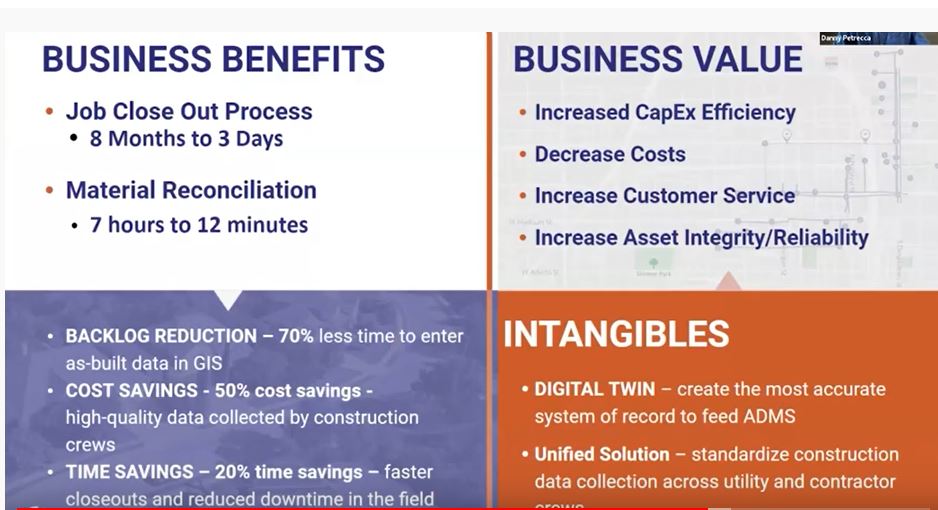
The key is real-time reality capture, that gets you the benefit of driving a digital twin into utilities by capturing the most accurate, high-fidelity data at the most opportune time during construction, not afterwards where you’re mapping a scar. Furthermore it’s a unified solution standardizing construction data collection real time across utility and contractor crews.
This post is based on Danny Petrecca’s and Robert Schultz’s (Locusview) talk at Subsurface Utility Mapping Strategy Forum (SUMSF).

Be the first to comment