I came across a fascinating talk by Dan Reicher , now with Google but who was Assistant Secretary of Energy for Energy Efficiency and Renewable Energy at the U.S. Department of Energy (DOE) from 1997-2001. His presentation was at the Energybiz Leadership Forum in Washington, DC. I wasn’t aware of this but Dan Reicher is the source of the intentional misquote of Bill Clinton’s “build a bridge to the 21st century”, instead we need to “build a fridge to the 21st century”. His point being that instead of refrigerators that use 2000 kWh/month, we need refrigerators that use 450 kWh/month.
Imagine walking into a grocery store where there are no prices on the items. You fill your shopping cart with what you need and when you leave you find out that the total bill is $95.36, but you don’t see an itemized breakdown. The point Mr. Reicher and Google are making is that to make informed decisions about how we use energy, we need more information about how and when we use energy. The quote from Lord Kelvin that Mr. Reicher and others at Google use is Lord Kelvin’s “If you cannot measure it, you cannot improve it.” What Google and others are working on is bringing IT to the power industry to empower the consumer by providing real-time access to energy consumption data. There is good evidence from a number of sources that providing information about energy consumption to consumers can reduce energy usage by 5 – 15 %. In its simplest form this means devices that can connect to the power grid and provide real-time information about your power usage. These may be smart meters installed by the power company or alternatively devices that you can install yourself. In either case internet-based software would allow you to access this information on the web based on an open architecture, open protocols, and open API’s from Google and others. In jurisdictions like some places in Ontario where you are billed based on time-of-use, which I blogged about before, this means that the consumer can decide to run the dish washer or a backup process at off-peak times to reduce the power bill.
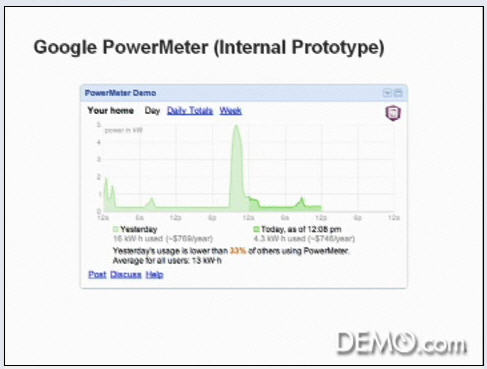
Google has pre-announced new software called Google PowerMeter, which will be a free, downloadable, iGoogle gadget that will allow you to monitor power usage in your home. To use it you will either have to buy a hardware device from a third-party company that you can connect to your fuse box, or a smart meter from the power company, which ever comes first.
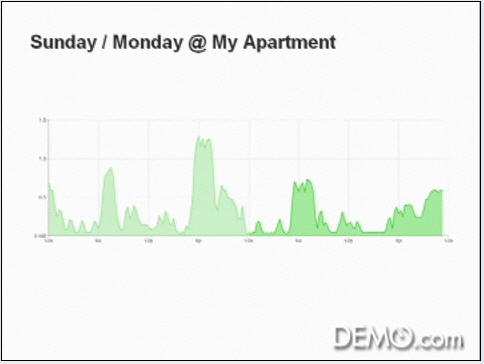
Initially this will simply show you your power usage as a function of time. But if this information is shared, then you will be able to compare your usage with others’. According to Google PowerMeter will be an open API which will allow third parties to develop applications.
There are companies like AMEE that attempt to convert power usage into carbon consumption, so in the future you not only will know how much energy you are consuming, but what kind of energy, renewable, coal, and nuclear, and how much CO2 you’ve just emitted by running the hair dryer.
Geoff Zeiss
Geoff Zeiss has more than 20 years experience in the geospatial software industry and 15 years experience developing enterprise geospatial solutions for the utilities, communications, and public works industries. His particular interests include the convergence of BIM, CAD, geospatial, and 3D. In recognition of his efforts to evangelize geospatial in vertical industries such as utilities and construction, Geoff received the Geospatial Ambassador Award at Geospatial World Forum 2014. Currently Geoff is Principal at Between the Poles, a thought leadership consulting firm. From 2001 to 2012 Geoff was Director of Utility Industry Program at Autodesk Inc, where he was responsible for thought leadership for the utility industry program. From 1999 to 2001 he was Director of Enterprise Software Development at Autodesk. He received one of ten annual global technology awards in 2004 from Oracle Corporation for technical innovation and leadership in the use of Oracle. Prior to Autodesk Geoff was Director of Product Development at VISION* Solutions. VISION* Solutions is credited with pioneering relational spatial data management, CAD/GIS integration, and long transactions (data versioning) in the utility, communications, and public works industries. Geoff is a frequent speaker at geospatial and utility events around the world including Geospatial World Forum, Where 2.0, MundoGeo Connect (Brazil), Middle East Spatial Geospatial Forum, India Geospatial Forum, Location Intelligence, Asia Geospatial Forum, and GITA events in US, Japan and Australia. Geoff received Speaker Excellence Awards at GITA 2007-2009.

Be the first to comment