
At the Global Infrastructure Leadership Forum, a very interesting presentation was given by two consultants from McKinsey on the major trends in global infrastructure development and some suggestions of ways to address some of the challenges they have identified.
First of all they are anticipating a massive spend on infrastructure, something on the order of $7 trillion annually. The infrastructure spend in the developing countries market is just as large as in the developed countries market. But infrastructure spending growth is significantly higher in the developing countries market. In many countries there is a shortage of infrastructure funding from governments, which sets the stage for greater private investment. Complex regulations and politics together are slowing infrastructure development. For example, in the US it can take 12-20 years to build a new transmission line. There are significant impediments preventing private capital from playing a greater role in funding infrastructure. For example, several speakers expressed doubts about the future of private-public partnerships (PPP), suggesting that a new paradigm for private investment is required. McKinsey singled out poor construction productivity as an important factor in eroding returns on infrastructure and making infrastructure less attractive for private investment.
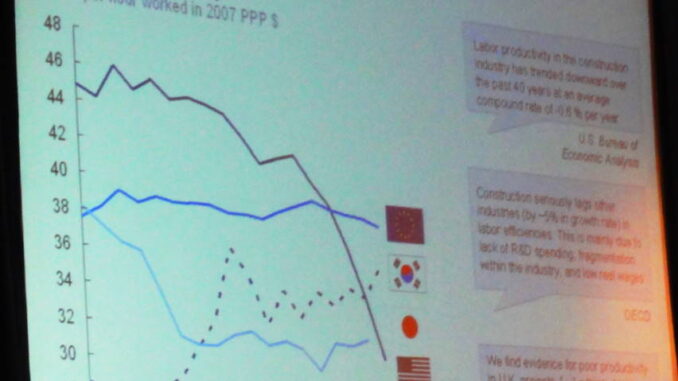
McKinsey says that construction productivity has stagnated or declined in many countries and gave historical construction productivity data for the European Union, Korea, Japan, and the U.S.
McKinsey suggested that governments and infrastructure investors could reduce risks and increase returns by focussing on three areas,
- Improving priductivity of existing and new assets
For example, by tuning the regulatory and market structure to improve efficiency and expand capacity.
- Making the economic model more attractive to investors
By being smarter about matching capacity expansions to demand and finding additional sources of revenue.
- Reducing cost and risk by improving project delivery
By allowing more competition, pushing more risk on to contractors, and encouraging engineering, procurement and construction (EPC) companies to increase their build capabilities.
Several speakers reiterated that one of the major problem in the infrastructure sector is the lack of data for comparing efficiency of construction and operation across projects.
McKinsey suggested that more private sector involvement in infrastructure projects could result in an estimated 30% improvement in construction productivity over 5-10 years, resulting from the combination of 5-15% reduction in the cost of design and planning, 5-10% in engineeering, 5-10% in materials purchase and sub-contracting, 3-5% in construction, and 3-5% from organizational enablers. They estimate that this would translate into a 20% reduction in overall infrastructure spend.

Be the first to comment