
I heard a very interesting presentation on energy modeling for buildings with a focus on reducing electrical load at the GORUG meeting here in Ottawa. Energy efficient building are becoming a priority for many utilities in the U.S., Germany and other locations.
Jean Carriere, an energy modeling specialist at 3D Energy Ltd, gave an insightful overview of what’s involved in energy modeling from the point of view of a designer who is familiar with building information modeling (BIM). The kind of design decisions that energy modeling helps with are
- How much energy should my building use ?
- Could I power it with solar PV or wind (Ontario has a feed-in-tariff program that encourages small scale renewable energy development) ?
- How much insulation is cost effective ?
- How sensitive is my building to changes in weather ?
Compliance
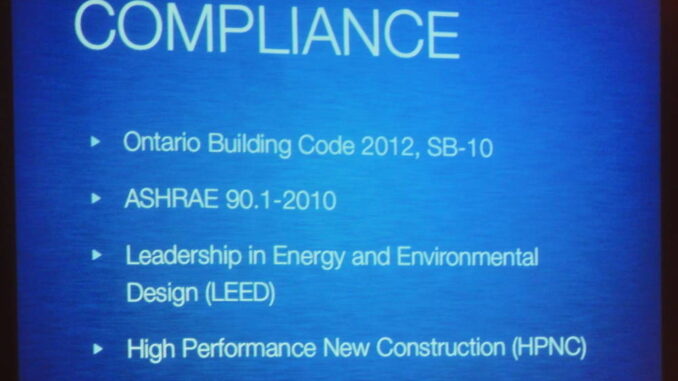
The motivations for conducting an energy analysis include the revised Ontario Building Code, LEED and other types of certification. In Ontario, new buildings with 40% or more external glazing are required to conduct an energy assessment. After January 1, 2013 new buildings will have to exceed ASHRAE 90.1-2010. In addition the High Performance New Buildings program rewards builders with incentives for offsetting the cost of energy-efficiency measures. According to Jean you get compensated for every kW saved.
I blogged previously about a new LEED program fro commercial buildings focussed on demand response and reducing peak electric power usage.
An energy analysis allows you to determine how much energy your building will consume in a year, cost effective insulation and glazing, and other things that you can do as part of the building design to opimize energy usage. An energy analysis requires a lot of data and according to Jean inputing the data is still a very manual process that takes more time than it should. Simulation applications allow you to include local environmental conditions and conduct thermal modeling, daylight and airflow simulations. Thermal modeling includes energy consumption, thermal comfort, CO2 emissions, renewable energy integration, and electric power load. Natural lighting includes visual comfort (glare) and the reduction of energy use through natural lighting. Airflow silumation includes external wind simulation, internal airflow simulation, clean room ventilation, and reduction in electrical load as a result of using natural ventilation.
 Workflow
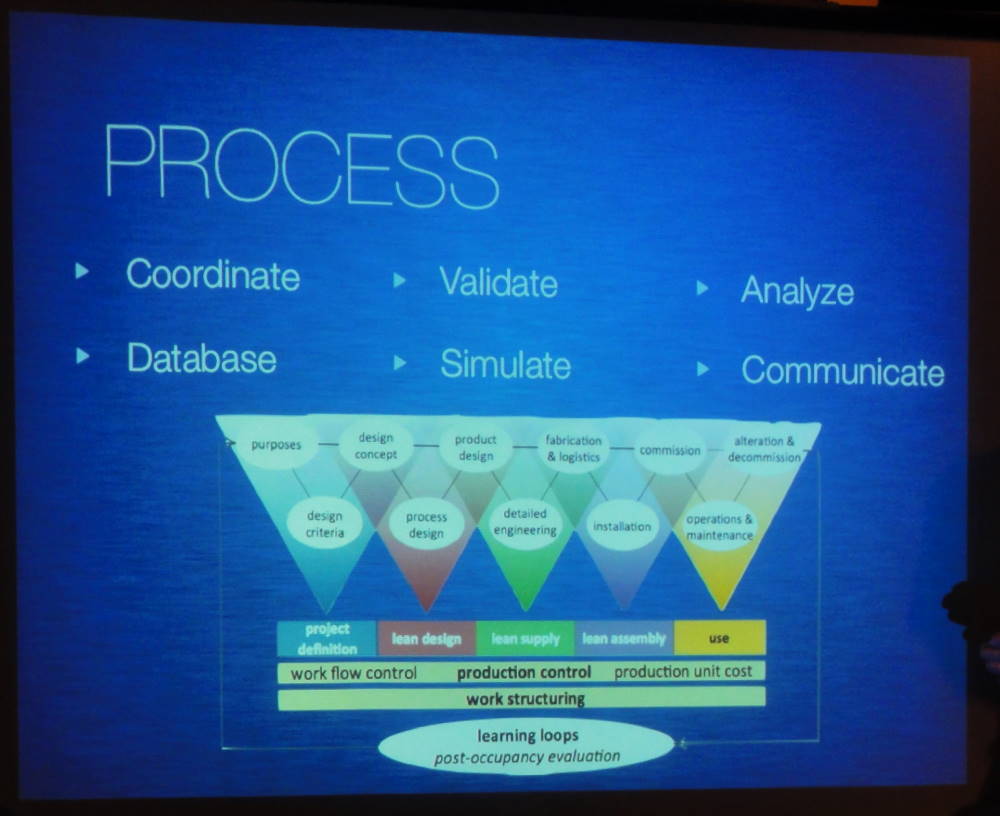
Jean devoted most of his talk to the workflow he uses to conduct an energy analysis. In most projects he is brought in after the building has been designed which significantly limits the opportunity for optimizing the design of the building for energy usage. He typically starts of with the architect’s BIM model and a database containing information about building elements as well as local envrionmental conditions.
The frist thing he does is to create a parallel model, which is a simplified BIM model derived from the architect’s model that contains the key elements that are required for the energy analysis usch as simplified walls and floors, room bounding elements, complete volumes, and window frames and curtain walls. He exports the simplified model as gbXML to an energy analysis package and runs a simulation or several simulations if he is able to consider alternative designs. The simulations generate a lot of data which he analyzes.
Finally, he uses a visualization based around the BIM model to communicate the conclusions derived from the analyses.
Standards
Jean repeatedly emphasized how standards, for interoperability like gbXML and for classifying building elements in BIM models, could contribute to streamlining the workflow for enegy analyses. He specifically mentioned Industry Foundation Classes (IFC) and Zero Energy Performance Index (zEPI), and it would seem that other standards for classifying elemnts in BIM models such as COBie and Omniclass could play a role in this as well.

Be the first to comment