
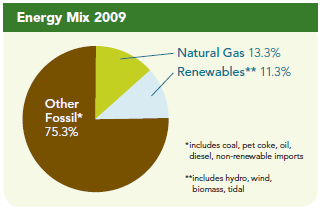
Nova Scotia introduced Renewable Energy Standards (RES), often called a renewable portfolio standard (RPS) in other jurisdictions in February, 2007. The RES are mandatory standards that require that by 2013, Nova Scotia will generate at least 18.5% of its electricity through renewable energy and by 2015, 25% of its electricity with renewables. Currently, 90% of Nova Scotia’s power is produced from fossil fuels, mostly by burning coal, which is imported. The rest comes from natural gas and from renewable sources.
Nova Scotia’s electricity market consists of Nova Scotia Power, a vertically integrated utility, and six municipal electric utilities.
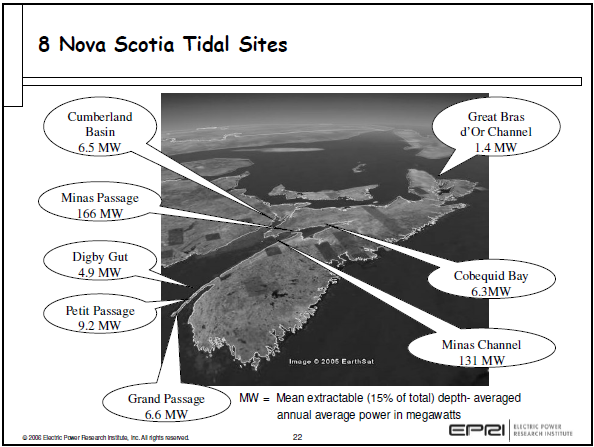
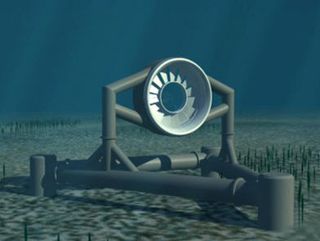
Nova Scotia is sitting on a potentially massive source of renewable energy, the Bay of Fundy, which has the highest tides in the world at 17 meters. Every 12.4 hours, 115 billion tonnes of water flow in and out of the bay, which exceeds all the water flowing down all the rivers in the world. The total energy potential of the Bay of Fundy has been estimated at as high as 1- 2 GW. It has been estimated that underwater turbines could generate 166 to 1000 MW of energy from the Minas Passage alone.
 Currently Nova Scotia’s link to the North Amercian power grid (Eastern Interconnection) is a single 345 kV transmission line and a couple of smaller lines.
Renewable Energy Plan
The provincial government has just introduced a provincial Renewable Electricity Plan that makes the commitment to 25% renewable electric power by 2015 law. It also adds a new objective of 40% renewable electricity by 2020, which exceeds the most aggressive RPS objective among US states, California’s objective of 33% by 2020.
The way the province intends to encourage this to happen is a combination of large scale projects implemented by Nova Scotia Power and independent power producers, community-based power projects encouraged by a feed-in-tariff program (COMFIT), and a way for individuals to provide power to the grid called net metering.
Net metering
 Net metering is an existing program from Nova Scotia Power that relies on bi-directional meters to monitor the power created by the customer’s renewable energy system and conventional electricity consumption. If the customer’s renewable energy generation produces more power than consumed, the excess power is delivered to the provincial grid and the customer used to receive an energy credit that could be applied against future usage. Under the new program Nova Scotia Power will pay customers at their retail rate for any overall surplus electricity produced on an annual basis. Net metering is not as aggressive in encouraging individuals to develop renewable energy sources as Ontario’s microFIT program, apparently because Nova Scotia wants to encourage community-based renewable energy generation.
Community Feed-in-tariff Program
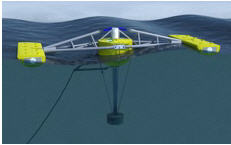 Municipalities, First Nations, co-operatives, local non-profits, and small businesses operating through Community Economic Development Investment Funds (CEDIFs) are eligible for the community feed-in-tariff (COMFIT) program. Renewable electricity generated from wind, biomass, tidal, wave, in-stream hydro as well as combined heat and power projects, but not solar, will be eligible for COMFIT rates. Most COMFIT projects will connect to the grid at the distribution level, but here is a special FIT program for tidal arrays at the transmission level. It is not yet clear exactly what the COMFIT rates are, but the plan says they will provide “basic cost recovery including cost of capital”.
Smart Grid
Nova Scotia Power and others in the maritime provinces have a multi-million dollar grant from the federal Clean Energy Fund for software and management systems to start testing smart grid technologies.

Be the first to comment