
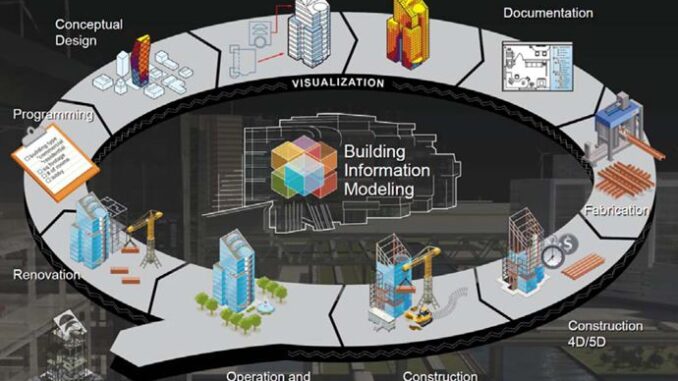
One of the most important things that impressed me at the Geospatial World Forum 2013
(GWF 2013) conference in Rotterdam is the degree to which in the Netherlands that building information modeling (BIM) and geospatial are perceived to be tightly linked. In my previous post I gave an overview of a presentation by Bram Mommers, who works for the large private engineering company ARCADIS, on why integrating geospatial into the construction process is important.
Jaap Bakkers, who is with the Rijkswaterstaat, the national water company in the Netherlands, presented more details about the Concept Library (CB-NL) initiative.
It is supported by the Dutch Council on Building Information (BIR), which is a joint industry and government council created to foster the development of building information modeling (BIM) in the Netherlands. It includes government agencies such as Rijkswaterstaat, private construction contractors, and engineering and architural firms. Government funds it, but most of its expertise is seconded from industry.
Construction processes in the Netherlands
 In the Netherlands many government projects are private-public partnerships (P3), where a private sector firm or consortium is responsible for the design-build-finance-maintain phases of the lifecycle and the government as the owner is responsible for operation.
 Many AEC firms are adopting BIM because it is cheaper, reduces risk of budget, schedule overruns, and results in fewer change orders. They may be motivated to adopt BIM to increase their margin or because they are required to by the owner, which is often a governmental organization such as the Rijkswaterstaat. Once construction is complete, at commissioning, the owner is handed a large volume of facilities data and as-builts. But this data is often unusable by the owner because it is incompatible or non-interoperable with the owner’s asset management, GIS, and other systems. This is the primary objective of the Concept Library (CB-NL), to create standards that enable re-use of design and construction data for operations. This is one example of the
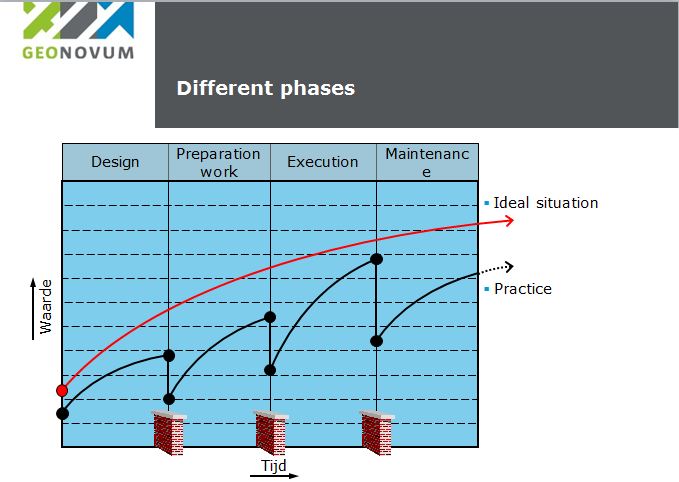 data impedance problem, where at every handover, design to construction, construction to operations, data is lost and has to be recreated.
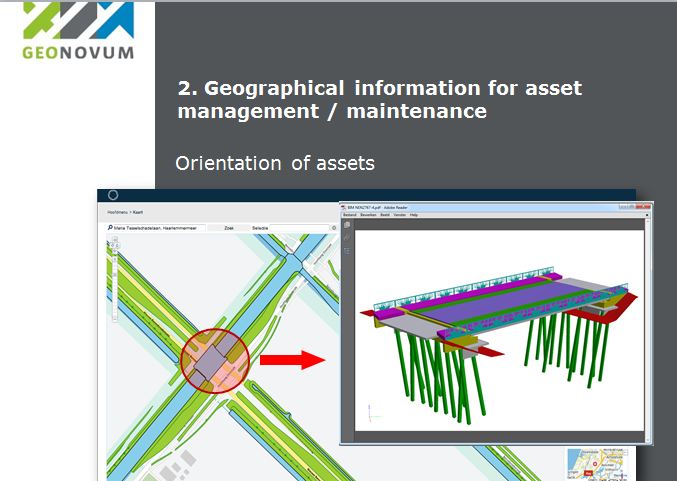 Geospatial in the construction process
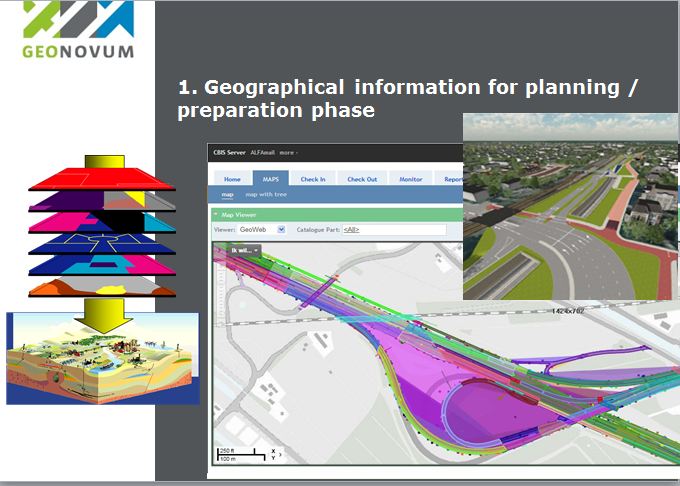
Marcel Reuvers, Manager of Geo-standards at Geonovum, gave an overview of some the critical roles that geospatial plays on the construction lifecycle.
- Planning / preparation phase
- Asset management / maintenance
- Managing as-builts
I would add sustainable design which always requires geospatial information about local prevailing weather pattern and the location and orientation of neighbouring structures for right to light, wind, solar heating, natural lighting, solar PV generation potential, and other analysis.
I blogged previously about some fundamental changes to the construction process that will make geospatial central to the construction process. What has been proposed is that a post-construction survey would become the critical
source of reliable
asset information in the form of a 3D intelligent model which would be maintained in a geospatially-enabled asset database. When a new
project is initiated, 80-90% of the necessary
information would already available in the
database making a
complete resurvey, as is the current construction practice,
unnecessary. All that is required before design can
begin is minimal due diligence to validate the as-builts. The new
process also implies that there is a reliable geospatially-enabled asset
database that is
maintained thoughout the operations and maintenance phase of the
lifecycle.
Concept Library (CB-NL)
In the Netherlands there is already a standard decomposition for buildings called COINS. The idea is to build on this to create a general approach for decomposing infrastructure as well as buildings and that it suffiiciently general to include geospatial.
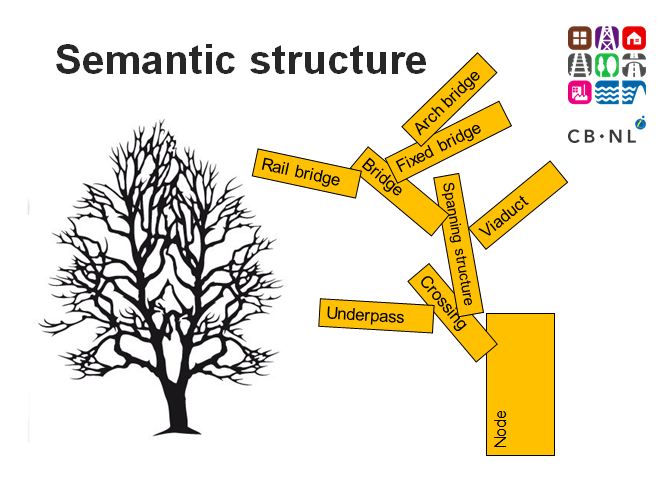
The Concept Library is intended to map different terminology across domains: design, engineering, architecture, construction, asset management, facilities manmagement,and geospatial. For example, it interelates terms like arch bridge, rail bridge, spanning structure, viaduct, and crossing, each of which may be used by a different domain to refer to the same structure. The business benefit is that it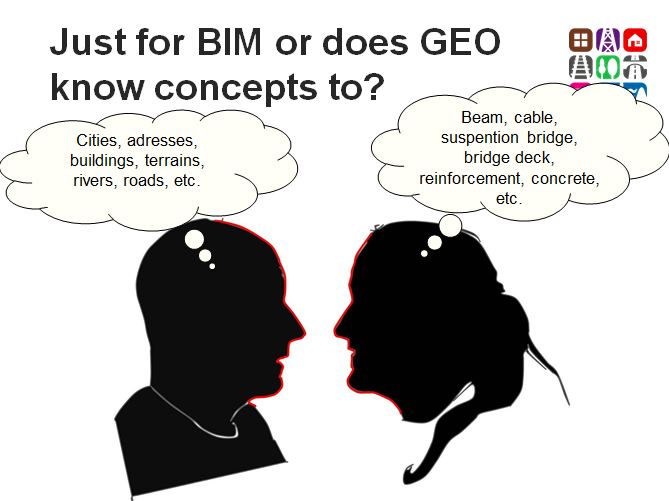 would reduce the data impedance problem, where at every handover in the construction lifecycle, designer to contractor or contractor to owner, data is lost and has to be recreated.
The vision is that the Concept Library is an open database based on a standard ontology that is searchable and has an open API so that vendors such as Autodesk, Bentley or ESRI can develop interfaces to it for their products.
CB=NL and geospatial
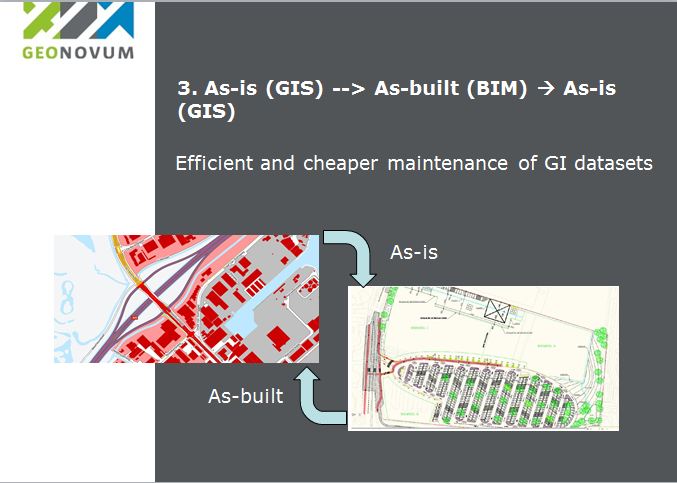 CB-NL was initially focused on BIM, but is being extended to include geospatial. CB-NL enables designers, contractors, asset managers and GIS staff to share a common dataset. It also makes it possible to automate the process of populating asset and facilities management application and GIS databases for the operations and maintenance phase of the lifecycle.
Concept Library (CB-NL)
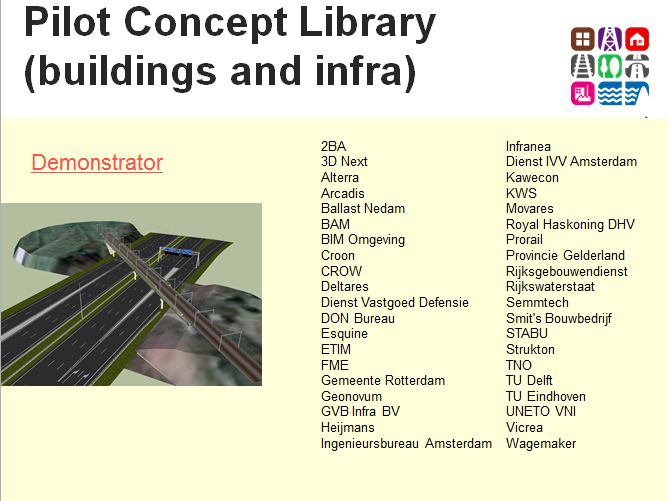 A two year project to develop the Concept Library has just been initiated, in January 2013, which is supported by a large number of government and private organizations. It is using the OWL ontology language, which has been endorsed by the W3C. It uses tools and constructs from buildingSmart’s Semantic Constructs for inputting and editing semantic content. Real world pilots, for example, a Rijkswaterstaat water services project and the Schipol, Amsterdam, Almere ring road project, will be used to demnstrate the practicality of the approach.
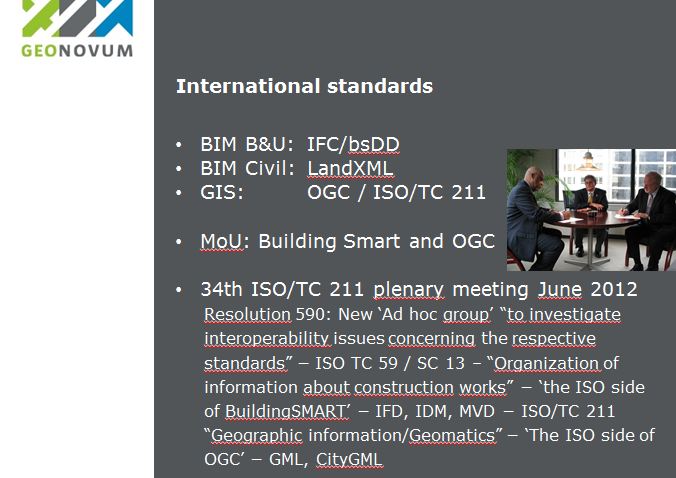 According to Marcel Reuvers, there are a number of standards that relate
to the CB-NL project from a number of standards bodies including the
OGC, buildingSmart, ISO/TC211, and LandXML. Jaap Bakker said that the project team has been in touch wth the Open Geospatial Consortium (OGC) in additon to the buildingSmart Alliance about the CB-NL project.

Be the first to comment