

The UK Government’s goals for construction industry is to reduce the CAPEX for public construction (design and build) projects and to reduce the UK’s carbon intensity in line with its EU carbon committments. To reach its goal for the construction industry the UK Government has undertaken several initatives, one of which is a commitment to embrace Building Information Modelling (BIM) in Government projects. The effort over a 5-year time frame is designed to encourage industry participation. One of the desired outcomes is to position the UK to become a world leader in BIM – creating export potential.
The UK Government has explicitly targeted Level 2 BIM in the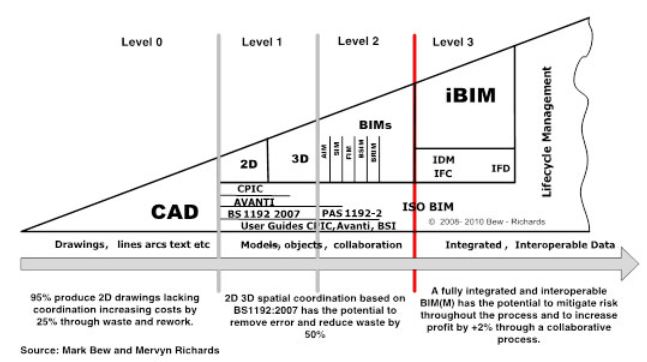 maturity ramp, defined as “file based collaboration and library management.” Level 2 BIM is a series of domain specific models (e.g. architectural, structural, services etc) where structured data can be shared based on COBie UK 2012. The mandate is quite far reaching. The projects that are covered are defined on the BIM Task Force’s site,
The Government Construction Strategy (GCS) requires that: Government will require fully collaborative 3D BIM (with all project and asset information, documentation and data being electronic) as a minimum by 2016. This refers to all centrally procured Government projects as outlined in the GCS including new build and retained estate, vertical and linear. The Government Construction Strategy and it’s BIM intervention is far reaching (there is no minimum value (£) on a BIM enabled project).
The inital focus is on the design/build part of the lifecycle, but the government has said that “the 20% saving refers to CapEx cost savings however we know that the largest prize for BIM lies in the operational stages of the project life-cycle”
At this year’s Royal Institution of Chartered Surveyors (RICS) BIM National Conference 2014, the keynote was given by Peter Hansford, Government Chief Construction Advisor on the status of the UK Government’s 2016 BIM objective. He made a link between the overwhelming interest in BIM as represented by the sold-out RICS BIM conference and the industry’s enhanced interest and appetite for BIM. He sees a shift in emphasis from asking ‘’should we do BIM?’’ to ‘’how do we do BIM?’’ He outlined six operational improvements have been found as a result of BIM Level 2.
- Design visualization – stakeholders are able to see what the building will look like during the design phase and before a shovel has gone in the ground. Based on the 3D visualization, they can suggest modifications to improve building performance.
- Clash detection – automatically finding clashes between different subsystems (HVAC, plumbing, structural, etc) during the design rather than during construction when the cost of resolving the conflict is much greater
- Constructability – determining what is required to construct the building as it is designed
- Simulating construction scheduling – simulating the construction process to find bottlenecks and other issues before they occur
- Laser-scanning to model existing conditions
- Creating a model and associated information for operations and maintenance (facilities management)
The UK Government is also moving ahead with a discussion about implementing BIM Level 3 in a 2018 timeframe. However, BIM Level 3 remains undefined at this point, though several speakers talked about whole lifecycle building management. I have a separate blog post about the Level 3 discussion at RICS BIM.
“Scan to BIM” models of existing buildings
Mollenhauer Group, a pioneer is applying laser scanning to existing buildings, outlined a major project to use total stations and laser scanners to create a BIM model of a large mall in Los Angeles. At the RICS BIM conference Mollenhauer presented important lessons learned from this “scan to BIM” project. I have a separate blog about that.
As an experiment RICS has commissioned the Severn Partnership to scan the RICS headquarters building in Parliament Square and create a classified (Uniclass2) BIM model of the structure that is intended to be kept and maintained. As part of the experiment RICS provided the BIM model to four firms and asked them to use the model to estimate certain dimensions of the building such as gross internal floor space (GIFA). The results were surprising – I have a separate blog post on that.
BIM data management: “1192 rules, OK ?”
David Philp, Head of BIM in the UK BIM Task Force outlined the data management challenges of BIM. BIM generates large volumes of data which creates a requirement for BIM data management for both graphical and non-graphical data. COBie 2012 was introduced to manage non-graphical data. Graphical data includes 2D PDFs and 3D models. The important documents for this are nearly complete;
BS1192:2007 Collaborative production of architectural, engineering and construction information
PAS1192-2 Specification for information management for the capital/delivery phase of construction projects using building Information Modelling
PAS1192-3 (2013) Specification for information management for the operational phase of assets using building information modelling
BS1192:4 (2014) Easter 2014 – This document is the final development of COBie-UK-2012, which is the interim data definition for information deliveries. This has been further enhanced and developed through work carried out in the infrastructure market to develop “COBie for all”.
Uneven adoption
In a panel discussion on the future of BIM, Rich Saxon, the UK Government’s BIM Ambassador for Growth, pointed out that some aspects of BIM Level 2 are still incomplete,
- Current software is targeted on designing new buildings and is difficult to use for modeling existing buildngs – this was a common theme is other presentations
- Level of Detail (LoD) remains undefined
- Standard for classification of BIM models – Uniclass2 was often mentioned at the conference in this context
- Migrating BIM to FM – The facilities management (FM) community hasn’t “signed up” for the BIM initiative
A recent poll of 410 live webinar participants found that almost three quarters of the respondents said that they were not yet operating at Level 2. Even more surprising over a quarter revealed that they had not even evolved to using 3D models. A survey by the National Federation of Builders in 2012 found that SMEs tended to lag behind larger firms in adopting BIM.
However, Paul Morrell, former Chief Construction Adviser, UK, has pointed out that an encouraging sign in the UK is that many private sector clients are also engaging with the BIM agenda, and are seeking to do so in a way that is aligned with the principles established by the government. At the RICS BIM Conference several firms with primarily private clients including Great Portland Estates and Balfour Beatty outlined the business benefits they have recognized for their private clients by using BIM.
Interoperability challenge: BIM and Facilities Management (FM)
Several speakers mentioned that clients are interested in migrating the BIM model and associated information into FM databases. But there is a reluctance in FM organizations to use BIM and associated information – the FM industry has not signed up yet to enable this to happen. Part of this is due to the lack of BIM/FM interoperability, the inability to package the BIM model and associated data in a way that it can be loaded into the databases of existing FM applications. Peter Trebilcock of Balfour Beatty mentioned a university client of theirs that is very interested in using BIM and associated information for facilities management. However, it is using a single FM application on three separate projects and doesn’t want to change the software.

Be the first to comment