
Flawed information flows affect safety
One of the major challenges facing the world’s utilities is one of data management, optimizng information flows that involve multiple divisions within a utility. I have blogged about this challenge on multiple occasions (here, here, here and here). This process needs to be optimized otherwise the quality of the information (“records”) about the utility’s overhead and underground infrastructure, where it is located and its maintenance history, is impaired, potentially leading to serious accidents like the gas explosions in Belgium in 2004 and the San Bruno explosion in 2010.
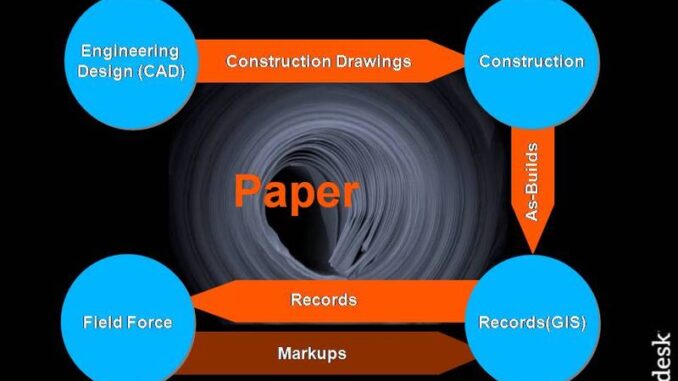
The basic process for designing, building and operating and maintaining a utilities network is essentially the same the world over and involves a cumbersome, inefficient, paper-based process. Designers or planners create the initial design, called a construction drawing. Construction crews, often comprised of sub-contractors, build the facilities using paper construction drawings. During construction, the drawing may  be marked up or redlined to reflect changes in the original design. After construction is completed, the construction drawing, now referred to as an “as-built”, is forwarded to the records department. The records department typically redrafts the paper as-built into the permanent records database, which is maintained as the company’s record of its network infrastructure.
For work relating to connecting or disconnecting customers to the network, adding new services, repairing or replacing network facilities, and call-before-you-dig requests the records department is responsible for preparing maps showing the location of the utility’s network facilities to assist field staff.
The symptoms associated with a flawed process for managing records are as-built backlogs stretching from months to years, resulting in out-of-date data, and poor communication between the field and records staff, resulting in inaccurate data about network facilities in the records data base . Inaccurate and out-of-date records not only reduce the productivity of field staff, but impact the safety of utility workers and the public, the primary concern of all gas and electric utilities.
In the San Francisco Chronicle it was reported that “Federal investigators had determined that a major factor in the San Bruno explosion was PG&E’s ignorance that its pipe had a seam running down the length of the line, which ruptured at an incomplete weld in San Bruno on Sept. 9, 2010. Such a seam would have been noted on an accurate geographic information system report, and if it had, PG&E would have been legally obligated to prove it was in good condition.”
Yesterday a utility company engineer testified that he “repeatedly told his bosses the company was relying on flawed data to vouch for the safety of its gas transmission lines before the San Bruno disaster, but that the utility took no steps to fix the problem.” He said that gas-system managers had ignored his and other employees’ concerns that the company was relying on incomplete and inaccurate records contained in its geographic information system.
Optimizing information flow problem
The important conclusion here is that installing a GIS does not solve the fundamental problem, which is an information flow problem. The most critical business process improvement is ensuring a digital information flow, pre-posting digital CAD designs directly into the records database, rather than redrafting the information from paper as-builts. The second most important process improvement is proving a direct wireless link for field staff enabling them to participate directly in ensuring the quality of the records database.
Heathrow Airport is an example where there is a lot of underground infrastructure, and it is an environment where even a minor accident carries the risk of serious consequences. Heathrow has developed work processes around a data management system which ensures web-based access to high quality information about Heathrow’s infrastructure. At Heathrow standards, guidelines, and work processes are designed to ensure reliable data. The most critical business benefit is safety. Other benefits of Heathrow’s apporach are that it minimizes rework, increases re-use of designs and provides for efficient handover for engineering designs from design to construction to operations.
The direct benefits of business process improvement are eliminating the as-built backlog, with the important benefit that the records database is uptodate, and accurate data, because the entire field staff is participating in maintaining data quality. Reliable data reduces the risk of accidents like Sana Bruno. It also improves efficiency and productivity. As utilities move to the new world of smart grid, or intelligent networks, reliable data about the network has become even more essential.

Be the first to comment