
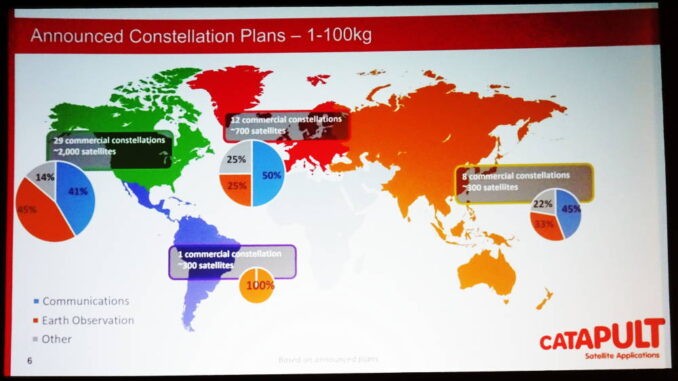
At GeoBusiness 2017 in London, Stuart Martin, CEO of Catapult Satellite Applications, made the case for importance of the integration of satellite data into geospatial technology. He cited a widely publicized figure that we capture 2.5 x 10**18 bytes (2.5 quintillion bytes or 2.5 exabytes) per day. Earth observation satellites are rapidly approaching new records with respect to coverage, geospatial resolution, temporal resolution and breadth of hyperspectral range. Satellites are capable of sub-meter resolution. Satellite constellations can capture the entire Earth daily and this is expected to apporach hourly soon. Radar on satellites can see through clouds and radar interferometry can detect changes with a resolution of two centimeters. There are plans in place for over 50 satellite constellations to be launched in the next 10 years.
The Catapults network was established by Innovate UK to support innovation by UK business by providing access to expert technical capabilities, equipment, and other resources required to take innovative ideas from concept to reality. Catapults are not-for-profit, independent physical centres which connect businesses with the UK’s research and academic communities.
The other part of the increasing importance of Earth observation satellites is that access to this data is becoming more open and less restricted either by regulation or economics. Google and Yahoo and others incorporated Digital Earth and other imagery into their basemaps a long time ago, but this imagery is usually out of date and of varying quality, especially with the current state of earth observation imagery where new imagery is being captured daily. Bird.i, based in Glasgow, is committed to making digital earth observation imagery available to the mass. At the beginning of 2017, three leading imagery suppliers, Airbus, Bluesky and DigitalGlobe agreed to become Bird.i’s image suppliers. Now Bird.i curates more than 10 million sq km of the satellite, airborne, and drone imagery every day from multiple sources with 1.5 meters resolution or better.
As an example of how geospatial technology works with satellites to solve major world problems is illegal fishing. Between a third and a fifth of all fish landed are caught illegally which increases the difficulty of preventing overfishing of vulnerable species. Satellites are now being applied to detecting illegal fishing. Satellite-AIS (S-AIS) is a satellite-based automatic tracking system used for collision avoidance among over 200,000 ships, especially in international waters. AIS provides unique identification (signature), position, course, and speed for individual ships. Satellites have special AIS receivers which are capable of deconflicting a large number of signatures. The International Maritime Organization requires AIS to be fitted aboard international voyaging ships with 300 or more gross tonnage and all passenger ships regardless of size. Global Fishing Watch analyzes data from AIS, which is collected by satellites and terrestrial receivers, to identify apparent fishing Apparent Fishing behavior based on the movement of vessels over time. Currently over 60,000 fishing vessels are tracked. Partners supporting Global Fishing Watch include Oceana, Skytruth and Google.
Indonesia, one of the largest fishing nations, has just announced that it is now sharing its proprietary Vessel Monitoring System (VMS) data for public display on Global Fishing Watch site and Peru has announced that it will also share its VMS data on Global Fishing Watch.

Be the first to comment