
Sensor web: drifting buoys

I blogged earlier about the sensor web that is taking shape.  It involves satellites and ground sensors.  I blogged about very inexpensive nanosatellites, typicaly 10 cm x 10 cm x 10 cm,  that are dramatically reducing the cost of sateliite imagery.

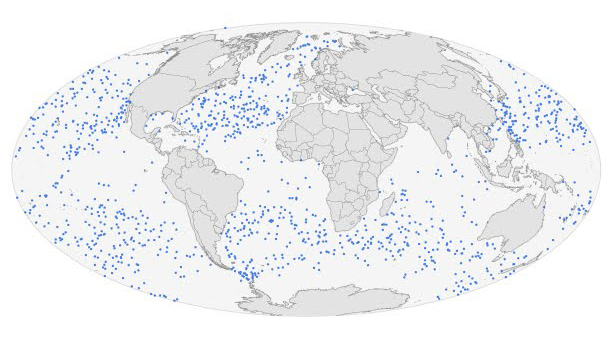
Drifting buoys are less than 22 feet long, weigh no more than 100 pounds, and typically survive on the open seas for an average of 450 days. Each drifter consists of a surface buoy and an underwater drogue attached by a tether. The thermometer, pressure sensors, batteries and other electronics reside in the buoy.  There are about 1,000 drifting buoys on the world’s oceans. The modern drifter weighs about 44 pounds with 16-foot drogues and cost around $1,700 each.

Roughly every hour, the drifter uploads data to a satellite passing overhead which in turn relays the observations back to an Earth receiving station.   Drifters measure sea-surface temperature and ocean current data as well as their location. For example, their observations help in tracking the impact of El Niño and La Niña on global ocean currents. In addition NOAA will sometimes deploy drifters in front of hurricanes to improve forecasts and investigate how the ocean and atmosphere interact within and around the storm.

The 1,000 or so drifters in the oceans collect about 30,000 observations per day, which are processed by NOAA’s Drifter Data Assembly Center in Miami and archived for research and placed on the Global Telecommunications System, where the National Weather Service and other forecasters can use them for weather prediction.

The map shows the location of all drifters as of April 26, 2013. (Credit: NOAA Climate.gov, based on drifter data from the Atlantic Oceanographic & Meteorological Laboratory.)

Geoff Zeiss

Geoff Zeiss

Geoff Zeiss has more than 20 years experience in the geospatial software industry and 15 years experience developing enterprise geospatial solutions for the utilities, communications, and public works industries. His particular interests include the convergence of BIM, CAD, geospatial, and 3D. In recognition of his efforts to evangelize geospatial in vertical industries such as utilities and construction, Geoff received the Geospatial Ambassador Award at Geospatial World Forum 2014. Currently Geoff is Principal at Between the Poles, a thought leadership consulting firm. From 2001 to 2012 Geoff was Director of Utility Industry Program at Autodesk Inc, where he was responsible for thought leadership for the utility industry program. From 1999 to 2001 he was Director of Enterprise Software Development at Autodesk. He received one of ten annual global technology awards in 2004 from Oracle Corporation for technical innovation and leadership in the use of Oracle. Prior to Autodesk Geoff was Director of Product Development at VISION* Solutions. VISION* Solutions is credited with pioneering relational spatial data management, CAD/GIS integration, and long transactions (data versioning) in the utility, communications, and public works industries. Geoff is a frequent speaker at geospatial and utility events around the world including Geospatial World Forum, Where 2.0, MundoGeo Connect (Brazil), Middle East Spatial Geospatial Forum, India Geospatial Forum, Location Intelligence, Asia Geospatial Forum, and GITA events in US, Japan and Australia. Geoff received Speaker Excellence Awards at GITA 2007-2009.

View article by Geoff Zeiss

Be the first to comment

Leave a Reply

Your email address will not be published.


*