
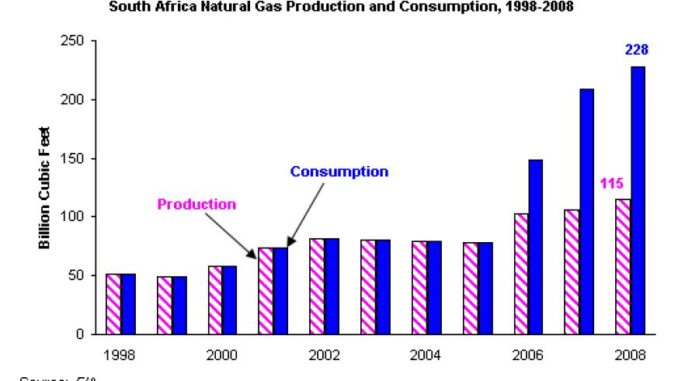
South Africa is a net energy importer. It has very limited oil and gas reserves, and has relied on coal and peat for 72% of its primary energy requirements. 67% of its petroleum is imported, primarily from Saudi Arabia and Iran.
ESKOM, the South African state owned electricity company, generates two thirds of the electricity produced in Africa and provides more than 60% of Africa’s demand. ESKOM has a generating capacity of 35 GW from 20 power stations, primarily coal-fired, but also a nuclear power station, gas turbine facilities, and hydroelectric plants. The company also owns and operates the national transmission system. It relies on coal for 95 percent of its electric power generation and the government plans to increase natural gas generation from three percent to 10 percent within a decade. Since 2006 natural gas consumption has exceeded South Africa’s domestic production by a wide margin, to the point where almost 50% of natural gas is imported from Mozambique.
 In June of last year the South African exploration regulator Petroleum Agency SA issued shale gas permits to several oil and gas companies in the central Karoo. Shell, one of the companies granted exploration permits, is considering using fracking to increase natural gas production. Fracking uses a lot of water, averaging four million gallons each time a well is fracked. The Karoo is semi-arid and an environmentally sensitive area and there is concern in South Africa about the impact of shale gas exploitation on both water and air quality, partially motivated by the EPA investigation into the environmental impact of shale gas and fracking in the US.
(Thanks to Dalla de Beer for pointing me to this.)
Be the first to comment