
New drilling technology including horizontal drilling and hydraulic fracturing has made possible the profitable extraction of natural gas from geologic formations, primarily shale, that are uneconomic for conventional natural gas production.
The impact of shale gas on the US economy is hard to underestimate. Recently FERC Commissioner Philip Moeller said that the biggest recent trend in the energy industry is the huge impact that shale gas has had on the energy industry by pushing gas prices down and keeping them there. The drop in gas prices has affected wholesale power markets and resulted in lower energy prices for consumers.
In the US large-scale shale gas production began during the 1980s and 1990s in the Barnett Shale in North-Central Texas and the Fayetteville Shale in North Arkansas. Later drilling was begun in the Haynesville, Marcellus, Woodford, Eagle Ford and other shales. Shale gas has become a “game changer” for the U.S. natural gas market by increasuing production of shale gas in the US from 0.39 trillion cubic feet in 2000 to 4.80 trillion cubic feet in 2010, which represents 23 percent of U.S. dry gas production. The EIA’s Annual Energy Outlook 2011 estimated that shale gas reserves are 862 trillion cubic feet or 34 percent of the domestic natural gas resource reserves of 2,543 trillion cubic feet. It is projected that by 2035 shale gas production will account for 46 percent of U.S. natural gas production.
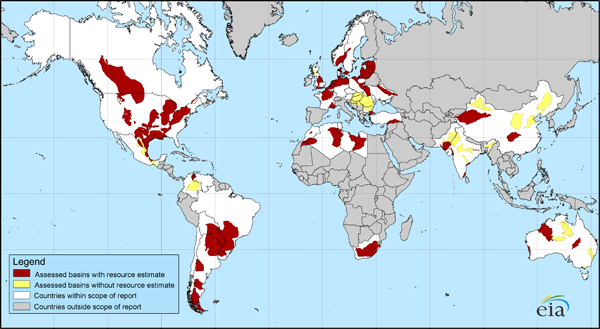
The US Energy Information Administration has released a report on world shale gas resources. The report assessed 48 shale gas basins in 32 countries.
Technically recoverable shale gas resources in the 32 countries examined is etsimated to be 5,760 trillion cubic feet. Together with the U.S. estimate of 862 trillion cubic feet means that the world’s shale gas resource is 6,622 trillion cubic feet. As of January 1, 2010, proven reserves of natural gas are about 6,609 trillion cubic feet and technically recoverable gas resources are roughly 16,000 trillion cubic feet, largely excluding shale gas. Shale gas resources increases technically recoverable gas resources by over 40 percent to 22,600 trillion cubic feet.

Be the first to comment