
The construction industry in the UK, as in many of the world’s advanced economies, suffers from low productivity compared to other industries, a situation which hasn’t improved in 25 years according to Simon Rawlinson of the Construction Leadership Council. Various types of laser scanners, software that creates point clouds from photos, and handheld scanners have the potential to dramatically improve productivity, but users of these devices in the construction and asset management industries are finding that these devices are creating a major data management problem which has to be addressed to enable the technology to achieve its full potential. At Geo Business 2017 in London I had a chance to chat with Pascal Martinez, Director Business Development at Bentley Systems about Bentley’s vision for converging reality capture, reality modeling, and asset management assist in improving productivity in the construction and maintenance of building and infrastructure assets.
Pascal was originally with Acute 3D which was acquired by Bentley two years ago. Acute 3D, now called ContextCapture, was originally targeted at creating point clouds from photos captured with an ordinary digital camera. The latest version of ContextCapture is able to integrate point clouds from LiDAR and photo cameras to generate a common 3D mesh using imagery from both sources.
Bentley’s vision for the evolution of reality capture is to be able to integrate data from multiple sources, both 2D and 3D, to create a common 3D mesh, classify it by associating areas of the mesh with existing data from other sources stored in databases such as Bentley’s Assetwise and Projectwise and then link objects in the mesh to information about the specific assets stored in the databases.
At the conference the model of what already exists or what has actually been constructed was frequently referred to as the digital twin of a building or other type of infrastructure (previously BIM). Associating classified elements of 3D meshes from reality capture with vector elements in the digital twin has a number of applications. In the case of a new building or new infrastructure it enables monitoring compliance with design during construction, even on a day by day basis, to catch issues early.
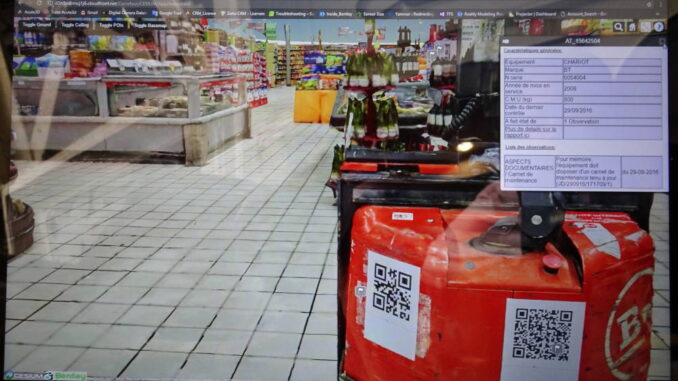
Being able to automatically associate areas of a 3D mesh with buildings, facilities and equipment in plants, and linear assets such as transmission lines, railways, and roads would have a dramatic impact not only on the efficiency of construction monitoring but also on asset management by reducing the time require to scan all or part of a facility and compare the captured reality with the digital as-builts. Pascal showed a very simple, but very cool, way to do this now, by placing a QR code on each piece of equipment which then can be clicked on in the mesh (scan) to bring up information stored in Assetwise about the piece of equipment.

Be the first to comment