
The Sixth National GIS Symposium was held in Al Khobar in the Eastern Province of Saudi Arabia last week. The conference was very well organized, and attracted a large number of attendees, including a significant number of international visitors. I found it to be one of the most interesting conferences I have been to recently, because of some exceptionally interesting presentations, but partly because of the location and the especially the field trip that was arranged by Saudi Aramco to Shaybah in the heart of the Ar-Rub al-Khali desert (Empty Quarter) in southeastern Arabia.
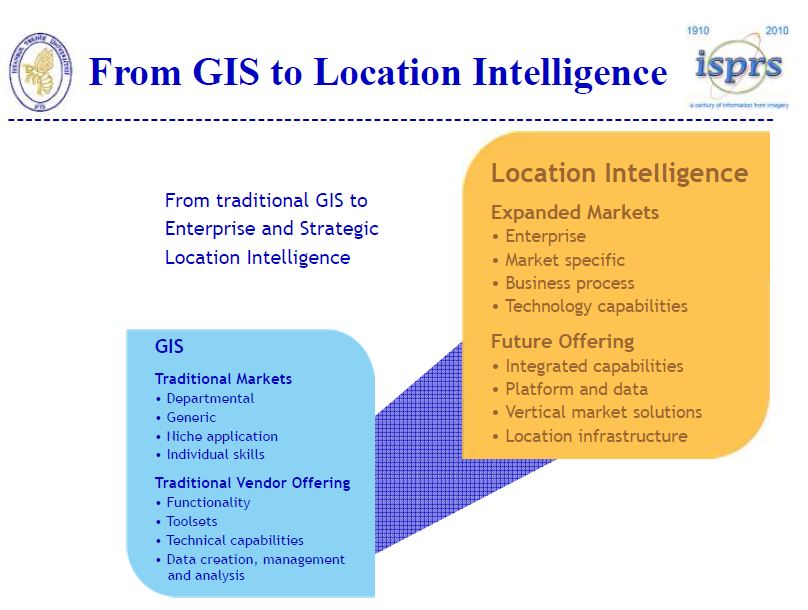 Orhan Altan, president of the ISPRS, gave a very topical opening keynote in which he suggested that the 21st century can be either the best century ever when we overcome some major challeges or our last century. He made the case that traditional GIS is changing, and that in the future we will need enterprise locational intelligence to address major societal needs. Improved access to the increasingly abundant geospatial information including satellite and aerial photogrammetry and laser scanning and tools to enable science to be transformed into practice are what he foresees as the major trends driving geospatial technology. Gov. Jim Geringer in his keynote made the case that our challenge now is to develop ways to transform the huge amount of available data into actionable information. In my keynote I made the case that the convergence of intelligent engineering models, high resolution imagery including laser scanning, and 3D visualization technology originally developed by the gaming industry are making it possible for technical solutions to societal challenges that were inconceivable even a few years ago. Abdul Karim Raeisi, GIS Executive Manager of Abu Dhabi, describes the Abu Dhabi Spatial Data Infrastructure program which has been able to develop a community of 45 participants from the federal and local governments, academia, and business, all motivated to use geospatial data to support egovernment services to the public.
Most of the technical and plenary sessions dealt with the application of remote sensing, LiDAR, GIS and 3D visualization to planning and analysis. Here’s just a few that I found particularly interesting.
Jeddah Flood Analysis
Most people probably don’t think that excess water would be a problem in Saudi Arabia, but in November 2009 in four hours more than 9 centimeters of rain, which is almost twice the average for an entire year. fell in the area around Jeddah. This resulted in serious flooding in the city of Jeddah with over one hundred fatalities. Dr Mashael Al Saud of the Space Research Institute of the King Abdulaziz City for Science and Technology described the fascinating analyses that she has conducted on the catchment basins surrounding Jeddah to understand how water was funnelled into downtown Jeddah.
Tracking location inside buildings
With GNSS technology it is possible to track the location of people, vehicles, and even animals wth high precision – even cm accuracy with an earth station. But as soon as the subject enters a building, this is no longer possible. A number of companies like Ubisense have been working on the problem of tracking people and objects in buildings. Obvious applications are enabling first responders to track their location inside a building in an emergency, keeping track of critical staff and equipment in hospitals, and many others. Professor El-Sheimy of the University of Calgary described how low cost micromechanical systems (MEMS) inertial sensors can be used to track location in a building and showed how these devices can be used to locate subjects in buildings with an average locational accuracy of about 2 meters.
Sensor Long Tail
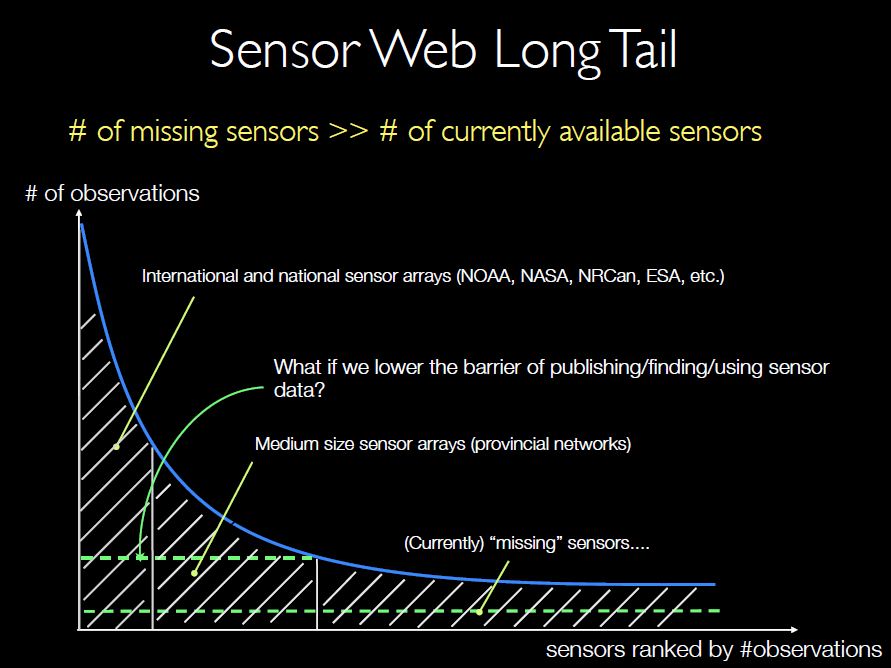 Dr Steve Liang has looked at the world’s sensors including large scale arrays that capture imagery and other data currently at a rate of terabytes per day. These are often developed by or sponsored by federal governments. Lower levels of government, utilities, and private agricultural organizations are increasingly sponsoring sensors for monitoring crops, vegetation encroachment on transmission corridors, illegal construction, and other areas. But what about the hundred of millions of devices that we all carry about with us or that are built into vehicles and desktop computers. This is what Liang calls the long tail, and he is interested in finding a way of accessing these devices so that they can be queried for non-private information that could be used in a variety of ways such as for scientific analysis or in an emergency. The idea of a sensor web is a fascinating idea and Liang has taken a first step in the form of the GeoCENS project, which is designed to be a standards (OGC SWE) based sensor web platform that combines a large number of sensors with geospatial information in a virtual globe environment.
Land Encroachment
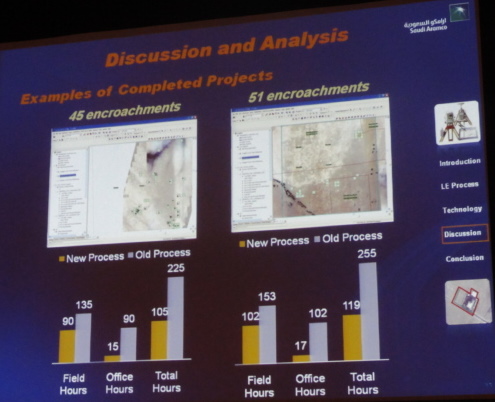 Saudi Aramco is responsible for 85,000 km2 of land reservations and pipeline corridors. One of issues that Saudi Aramco has to deal with is encroachment. At the conference Yousif Al-Ghamdi and Saleem Haja described how their team has analyzed the workflow for identifying and resolving encroachments, and using imagery, mobile survey equipment, and custom developed applications have been able to reduce the survey time to document encroachments by 50 %.
Shaybah
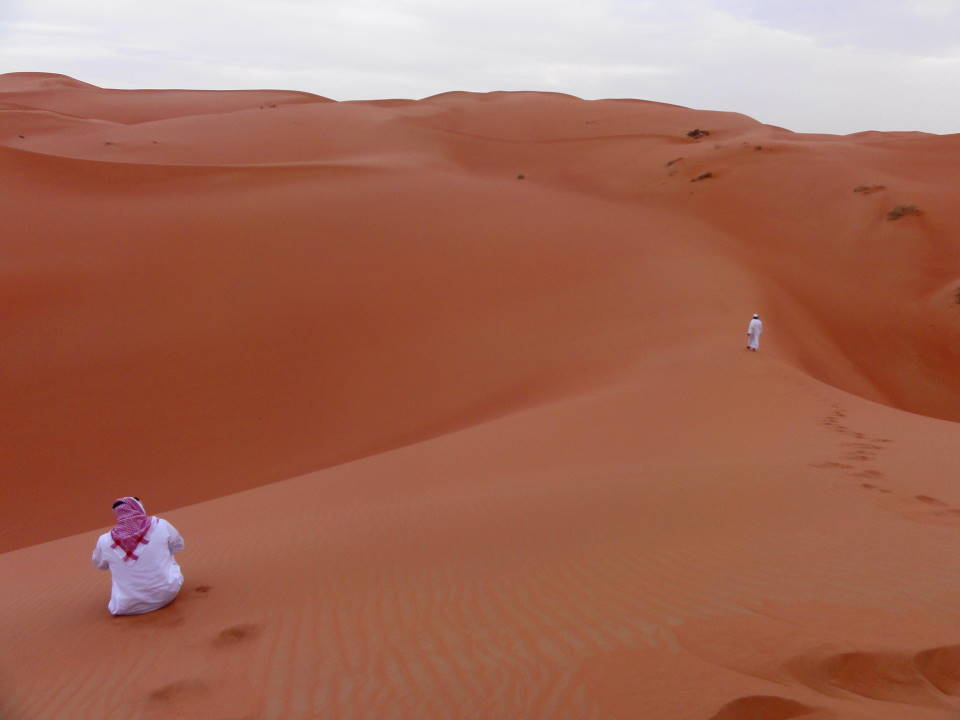 On the last day of the conference Saudi Aramco flew us all to Shaybah in the Ar-Rub al-Khali desert, often called the Empty Quarter for reasons that are obvious once you’ve been there. You can see Shaybah and surrounding area on Google. Shaybah is very close the the UAE border. The Ar-Rub al-Khali desert covers 650,000 km2 and is extremely arid with average annual rainfall of less than 3.5 centimeters and maximum temperatures ranging from 47 °C to as high as 60 °C. Some of the dunes are 250 meters high. Saudi Aramco has four gas oil separation plants (GOSP) at Shaybah producing 750,000 barrels of petroleum per day.
We had an opportunity to walk on the dunes. The sand, which is almost red and as fine as pastry flour, appears to undulate. It is contantly moving and I could see plow marks along the highways to keep them clear, just as in Canada we have to plow highways to keep them clear of snow. It was hard not to think of this as red snow.
A most memorable experience.

Be the first to comment