
Urbanization is a worldwide phenomenon. Smart city technology is becoming an essential element in the development of the world’s megacities. For example, the new Indian government’s just released budget includes an allocation for initiating the development of 100 smart cities. Songdo IDB in Korea and Fujisawa in Japan are two smart cities already under development. China has 36 smart cities in development and a low carbon model city in Tianjin. Singapore plans to become a smart nation by 2015. Iskandar is Malaysia’s first smart city. The Delhi-Mumbai Industrial Corridor (DMIC) incorporates smart city concepts.
According to the report “Smart Cities Market – Worldwide Market Forecasts and Analysis (2014 – 2019)”, published by MarketsandMarkets, the global smart cities market is forecasted to grow from $410 billion in 2014 to $1.1 trillion by 2019 at a compound annual growth rate (CAGR) of 22.5%. This includes smart homes, intelligent building automation, energy management, smart health, smart education, smart water, smart transportation, smart security, and related services. Most of this activity is expected to occur in Asia and the Middle East.
Navigant Research forecasts that cumulative global investment in smart city technologies, including smart grid, advanced water monitoring systems, transportation management systems, and energy efficient buildings, could total $174.4 billion from 2014 to 2023, growing from $8.8 billion annually in 2014 to $27.5 billion in 2023. Navigant forecasts that annual smart city technology investment in Asia Pacific will increase from $3.0 billion in 2014 to reach $11.3 billion in 2023.
What are cities already doing ?
In a recent study by Arup and University College London, Delivering the Smart City, the researchers analysed the spending patterns of eight U.K. cities; Leicester City Council, Manchester City Council, Leeds City Council, Portsmouth City Council, Sheffield City Council, Liverpool City Council, Bristol City Council and Coventry City Council. These are medium-sized cities with populations between 200,000 and 760,000.
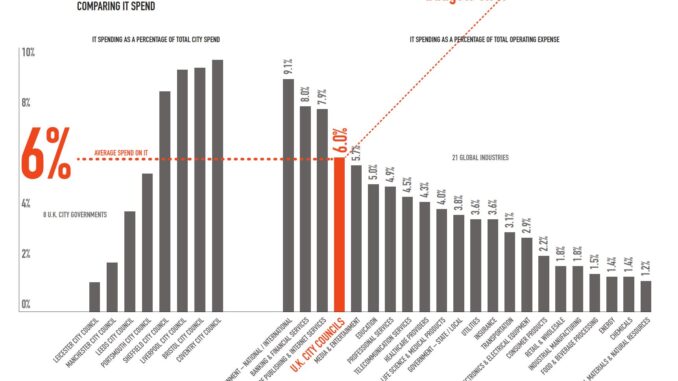
This type of analysis has become much easier because of the open data movement in the U.K. which has generated significant amounts of accessible data about government spending and procurement. 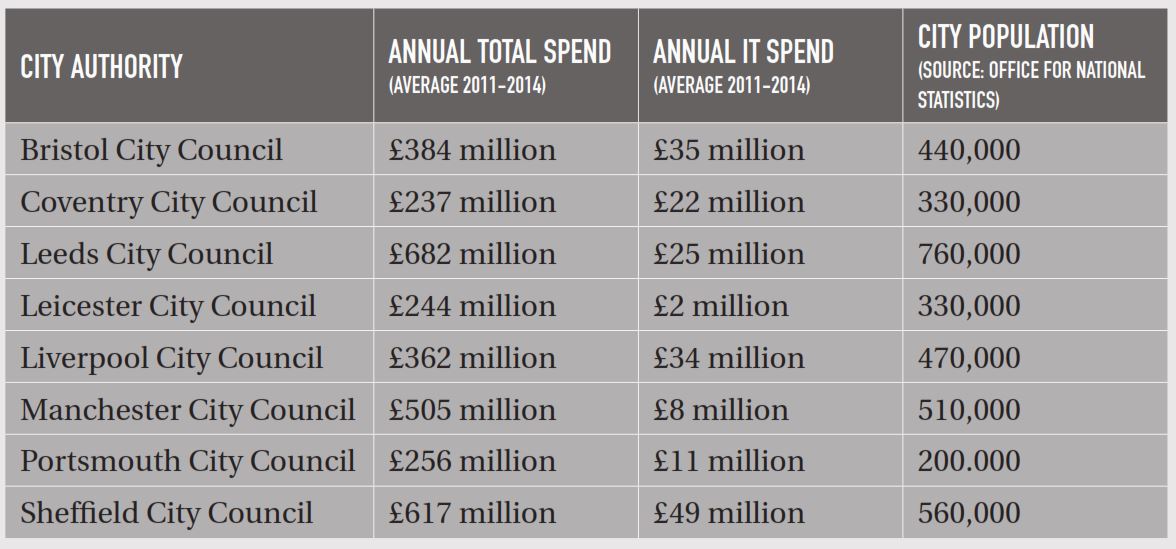 The analysis showed that the eight cities were spending on average 6% of their expenditure on information technology (IT). That’s an average of £23 million a year on IT. Four of the eight spent between 8 and 10% of their budgets on IT. To put this in context the proportion that these city governments are spending on IT is more than many industries and is comparable to the banking and financial services industry which spends on average 8% of operating expenditure on IT.
This research shows that cities are already investing a significant amount on something which is a foundation for smart city technology. IT already underpins many services offered by city governments today including public security and health, transportation, public works, natural resource management, and permitting and licensing.
Other research also shows that city governments globally are spending a significant proportion of their budgets on IT. Gartner analysed the IT spending patterns of 99 local governments across 80 countries in the U.S. and found that that IT accounted for 3.8% of their total operating expenses. U.S. local governments, including 3,200 counties and 19,000 cities, spent approximately $34 billion on traditional IT goods and services in 2013.
According to Gartner national and regional governments in the Middle East and North Africa will spend US $12.2 billion on IT products and services in 2014, up 1.3 % from 2013. This includes internal services, software, IT services, data center, devices and telecom services. Saudi Arabia is investing in various digital government initiatives including King Abdullah Economic City (KAEC). The United Arab Emirates (UAE) is planning multiple smart cities.
City governments are not the only organizations providing IT services to support city operations. For example, installation of 5,000 smart meters in homes and businesses across London involved investment from private companies including EDF Energy, Siemens, Logica, as well as the electricity transmission and network operators, National Grid and U.K. Power Networks, the transport operator Transport for London, and the city government Greater London Authority.
The U.S. spending analysis also showed that local governments, in addition to more traditional IT products and services, are procuring cloud-based services to modernize citizen services and reduce operational costs. An example is online portals for tax collection and business licensing. These IT projects are usually part of wider modernization projects being carried out within departments rather than standalone technology initiatives at the city level.
UK city governments buy IT products and services from large vendors
City governments in the U.K. tend to purchase their IT products and services from large vendors. According to the UK analysis of eight cities large and middle-sized vendors accounted for the overwhelming majority of IT spending (98%) with small businesses only accounting for 2%.

Be the first to comment