
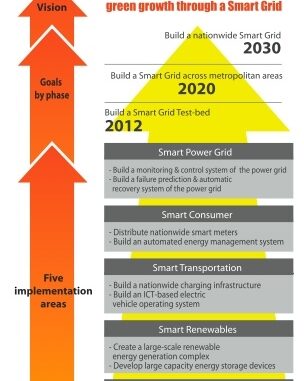
I blogged previously about a smart grid project being developed by a consortium of Korean firms including LG, SK Telecom and KT on Jeju Island south of Seoul. Since then it has been announced that South Korea is planning to spend more than US$24 billion over the next two decades on smart grid development. South Korea is a major oil importer so that managing electricity more efficiently and enabling alternative sources is critical to the South Korean economy. South Korea plans to complete a nationwide smart grid by 2030.
Samsung Electronics, LG Electronics, SK Telecom, LG Powercomm, Korea Electric Power Corporation (KEPCO), Hyundai Motor and Hyundai Heavy Industries are the Korean companies that are directly involved in the South Korean smart grid initiative. In South Korea the focus of the smart grid initiative appears to be
- Consumer empowerment – to put “advanced smart meters” in every Korean home together with time-of-use pricing
- Electric vehicles
- IP-based bidirectional communications network
- Sensors to monitor and help manage electricity flow
- Self-healing to increase reliability
- Enabling alternative energy sources such as wind and solar – Korea’s CO2 target is 30% reduction by 2020
- Energy conservation
 KEPCO is developing a test bed smart grid project on Jeju Island south of Seoul, where it plans to build two 10 MW substation transformers and four power distribution lines in an area that includes 3,000 households as well as commercial districts and power generation facilities. The project is estimated to cost US$65 milllion and is be completed by 2011. Those parts of the project that are deemed to be technically and commercially viable would then be deployed in further projects in Seoul and Chicago – apparently the Jeju Island project is being assisted by of the State of Illinois.

Be the first to comment