
I had heard of a project to cover the Sahara with solar panels, but until Michaela Schneeberger pointed me to the Desertec project, I thought it was a concept only. It has been estimated that covering 3 per cent of surface of the Sahara with solar power plants would be sufficient to meet the world’s energy needs.
Desertec seems to have gone quite a way down the road both financially and technically.
The project already has the interest of around a dozen companies including Munich Re, Deutsche Bank, RWE, Eon and Siemens as well as interest from political figures such as Angela Merkel and José Manuel Barroso.
Technically the idea is not to use photovoltaic cells, but mirrors, a heat concentrator, and standard turbine generators to produce electricity. Unlike photovoltaic solar cells, these plants are theoretically capable of generating electricity at night or on cloudy days, by storing the heat they produce. For example, the PS10 solar power tower stores heat in tanks as pressurized steam, but storage is only for one hour, and I don’t know of a practical example of longer term storage.
Due to new innovations, concentrating solar power (CSP) or concentrating solar thermal (CST) plants are becoming more cost-effective. A reflector concentrates light onto a receiver filled with a working fluid. The reflector follows the Sun during the daylight hours. The working fluid is heated as it flows through the receiver and is then used as a heat source for a power generation system. Working examples include the Solar Energy Generating Systems (SEGS) plants in California, Acciona’s Nevada Solar One near Boulder City, Nevada, and Plataforma Solar de Almería’s SSPS-DCS plant in Spain. 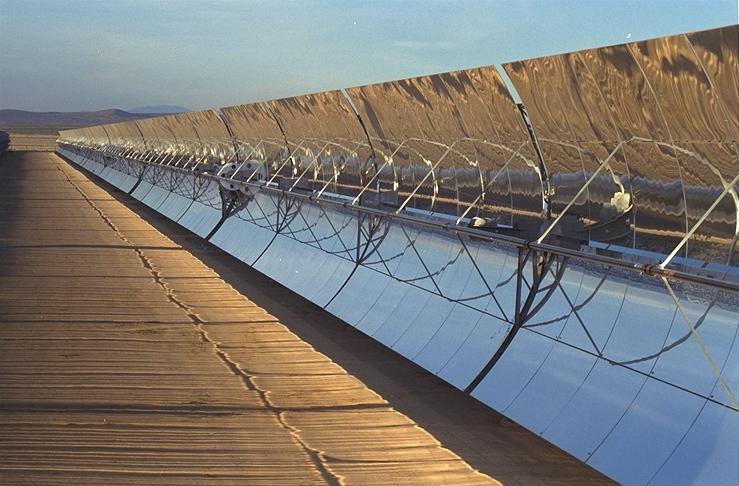
 SEGS, which is the largest solar energy generating facility in the world, is comprised of nine solar power plants in California’s Mojave Desert and is operated by FPL Energy. SEGS has almost a million mirrors and covers more than 1,600 acres. It has an installed capacity of 354 MW. In addition, the turbines can be utilized at night by burning natural gas. (Photo SEGS)
SEGS, which is the largest solar energy generating facility in the world, is comprised of nine solar power plants in California’s Mojave Desert and is operated by FPL Energy. SEGS has almost a million mirrors and covers more than 1,600 acres. It has an installed capacity of 354 MW. In addition, the turbines can be utilized at night by burning natural gas. (Photo SEGS)Nevada Solar One, with a capacity of about 64 MW, has more than 180,000 mirrors that concentrate solar radiation onto tubes containing a heat transfer fluid. The heat transfer fluid is heated and then the heat is exchanged to water to produce steam which drives a conventional turbine. Thermal energy storage systems could extend the solar thermal operating periods to night and cloudy periods.
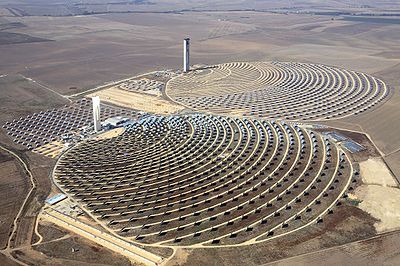 The mirror configuration of the Desertec technology would be closer to the PS10 and PS20 solar power towers operating near Seville in Spain. PS10 is Europe’s first commercial solar plant and has a capacity of 11 MW. PS20 has a capacity of 20 MW. PS10 is comprised of a solar power tower with 624 large movable mirrors. The mirrors follow the Sun and concentrate solar radiation on the top of the 115 meter high tower where a solar receiver and a steam turbine are located. (Photo PS10 and PS20)
However, there are serious technical challenges for the Desertec project. One is that the process requires water, not overly abundant in the Sahara, for cooling and it requires efficient long distance transmission lines. 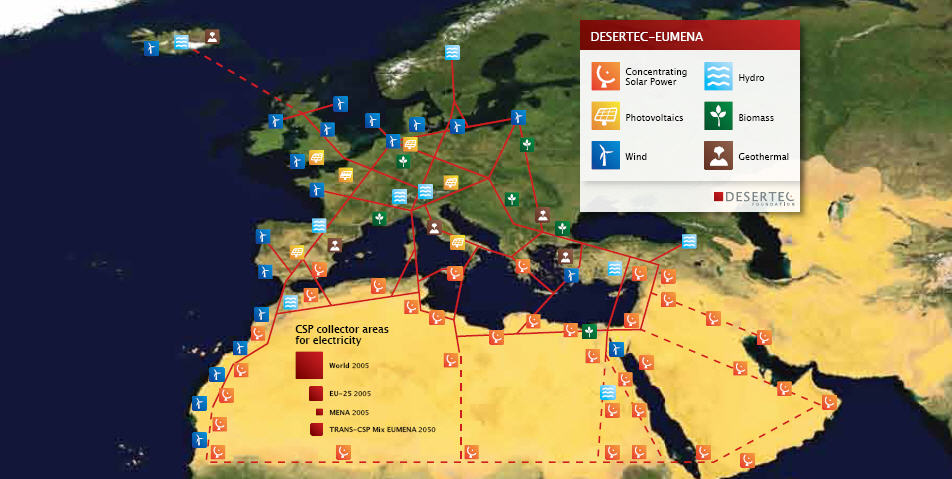 The plan is to use high-voltage direct current transmission lines to carry the electricity from the Sahara to Europe. Most transmission lines around the world are alternating current so this is not mainstream technology.
The plan is to use high-voltage direct current transmission lines to carry the electricity from the Sahara to Europe. Most transmission lines around the world are alternating current so this is not mainstream technology. Desertec’s technology is non-emitting which appeals to political leaders. The plan involves hundreds of mirror farms scattered around North Africa and the Middle East. The estimated cost of an implementation that would supply 15% of Europe’s power is about €400 billion which includes a supergrid covering Europe, North Afirca, and the Middle East.
Be the first to comment