
Solar Power from the Sahara: Storing Solar Power

I blogged earlier about the Desertec project which plans to use solar power from the Sahara to provide up to 15% of Europe’s power.  There are two key technologies that are key to that project, concentrated solar power (CSP) and direct current transmission.  

An advantage of CSP over photovoltaic cells is that CSP can use standard steam generation to create electricity.  In some CSP plants such as P10 and P20 in southern Spain concentrated solar energy is used directly to heat water to create superheated steam.  But at these plants the superheated steam can only be stored for up to an hour.  

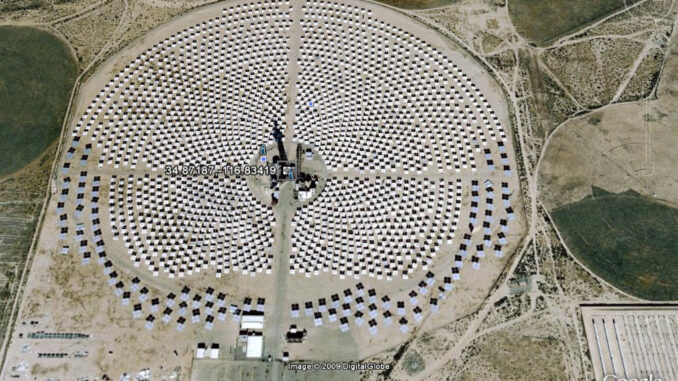
Another technology, that was used at Solar 2 in the Mojave Desert in California, is to use concentrated solar energy to heat salt (a mixture of sodium and potassium nitrates) to about 550o Celsius.  The molten salt is subsequently used to heat water to create superheated steam which is then used to generate electricity.  The advantage of molten salt is that it can be efficiently stored in large tanks and used at night or during cloudy periods for power generation.  Solar Two in California with about 2000 mirrors could produce 10 MW and used a combination of 60% sodium nitrate and 40% potassium nitrate as the energy storage medium. (Image Solar 2) 

Currently Torresol Energy is building a commercial power plant, Solar Tres Power Tower, near Seville in southern Spain with a generating capacaity of 17 MW.  The 3000 mirrors will be glass instead of metal which will reduce costs significantly. Like Solar 2 it will use molten salt as the heating material.  It will have large storage tanks that will be able to store molten salt for up to 15 hours of power generation and it is expected it will be able to run 24×7 in summer.

Geoff Zeiss

Geoff Zeiss

Geoff Zeiss has more than 20 years experience in the geospatial software industry and 15 years experience developing enterprise geospatial solutions for the utilities, communications, and public works industries. His particular interests include the convergence of BIM, CAD, geospatial, and 3D. In recognition of his efforts to evangelize geospatial in vertical industries such as utilities and construction, Geoff received the Geospatial Ambassador Award at Geospatial World Forum 2014. Currently Geoff is Principal at Between the Poles, a thought leadership consulting firm. From 2001 to 2012 Geoff was Director of Utility Industry Program at Autodesk Inc, where he was responsible for thought leadership for the utility industry program. From 1999 to 2001 he was Director of Enterprise Software Development at Autodesk. He received one of ten annual global technology awards in 2004 from Oracle Corporation for technical innovation and leadership in the use of Oracle. Prior to Autodesk Geoff was Director of Product Development at VISION* Solutions. VISION* Solutions is credited with pioneering relational spatial data management, CAD/GIS integration, and long transactions (data versioning) in the utility, communications, and public works industries. Geoff is a frequent speaker at geospatial and utility events around the world including Geospatial World Forum, Where 2.0, MundoGeo Connect (Brazil), Middle East Spatial Geospatial Forum, India Geospatial Forum, Location Intelligence, Asia Geospatial Forum, and GITA events in US, Japan and Australia. Geoff received Speaker Excellence Awards at GITA 2007-2009.

View article by Geoff Zeiss

Be the first to comment

Leave a Reply

Your email address will not be published.


*