
 I blogged previously about a presentation that, Rod Nikula, VP Power Supply at Wright-Hennepin Cooperative Electric Assn (WH)
in Minnesota, gave at this year's NRECA conference that hit on a very sensitive topic among power utilties. Companies like Solar City,
a full service solar PV energy company, offer a financially attractive
solar package (that does not involve the local power utility) once the
power rate from the local utility reachs 14 cents/kWh or above. Solar
City offers a unique leasing plan that requires no money down.
It offers a flat rate for 20 years, and payments are made against
savings from the monthly utility bill.
In a report by John Farrell at the Institute for Local Self-Reliance, Rooftop Revolution: Changing Everything with Cost-effective Local Solar,
the levelized cost of solar PV power is compared with the cost of power
from local utilities. The report concludes that right now solar PV
delivers power more cheaply than the local power utility for 10% of
residential demand in California, Connecticut, Hawaii, New Hampshire,
and New Jersey.
By 2022 it is projected, assuming continued decreases in the cost of
solar panels, that solar power will deliver power more cheaply for 10%
of residential demand in 49 states, the only exception being the state of Washington which has the lowest power rates in the United States.
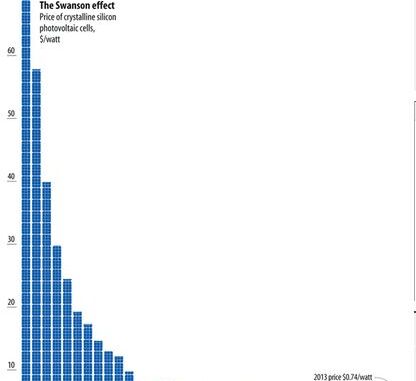
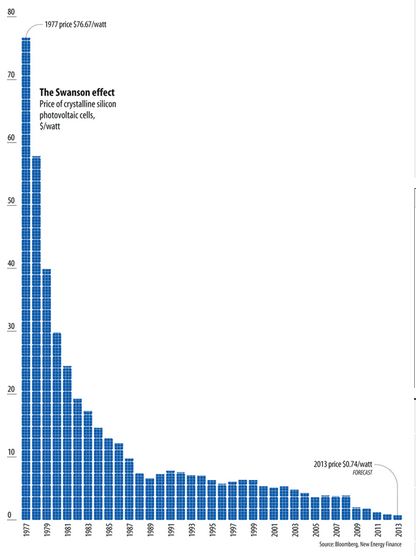
Now the Economist has produced a stunning graphic illustrating the Swanson effect that posits that the cost of the photovoltaic cells falls by 20% with each doubling of global manufacturing capacity. What this means is that panels that used to cost $76.67/watt in 1977 is projected to cost $0.74/watt in 2013 and this trend is expected to continue into the future. As a result the Economist says solar energy, which currently represents only 0.25% of the planet’s electricity supply, but which grew 86% last year, has the "potential to disrupt the electricity market completely."
Thanks to Derrick Oswald for pointing me to the Economist article.

Be the first to comment