
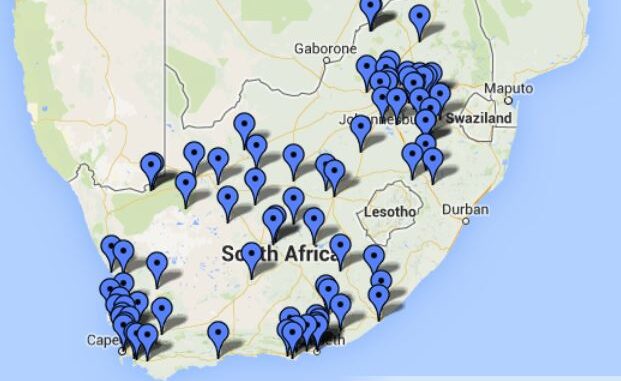
South Africa is a net energy importer. It has very limited oil and gas reserves, and has relied on coal and peat for 72% of its primary energy requirements. 67% of its petroleum is imported, primarily from Saudi Arabia and Iran.
ESKOM, the South African state owned electricity company, generates two thirds of the electricity produced in Africa and provides more than 60% of Africa’s demand. ESKOM has a generating capacity of 35 GW from 20 power stations, primarily coal-fired, but also a nuclear power station, gas turbine facilities, and hydroelectric plants. The company also owns and operates the national transmission system. It relies on coal for 95 percent of its electric power generation.
The South African economy has expanded significantly during the past few decades. This has resulted in growth in electricity demand. The South African Government wants to diversity its power generating fleet beyod coal. The South African Integrated Resource Plan (IRP 2010-2030), issued in May 2010 by the Department of Energy (DoE), calls for 18 GW of renewable energy over the next two decades.
The DoE has created an enabling environment to attract private sector investment in the energy sector. The program is targetted toward independent power producers (IPPs). A renewable energy fund is seen as one of the important steps to ensure the long-term affordability and sustainability of the renewable energy programme in South Africa. The intention is to lower the cost and impact of renewable energy on the economy by leveraging private sector investment.
South Africa has a high level of renewable energy potential and presently has in place a target of 10 000 GWh of renewable energy. DoE has determined that 3 725 MW of renewable energy is required to ensure an uninterrupted supply of electricity. This 3 725 MW is in accordance with the capacity allocated to renewable energy generation in IRP 2010-2030.
The IPP Procurement Programme has been designed so as to contribute towards the target of 3 725 megawatts and towards socio-economic and environmentally sustainable growth, and to start and stimulate the renewable industry in South Africa.
The following technologies and capacities are considered as qualifying technologies for selection under the IPP Procurement Programme:
- onshore wind – 1 850 MW
- concentrated solar thermal – 200 MW
- solar photovoltaic – 1 450 MW
- biomass – 12.5 MW
- biogas – 12.5 MW
- landfill gas – 25 MW
DoE has also allocated 100 MW of the 3725 MW to the procurement of small projects which individually have generation capacity between 1MW and 5MW. The technologies that qualify for the Small Projects IPP Procurement Programme include onshore wind, solar photovoltaic, biomass, biogas, and landfill gas.
Construction on the first utility-scale concentrating solar power plants (CSP) in Africa has been announced. The plants will have a combined capacity of 150 MW. The output from the plants will be purchased by Eskom. Technically the most interesting aspect of these plants is that to minimize water use, both plants will employ dry cooling technology. Dry cooling is critical technology in deserts such a those in South Africa where the need for water for evaporative cooling for conventional CSP plants has inhibited the deployment of CSP plants.
Be the first to comment