
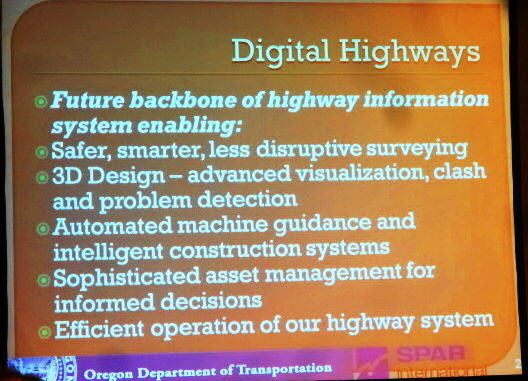
At SPAR 2013
I had the opportunity to hear very forward looking presentations by Ron
Singh, Chief of Surveys/Geometronics Manager at the Oregon Department
of Transportation. What Ron sees in the future and what motivates a lot of what Don sees needs to change in the highway construction process is autonomous vehicles, which will provide a major motivation for what Ron refers to as digital highways.
Automation over the last 25 years
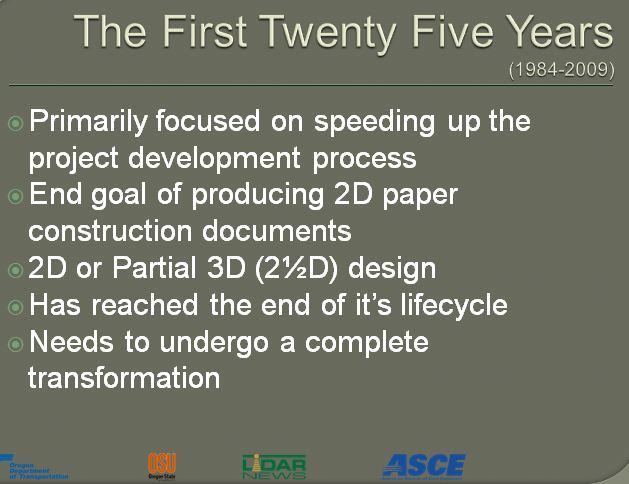 If you look at the last 25 years there has been quite a lot of automation in the form of survey automation such as electronic data collection, GPS, and basic 3D laser scanning; design automation such as computer aided design and drafting, and a bit of construction automation. The primary focus has been on speeding up the project development process, but the end goal remains 2D paper construction documents. Some people have been using what is called 2..5 D, a 3D roadbed prism with 2D objects on it. In Ron’s view the current way of designing and building highways has reached the end of it’s lifetime and a complete transformation to a new paradigm is required. The way Ron refers to this is standing the current process on its head and I blogged about it yesterday. Fundamentally it involves intelligent 3D models replacing the current as-builts and a process that speeds up project development because it leverages existing engineering data rather that requiring a complete resurvey at the beginning of every project..
A new paradigm for intelligent highways
The objective is intelligent highways that will support autonomous and partially autonomous vehicles. The new paradigm needs to be data-centric and real-time. It will involve automated construction. From a data management perspective it will require highway infrastructure lifecycle management, which will involve a very different approach to the survey/design/construct/maintain process that is currently used for highway projects in North America.
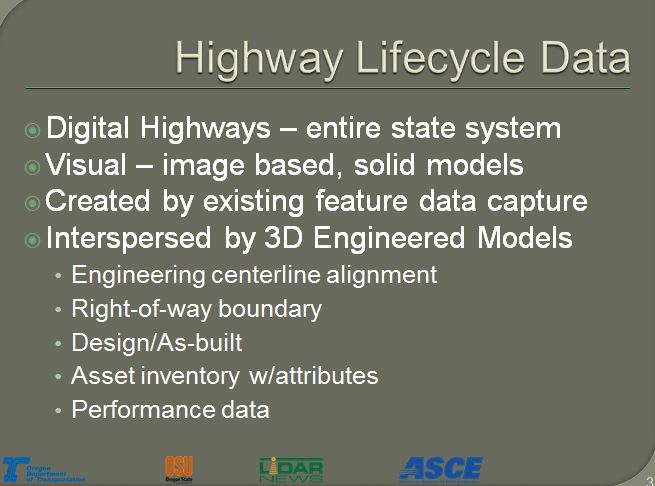 First of all, it will involve geospatially enabled 3D digital data. A key requirement is a low distortion geospatial coordinate system that will provide the foundation for geolocatiig all infrastructure including utilities. It will require interoperability using industry standards for data exchange. Most importantly it will support a construction process that uses post-construction surveys to replace as-built plans with a full 3D engineered model that supports GIS/engineering data integration.
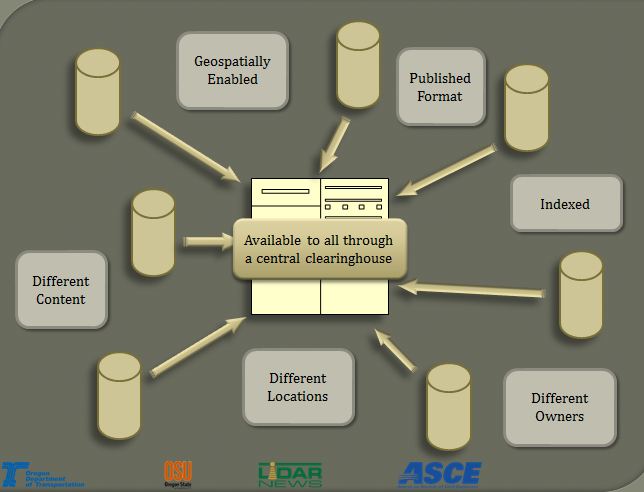 It will require geospatially-enabled enterprise data management including version control and the ability to search for things geospatially. It will provide tools for geospatially enabled asset management. It will provide a framework for developing and maintaining engineering and geospatial data including 3D engineered models as well as scanned data for existiing structures for the entire life cycle of a highway.

Be the first to comment