
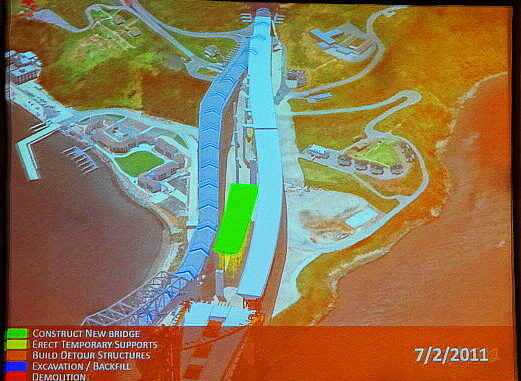
Kevin Gilson, of the Project Visualization group at Parsons Brinckerhoff (PB), gave an overview of how PB manages 3D+ datasets in support of design and construction for large infrastructure projects such as the San Francisco-Oakland Bay Bridge, the I-95 New Haven Harbour Crossing /Q-Bridge reconstrcution, and the Alaskan Way viaduct project. He showed how the project visualization team leverages geospatial data, LiDAR data, design data and construction planning data together in large integrated datasets that concurrently support visualization, stakeholder communication, design, construction planning and site logistics.
PB has more than 30 staff dedicated to project visualization. That included folks who do 3D modeling, design visualization, web design, and programming. 3D technologies include building information modeling (BIM), 3D design, virtual desgin and construction (VDC) and laser scanning (LiDAR).
3D modeling for design and construction
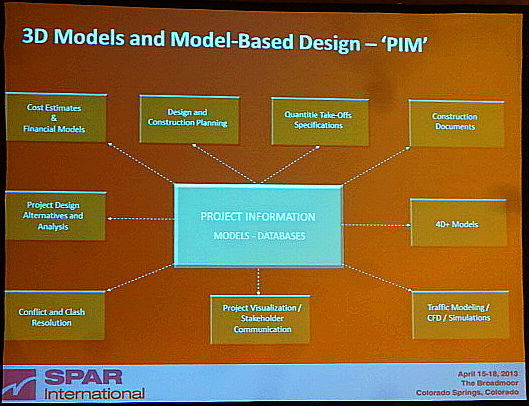 Some of the reasons that designers and construction firms are adopting 3D technology are the serious limitations of 2D sheet sets, still legally required fro s-builting but very unreliable, the design efficiencies of 3D parametric models, and the limitations of siloed project data. PB has adopted the concept of project information models or PIMs, that integrate information about all aspects of the design and build process and that potentially can flow data through for operations and maintenance.
3D modeling and model-based design are used by PB for design validation, clash detection, and parameteric modeling, civil integration management, 4D modeling (time+3D), 5D (cost+time+3D), and design visualization. Model-based design involves integrating CAD, GIS, survey, analytics, BIM and associated databases, and 3D visualization typically in a vitual gaming environment.
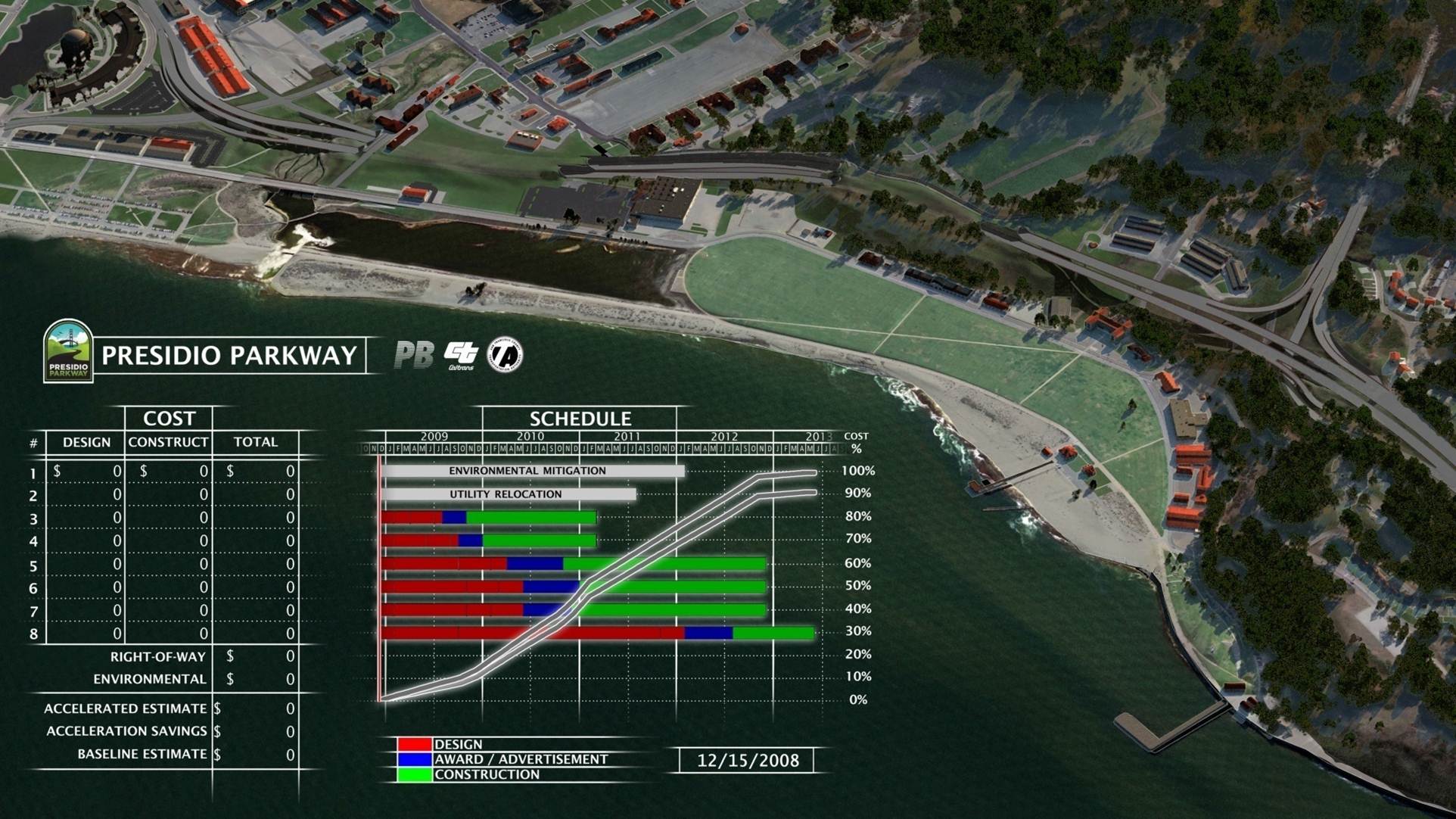 Construction firms in particular see tremendous advantages in 4D models that integrate design and gespatial data and allow the construction team to virtually build the project so that they can check staging and construction sequencing and site logistics virtually. 5D and higher dimensions allow them to add additional metrics including cost, resources, materials, and equipment.
The benefits that PB realize by this integrated approach based on 3D+ dataest include finding and fixing conflicts between different design groups (HVAC, plumbing, electrical, structural, and so on) during the design phase rather than during construction when clashes are much more expensive to fix. Another benefit is being able to quantify t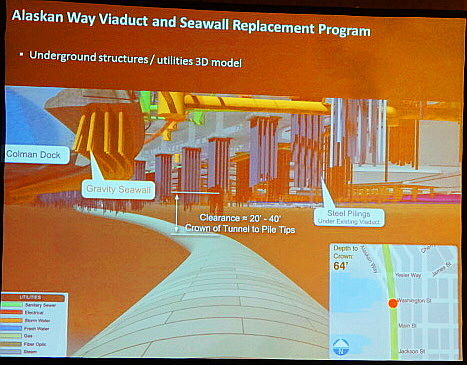 hings using analytics, so that decisions are data-driven rather than subjective.
A major benefit is less re-work is required reducing the risk of cost and schedule overruns. A big advantage is improved communication and coordination between all project stakeholders, and especially with non-technical decision makers. Being able to see photorealistic visualizations of what the project is going to look like makes a huge difference in communicating with politicians and the public. PB uses gaming technology making it possible to experience a project before a shovel has gone into the ground. For example, on highway projects, PB’s visualization makes it possible to drive the highway and even the detours required during construction in a virtual environment so that the public can experience the changes and be prepared for them before they actually happen.
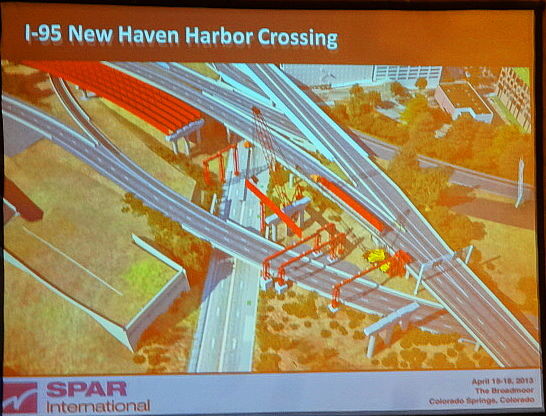 Another important benefit that Kevin sees from a project approach that includes visualization is that “sexy deliverables” get peoples attention, within the project team as well as with external stakeholders. Several other speakers at SPAR 2013 also emphasized the importance of the “sexiness” factor.
Laser scanning in construction
Kevin described a number of applications of laser scanning (LiDAR) as part of the 3D constrcution process. A major application of LiDAR is contruction monitoring, capturing construction progress as well as being able to automate the process of checking for divergence from design when contractors for a variety of reasons don’t build what is designed.
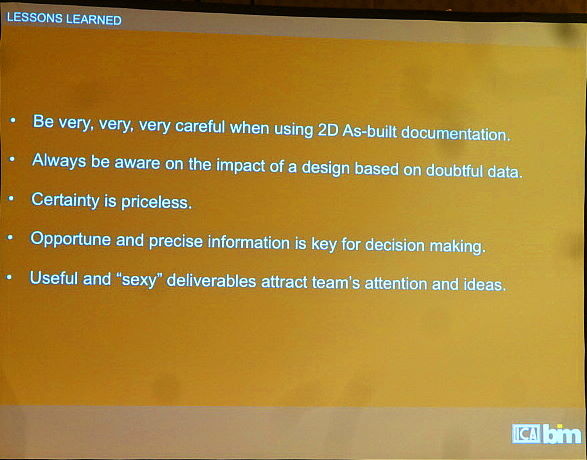 Another important Laser scanning application is accurate and reliable as-builts. At SPAR 2013, speaker after speaker in different sectors of the construction industry reiterated that current 2D as-builts, still legally required, are unreliable and rarely looked at by anyone post-construction. Marco Vidali Castillo at ICA which is responsible for the Autopista Urbana Sur project in Mexico City gave an example of how trying to use 2D as-builts can lead to problems neces
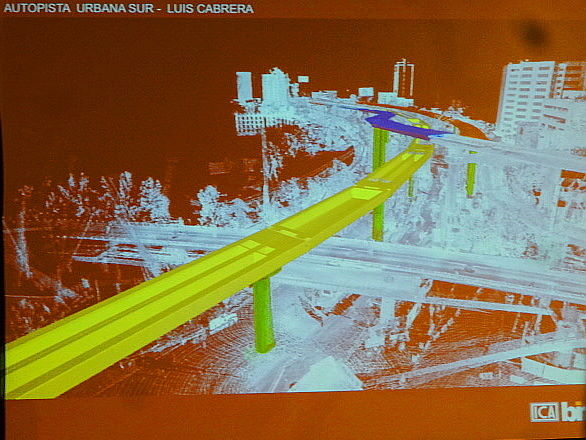 sitating major re-engineering. LiDAR scans of a completed project can provide the reliability that 2D as-built sheet sets lack. On the Autopista Urbana Sur project Marco says that ICA intends to deliver LiDAR scans as well as the legally required 2D as-built sheet sets.
3D modeling and sustainability
There are also benefits from the perspective of sustainability to PBs project approach. Collaboration typically has relied on the exchange of paper documents which on a large project can involve many thousands of paper documents. Collaborating in a virtual environment can dramatically reduce paper flow while improving the quality of communication. It can also improve traffic flow and resource management during construction, thereby reducing emissions. A life-cycle approach to data management during design and construction, with data being reused for operations and maintenenace can reduce rework resulting in significant efficiencies.
Selecting software tools
The PB project visualization team takes a best of breed approach in selecting software for 3D modeling and visualization. An important criterion in selecting tools is interoperability between the different technologies. Currently the software stack that PB relies on includes
Geospatial
- ESRI
- Global Mapper
- Infraworks (Autodesk Infrastructure Modeler)
CADD
- Microstation InRoads
- AutoCAD/Civil 3D
- Solidworks
Visualization
- 3ds Max
- Sketchup
- Realtime – UDK, Unity
Collaboration/4D
- Navisworks

Be the first to comment