
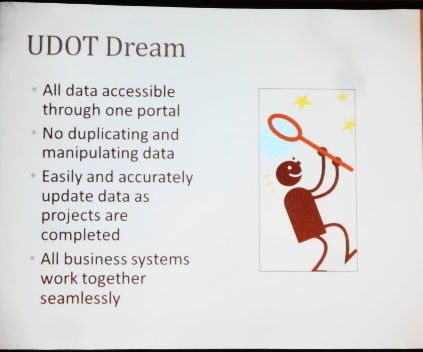
The Utah Department of Transportation (UDOT) is responsible for about $30 billion in assets including pavement, bridges, signs, culverts and signals. At SPAR 2013 Stan Burns, Asset Management Director at UDOT gave an overview of a very ambitious program involving inventorying all assets and developing an integrated gespatially-enabled asset management system.
UDOT has about 6000 centre-line miles (10 000 km) of highways and has just completed an inventory of the entire system. The inventory generatd a total of 30 terabytes of data, 6 terabytes of imagery and 24 terabytes of point cloud data captured by LiDAR.
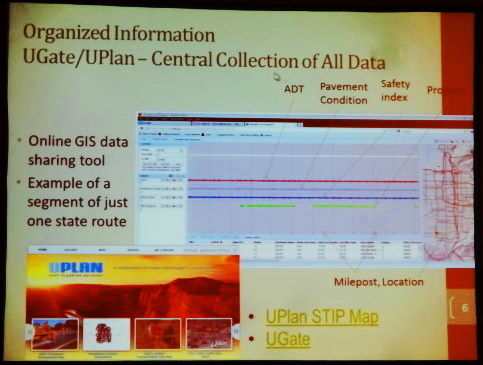 UDOT is in the process of developing applications that are designed to provide a common interface for the dozen or so UDOT groups that provide a variety of services. One of the most important features of the architecture of the integrated asset management solution that UDOT is developing is that location represents a fundamental way of indexing and integrating disparate data sources. For example, it makes it possible to see critical maintenenance issues in different layers such as culverts, pavement, and bridges on a common landbase map, so that repairs can be coordinated for all of these assets at the same time.
A critically important objective is no data duplication by implementing a data management stategy based on data stewardship, In essence every piece of data has a single owner, which could be a group or department.
Interoperability is a critical issue because UDOT has many different software systems from different vendors including Oracle, Bentley, ESRI, Deighton, Mandli, Virtual Geomatics and others.
But perhaps the most important aspect of this project is the sharing of a common dataset among all the departments of the UDOT. As Gene Roe of LiDAR News said in another session, sharing of data among different departments of DOTs is not the current situation in many DOTs.
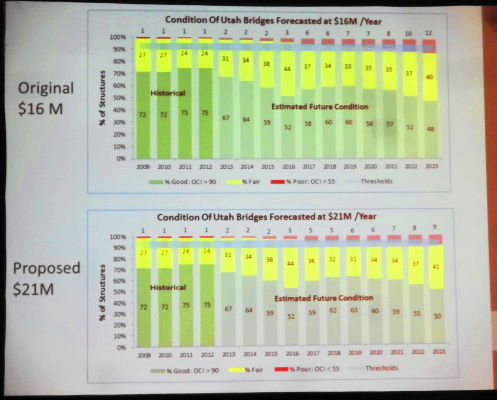 This type of asset management represents a cultural shift for DOTs, because it makes it possible to maintain assets proactively, develop strategic directions, and create wisdom from the huge volume of asset and other data such as historical weather conditions. For example, it makes it possible to predict future bridge and pavement conditions, so that funding requirements can be projected into the future.
Be the first to comment