
Productivity has become a critical issue in the utility and telecom industries as a result of the aging and shrinking workforce. Organizations are losing experienced designers to retirement faster than they can replace them with younger inexperienced workers. This means that they are not only facing reduced headcount, but also fewer experienced workers.
I blogged previously about the challenge of an aging workforce in Europe. Europe’s work force will begin shrinking in the coming years and is expected to become 15% smaller within five decades, according to the OECD.
This has long been recognized as a problem in North America as well. In the US a Conference Board study Managing the Mature Workforce predicted that by 2010, the number of workers aged 35 to 44 will decline by 19%. A study from the American Public Power Association (APPA) called Work Force Planning for the Public Power Utilities: Ensuring Resources to Meet Projected Needs reports that the loss of critical knowledge and the inability to find replacements with utility-specific skills are the two biggest challenges facing the industry. In the utility industry as many as 60 percent of experienced utility workers will have retired by 2010. A Booz Allen Hamilton study predicted a 20% decline in productivity in the US power industry.
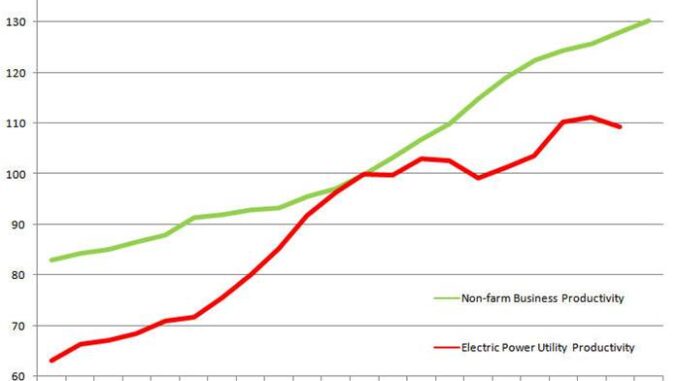
I collected some statistics from the US Bureau of Labor Statistics to compare productivity in the electric power industry to non farm industrial productivity. The results, which are shown in the attached graph, show that productivity in the electric power industry increased more rapidly than non farm industrial productivity through 1998, but that since 1998 productivity in the electric power industry has stagnated. This confirms that the electric power utility industry is facing a serious productivity problem, which could not be happening at a worse time. Green energy and smart grid initiatives mean that utilities have more on their plate than at any other time in recent memory. Retiring workers are leaving faster than younger replacements can be hired and trained. Workers who are retiring have many years experience and are being replaced with younger, inexperienced workers. And utilities are having a difficult time retaining younger workers.

Be the first to comment