
In a paper Semantic 3D Modeling of Multi-utility networks in Cities presented at GSDI 2012 in Quebec City, Thomas Becker; Claus Nagel and Thomas H. Kolbe have outlined how they are translating a vision of the city as an interactive system comprised of functional components, utility networks connecting components, and interdependencies between utility networks into standards-based intelligent models that can be used to analyze urban environments for a variety of purposes including
- Risk- and disaster management
- Energy consumption
- Carbon balancing
- City life-cycle management
 The see ciities as being very complex, diverse and highly interrelated, that is a system of systems, buildings, utility infrastructure, transportation infrastructure, health and social, and so on. Many different players are involved in designing, building, running and maintaining a city, and each needs a different view of the city. The advantage of having a model of the city is that it provides a simplified representation of the city that provided “ontological and semantic clarity”.
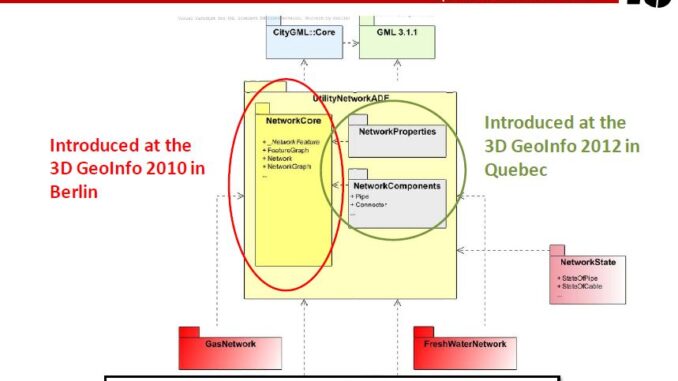
Thomas Kolbe and co-workers are the developers of the CityGML standard that has been adopted by the Open Geospatial Consortium. There are several Application Domain Extensions (ADEs) that have been developed to extend CityGML to other domains. In 2010 a basic extension UtilityNetworksADE was proposed for city utility networks, and at Quebec it was announced that this was being futher extended.
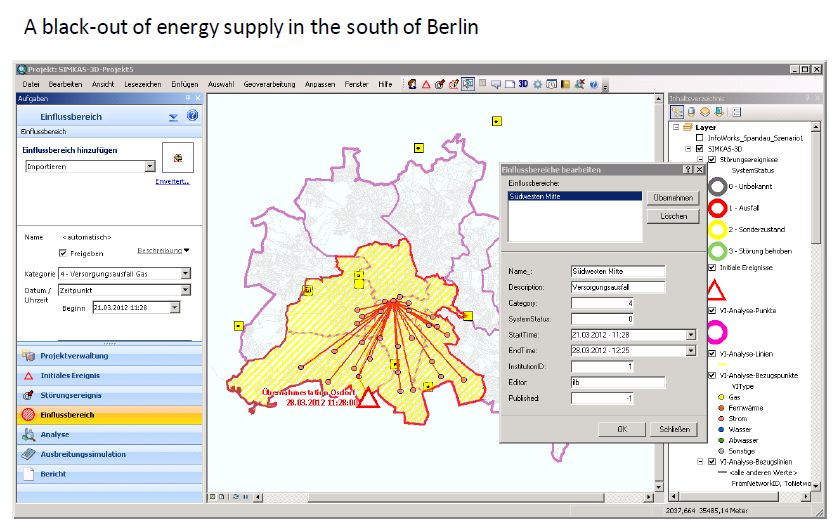
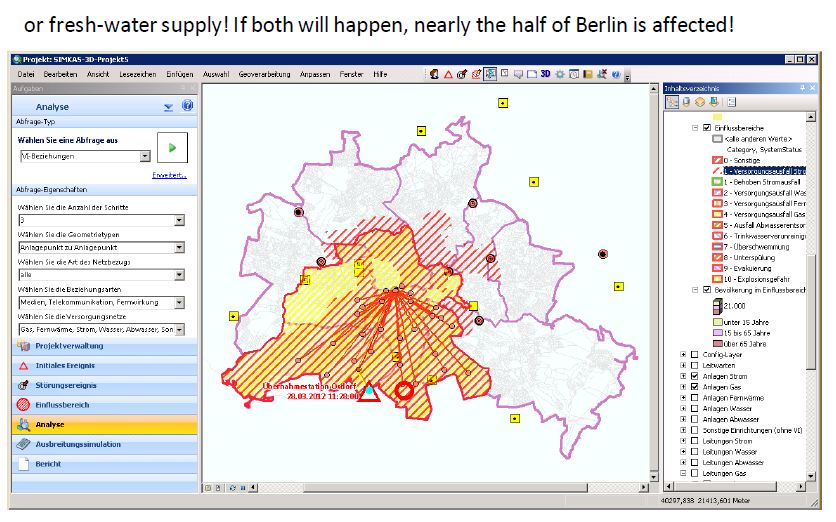 The intention is to model infrastructure networks both as a 3D topographic, topological and and functional network. In other words, this is not simply a compilation of network as-builts, but includes the function of each component and its relationships to other components. It knows the difference between different network topologies; water, electric power, steam, wastewater, and communications. It also knows the interdependencies between different networks. For example, in case of a flood, from the digital terrain model, it is possible to determine which electric power substations are flooded, from the electric power network topology, which feeders are no longer operative, from the relationships between the electric power and water networks, which pumping stations are no longer operating, and ultimately who is without water and power.
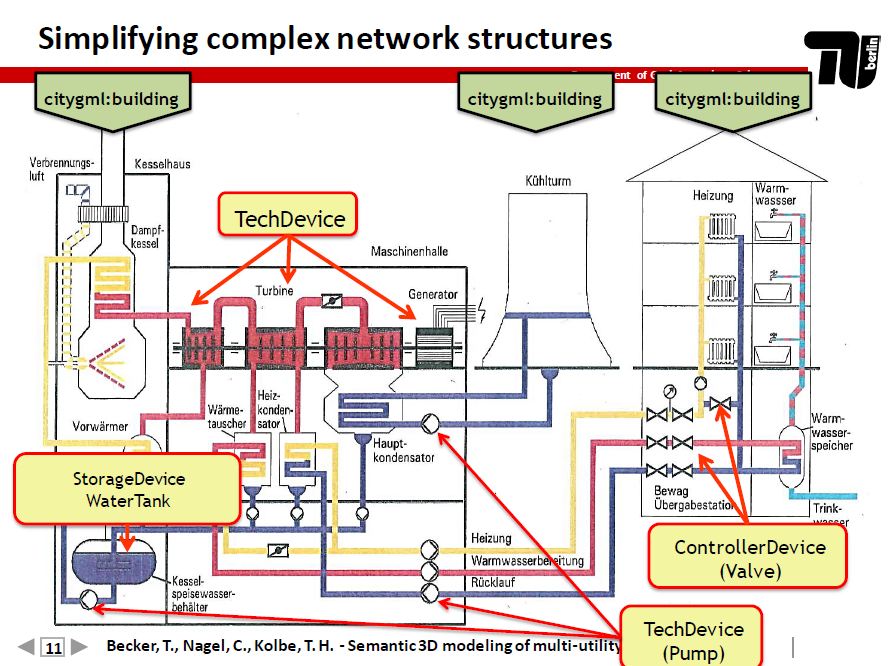 Functionally, every utility network ias modeled by three types of components
- Distribution elements (conductors, pipes, fiber cables) − For distribution of electric power, gas, and messages.
- Protection devices (fuses, relays, breakers, and ducts) − Does not actually carry electric current, water, gas, or messages, but supports the distribution system.
- Functional components (man-holes, water treatment plants, substations, pumping stations and switches) − Needed for linkage, maintenance, and measurement
 I like to think of these as connected elements where the connectivity between elements allows traces, from a customer experiencing an outage to a failed device such as a transformer or substation or from a failed device to all affected customers, structural elements, which support the connected elements such as poles or ducts, and devices which generate, transform, switch, and measure.
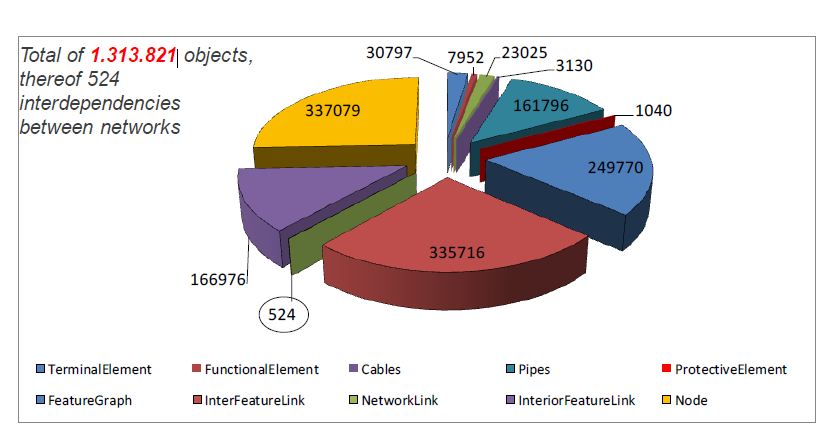
To better understand this implication of this approach,Kolbe et al have compiled a model database of 1.313,821 infrastructure elements including interdependencies between different networks. Addendum According the Thomas Kolbe (personal communication), for each utility company in Berlin involved in the SIMKAS-3D project (Vattenfall – electricity and district heating, GASAG – gas, and Berlin Water – drinking water and waste water), his team implemented a converter from the respective utility’s dataset to the CityGML ADE utility model using Safe Software’s FME.

Be the first to comment