
As I have blogged about previously, one of the most difficult things to do in many parts of the world if to find reliable data about underground assets, utility networks such as water and waste water, power, gas, oil, and steam telecommunications including copper, fibre, and coax. When I was in Penang, Malayia I encountered an interesting approach for mapping and maintaining a database of underground facilities that is unlike anything I have seen elsewhere. It’s called Sutra D’Bank (PENANG STATE GOVERNMENT SUBTERRANEAN DATA BANK) and is maintained by a joint venture company EQUARATER (PENANG) SDN BHD (EPSB) formed by Equarater Sdn Bhd and the Penang Development Corporation.
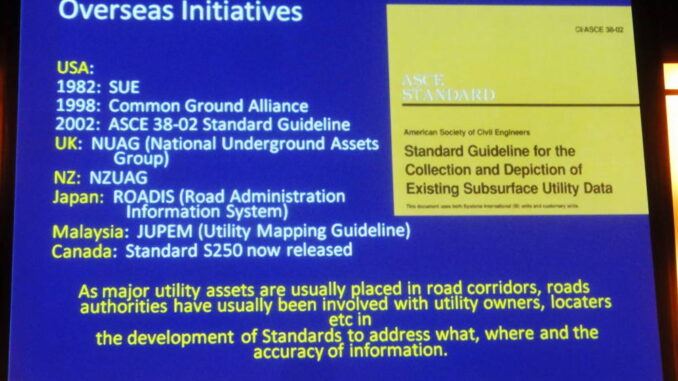
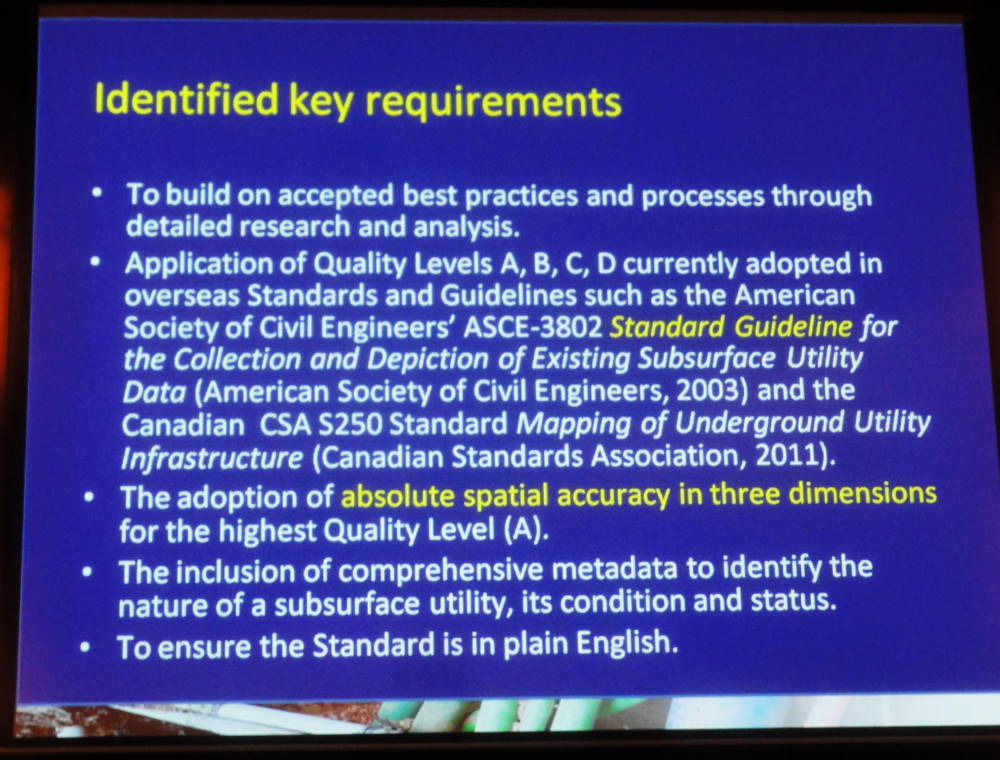 At the GITA ANZ conference in Melbourne, Bruce Potter of Cardno gave an overview of the progress toward defining an Australian standard for classifying the reliability underground utility data. Their research has identified several international standards in other countries around the world including the UK, US, Canada, Malaysia, and Japan.
The Australian standard is intended to build on the ASCE 38-02 standard including the A, B, C, and D Quality Levels, but extend it to include
- 3D spatial accuracy as part of Quality Level A
- Metadata about the nature of the facility, its condition and status.
ASCE 38-02 – Standard Guideline for the Collection and Depiction of Existing Subsurface Utility Data
 Published in 2002, this standard is intended to standardize the classification of the quality of location information about existing subsurface utility networks included on engineering drawings. The standard defines four quality levels:
- D – Information derived from existing records or oral recollections.
- C – Information obtained by surveying and plotting visible above-ground utility features and by using professional judgment in correlating this information to Quality Level D.
- B – Information obtained through the application of appropriate surface geophysical methods to determine the existence and approximate horizontal position of subsurface utilities.
- A – Precise horizontal and vertical location of utilities obtained by the actual exposure and subsequent measurement of subsurface utilities, usually at a specific point.
 Classifying the quality of data about underground utility networks reduces risk and allows engineers to make decisions about remedial measures to gather accurate location data for underground facilities. When underground facilities are unexpectedly encountered during construction, there is the potential for catastrophic results.
This stantard has been endorsed by both AASHTO (A Guide for Accommodating Utilities Within Highway Right-of-Way) and the Federal Highway Administration (FHWA).
Be the first to comment