
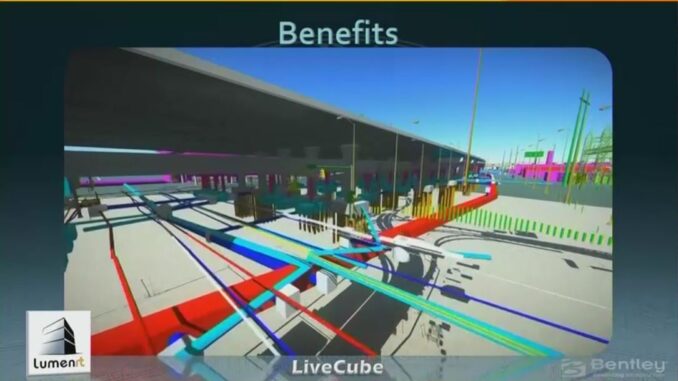
Unknown or inaccurately located underground utilities can make or break a highway construction project’s schedule. For the largest construction project in the state of Alabama’s history, the Alabama Department of Transportation (ALDOT) used ground penetrating radar (GPR) and other technology to create an accurate 3D model of underground infrastructure prior to designing a replacement for one of the busiest interchanges in the state. ALDOT estimates that the 3D model, which was provided to all contractors bidding on the project, saved millions of dollars and reduced the risk of budget and schedule over-runs.
The location of existing underground utility infrastructure is more often than not poorly known which creates significant risk for infrastructure and highway construction projects. Typically on highway construction projects, the right of way is chosen, the highway designed and the project readied for construction before the one-call centre is contacted and the affected utilities arrive to detect and locate their underground facilities, usually in 2D. The utilities that have been detected are then moved to make way for building the highway. Not infrequently the location of the identified utilities turns out to be unreliable and during construction other unidentified utilities are encountered both of which can lead to delays and to budget overruns.
I blogged previously about a gas line construction project that was a Year in Infrastructure Award finalist in 2015. For this project a 3D model of the existing underground and above ground infrastructure was created before design and construction. The benefit of having the 3D model was clear; during construction there were no utility strikes, there were no change orders and the project was completed in 7 weeks instead of the expected 10 weeks.
At this year’s Year in Infrastructure Awards in London an outstanding project submitted by the Alabama Department of Transportation (ALDOT) was selected as finalist. The I-20/I-59 Corridor is the largest construction project in the State of Alabama’s history with a cost of $750 million. The project has a very tight timeframe. ALDOT’s Design Bureau’s Visualization Group was tasked to provide a complete 3D proposed model for building information modeling (BIM). The BIM model needed to provide the information necessary for multiple uses including: visualizations, design checks, construction analysis, clash detection, right-of-way negotiations, lawsuits, and aesthetics. The model had to be very accurate because it was intended to be provided to the construction bidders to enable more accurate cost estimates and lower bids.
One of the important challenges faced by this project was utility coordination because the interchange is situated in Birmingham’s business district. Realizing that underground utilities can make or break a project’s schedule, ALDOT invested a considerable effort in locating utilities and creating a 3D model of above and below-ground utilities. Potholing and scanning with ground penetrating radar augmented existing as-built records to enable ALDOT to create accurate 3D model of underground utilities. 3D is important because what appear to be clashes in 2D may not actually be. 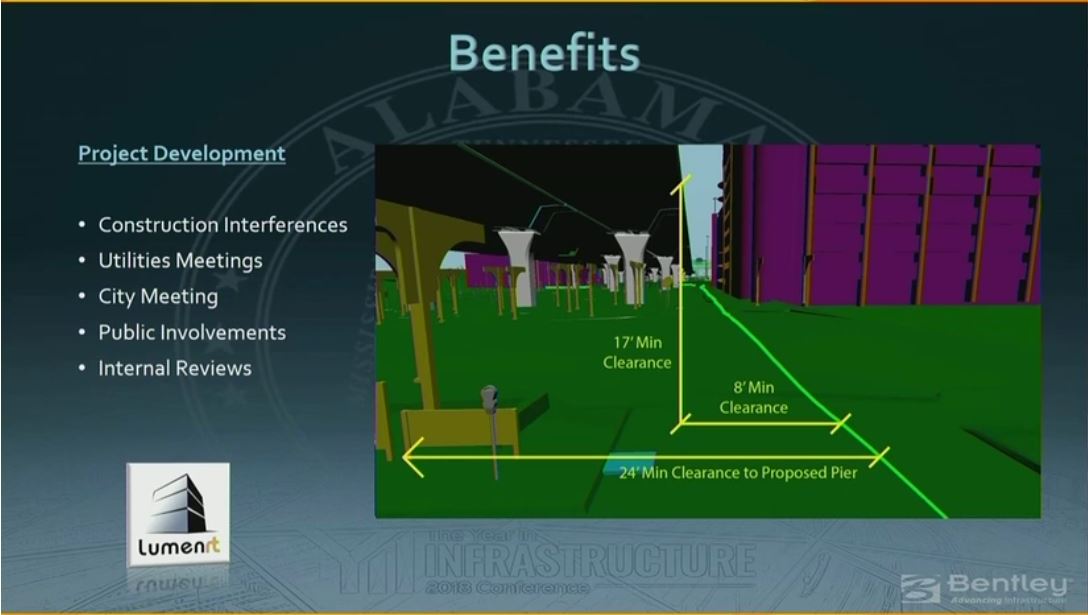 Also it was much easier to explain to utilities in 3D that a costly move of a utility line is not necessary. ALDOT’s Visualization Group was tasked with detecting clashes between the proposed design with the existing conditions. Every contractor bidding on the project got the full 3D model. Because of the reduced risk associated with underground infrastructure ALDOT estimated that it saved over $10 million by using 3D modeling of underground and aboveground utilities.
 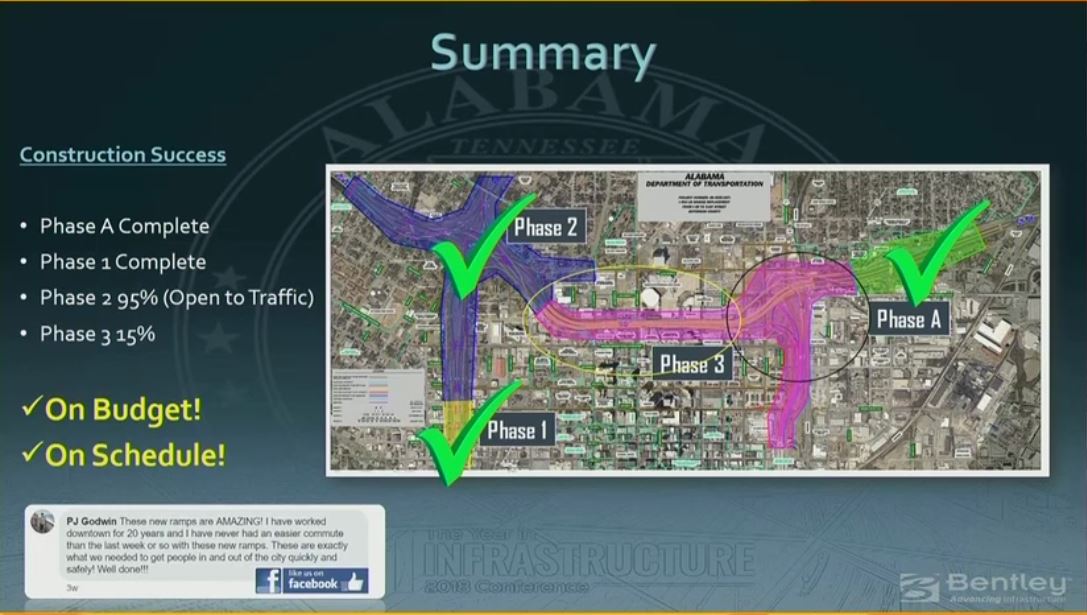 To date the project is on budget and on schedule. After completion of the project ALDOT plans to retain the 3D model which can be reused for other projects in the same area.
ALDOT found other advantages of 3D modeling as well. Public and stakeholder perspectives of the project was a major concern and using the 3D model allowed the Visualization Group to provide accurate photomatches, renderings, and animation to relay projects impacts to all stakeholders. While the project is under construction the 3D model is also being used by inspectors in the field so that construction details are relayed accurately to the workers.
This project provides further evidence of the significant benefits of a 3D model of underground infrastructure which can be used during design and construction to reduce the risk of utility hits, reduce the cost of utility relocates, and avoid unnecessary utility relocates.

Be the first to comment