
Yesterday the Ottawa Chapter of the Canadian Green Building Council sponsored a presentation “Building Green in a Collaborative Virtual Environment” by Jean Carriere of 3DEnergy, Ltd.
Where we are now
Jean gave an overview of the state of the art for energy performance modeling for new buildings. To summarize, there are a lot of energy analysis tools (lighting, thermal, emissions, water usage, etc) , many are very complex, and the volumes of data that are required is increasing exponentially. Interoperablity is one of the biggest major challenges that is inhibiting productivity in energy performance analysis.
Energy performance modeling is a new field, so new that there is no set of standard best practices. Energy modelers are making it up as they go.
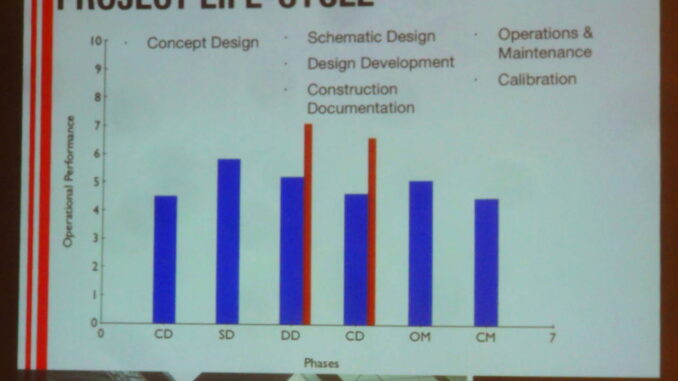
Another important factor inhibiting the full benefit of energy modeling is that it is rarely used in the conceptial design phase of a building project when its impact would be most significant. In Jean’s experience he is called in after the architect has completed the basic design, during the design development and construction documentation phases. This late in the game there are severe limits on what can be changed to optimize building energy performance.
One of the most, if not the most important, motivations for conducting an energy analysis for a new building in Ontario are programs run by the Ontario Power Authority (OPA) that provide direct payments not ony for reducing the energy load of a building but also for the energy analysis itself. The program that Jean cites most often is the High Performance New Buildings (HPNC) program that pays $400 to $800 to the builder for every kW of electric power saved over what is mandated by the Ontario Building Code (ASHRAE 90.1 2010). Regulation is also starting to be an important factor as well. In Ontario there is a new regulation that requires that any building with 40% or more glazing has to be 5% more efficient than ASHRAE 90.1.
Trends
There are important trends that are emerging that point to where the industry is headed.
BIM
First of all, from Jean’s perspective the natural place to start energy modeling is with a Building Information Model (BIM). There are several reasons for this. First of all it is what many of the energy performance analysis packages expect and it is supported by the gbXML standard. Secondly it allows all the information required by the architect, engineers and construction contractors to be accessed in one place. And thirdly it helps in communicating the results of the energy performance analysis to the people who need it including heating and cooling, lighting and other types of engineers, all of whom may require the same information but communicated in dfferent ways.
Interoperability standards
From Jean’s perspective the big challenge is getting the right information stored in the BIM model into the energy performance analysis package. Jean sees interoperability as having the biggest productivity impact on the energy analysis process. Jean has put a lot of effort into streamling the flow of building properties from the BIM model to the energy analysis package. He relies on the gbXML open schema to transfer building properties stored in the BIM model to engineering analysis tools.
Jean has focussed particularly on hospitals and reports that after working on several hospitals he has optimized the process so that starting from paper architectural drawings, he can develop the BIM model, compile energy performance parameters, generate gbXML, and conduct a complete energy analysis (daylighting, thermal analysis, etc) for the proposed building in only two weeks. People in the audience were astounded at how quickly Jean is able to do this. One person cited several months as their typical experience in doing an energy analysis of a building design.
 Getting the biggest bang for the buck
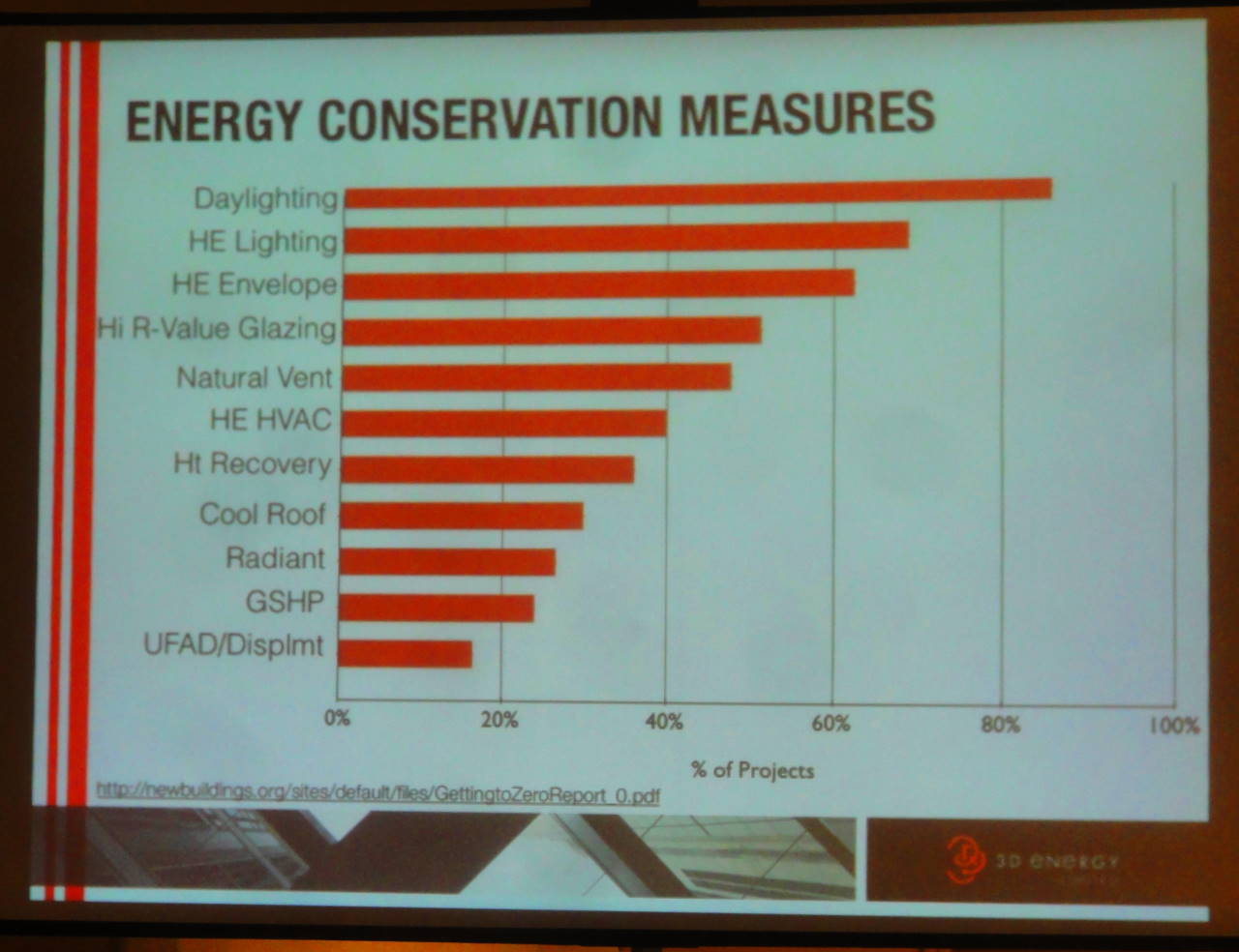
Jean showed a fascinating graph that compared the energy reduction impact of various strategies. I and a few others were surprised that daylighting, reducing the need for electric lighting, is one if the easiest strategies to implement and is one of the most effective way to reduce energy usage by a building.
Training and education
One of the challenges that has to be addressed, and that educational programs like this one organzed by the CaGBC, is making everyone involved in construction, but especially those involved in the early conceptual design phase, more aware of energy modeling. Currently on many design/build projects, one group does the conceptual design, which is then handed over to a second delivery group that developes the schematic design and builds the building (and often leaves detailed design to the construction contractors.) Jean rarely gets a chance to work with the conceptual design group, who are often not that conversant with energy performance of buildings and the important implications some of their design decisions have for the energy performance of the finished building. By the time the delivery group calls Jean in to conduct an energy analysis, design decisions that could have dramatically changed the energy profile of the building have already been made and at that point are cast in stone.
Future
The future is net zero energy buildings. I have blogged about the mandated objectives for near zero energy buildings in the EU, the emerging objectives for zero emissions buildings in Japan, and the Federal objectives for net zero energy buildings in the U.S. Buildings that either use net zero energy or even contribute more energy back to the grid than they consume are clearly the future. But getting there will require changes in how we design and build.
First of all, from Jean’s perspective energy analysis has to happen earlier in the design/build cycle. Secondly, it will require much more collaboration than is typical of the overwhelming majority of construction projects. Integrated Project Delivery (IPD) where everyone involved in a project work in the same big room is an example of the type of collaborative approach to construction projects that could enable much greater energy savings.
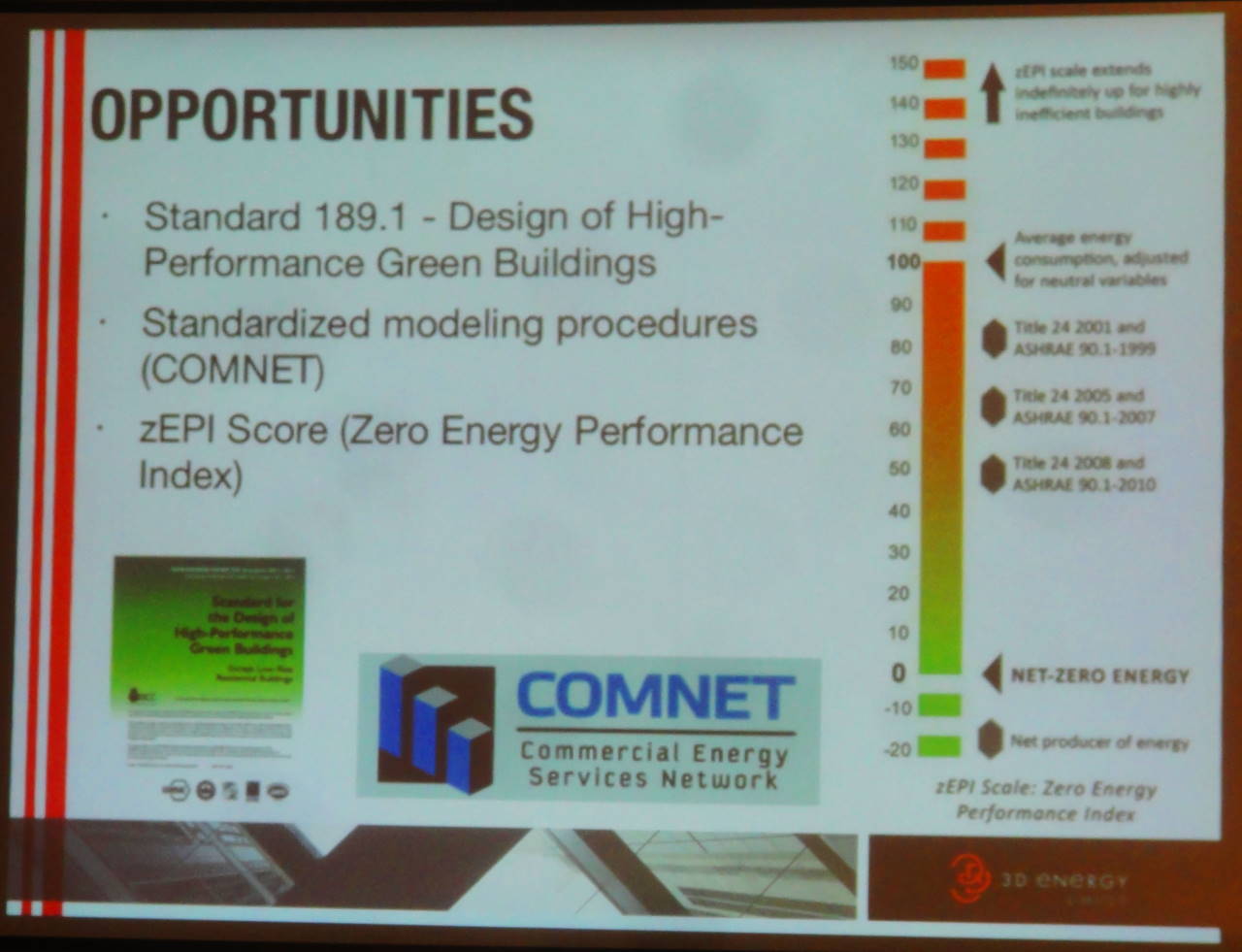 Some of the things that are on Jean’s radar as we move toward net zero energy buildings are ASHRAE 189.1 a standard for the design of high-performance green buildings, standard building energy modeling procedures and guidelines (COMNET), and the zero energy performance index (zEPI), which is the ratio of the energy
performance of a building to the average energy consumption of a
similar building at the turn of the millennium that is operated in a
similar climate, for similar hours of and similar operating conditions.

Be the first to comment