
As a speaker said at a recent conference, building a transmission line used to take 90 days, now it takes between 12 and 20 years because of the complicated permitting process,
- Planning 1-2 years
- Cost allocation 6-12 months
- Federal approval 3-5 years
- State approval and siting 3-5 years
- Construction including access roads 2-7 years
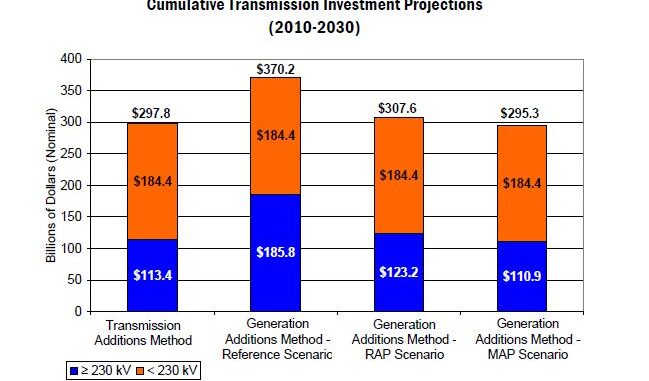
The Brattle Group has estimated the total investment in transmission required between 2010 and 2030 to be on the order of $300 billion. With an estimated 50,000 miles of new transmission lines required in the US primarily to bring renewable energy to market, something needs to be done to speed up the cumbersome permitting process
As a first step in October of 2009, nine Federal entities including, the White House Council on Environmental Quality (CEQ), the Department of the Interior (DOI), the Department of Agriculture (USDA), the Department of Energy (DOE), the Department of Commerce, the Department of Defense, the Environmental Protection Agency, the Federal Electric Regulatory Commission (FERC), and the Advisory Council on Historic Preservation, signed a Memorandum of Understanding increasing their coordination to expedite and simplify building of transmission lines on Federal lands.
 The Obama administration has just announced pilot projects to streamline the permitting of transmission lines ,to speed up integration of renewables and electric vehicles integration, increase the reliability of the grid, and reduce the need for new power plants.
The transmission line permitting process involves many federal agencies including DOE, FERC, Interior, Defense, Agriculture, the Council on Environmental Quality, and the EPA. This is in addition to state regulators, local government and tribal stakeholders.
The administration’s transmission pilots will focus on accelerating permitting for seven proposed transmission lines affecting 12 states: Arizona, Colorado, Idaho, Minnesota, New Mexico, Nevada, Wyoming, Utah, New Jersey, Pennsylvania, Oregon and Wisconsin. The accelerated process involves coordinating statutory permitting, review and consultation schedules and processes among the federal and state agencies; applying a consistent approach to consultations with tribal governments, and quickly resolving interagency conflicts and ensuring that all participants are fully involved and meeting schedules.

Be the first to comment