
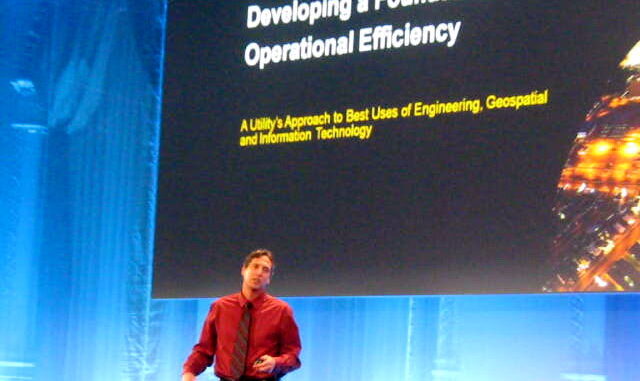
Jonathan Pickus from Las Vegas Valley Water District (LVVWD) gave one of the most insightful presentations I have seen on the typical challenges facing utilities and what the LVVWD has
achieved in streamlining the flow of engineering design data within their organization.
Las Vegas is a very unique place, not only because of the “strip”, the casinos and other entertainment establishments that attract over 40 million visitors per year, but also because it has been one of the most rapidly growing residential areas in the US. Between 2000 and 2006 there were on average 17 000 new water connections every year. (The sub prime loan credit squeeze has slowed this dramatically. In 2007 there were only 6000 new water connections.)
Ninety percent of Southern Nevada’s water comes from Lake Mead created by the Hoover Dam on the Colorado River, with
releases regulated by the Southern Nevada Water Authority. Lake Mead storage is currently 50 percent of capacity with a water elevation of 1116.9 ft. To put this in context when the lake top drops below 1,125 feet, a Drought Emergency goes into effect, which is the situation at the present time.
When Jonathan joined the LVVWD in 2001, he found the classic problems that I have seen at utilities worldwide, poor data quality, as-built backlogs, redundant data, and unhappy customers and an unhappy regulator. But he had the perception to recognize that technology is no longer the excuse, the biggest challenge was institutional. He also realized that he had a major advantage in that engineering (CAD), records (GIS), and survey were all part of the same organization with a single head. This is not typical of many utilities. In many utilities and other organizations managing infrastructure, the organization reinforces the problem of islands of technology. Engineering (CAD), records (GIS), assets (ERP), and operations (paper) are separate organizations each with its own head. One of the rules of thumb of IT is that the IT architecture implemented by an enterprise reflects its organizational structure. The result is the problems that Jonathan found at LVVWD.
What Jonathan achieved at LVVWD sounds extremely simple once you’ve recognized the problem;
- integrate CAD and GIS to allow as-builts to flow freely
- allow facilities data to flow freely between the field (operations) and records.
Similarly to what Brad Lawrence implemented at ENMAX Power, he gave priority to facilities data coming back from the field. The results were no data redundancy, improved data quality, no as-built backlog, and the as-built team was freed up to devote their efforts to more strategic activities, doing more with less, a really
remarkable achievement.
LVVWD also implemented a geospatial portal that integrated many of their internal systems including records, operations, and ERP, and focussed on streamlining two key activities; vehicle dispatch and tracking and call before you dig. Another amazing result of what LVVWD has done is that leakage has been reduced to 3%, which is critical given the severe drought situation in Southern Nevada.
Be the first to comment