
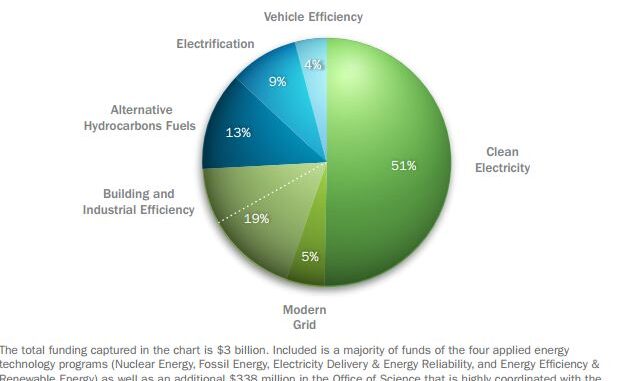
According to a major new study [Nature Climate Change 2, 780–788 (2012)] the EU, the U.S. and the major developing countries allocate two thirds of their public R&D budget to energy-supply technologies, but as was identified in a
recent review of US energy research and developmen [Department of Energy Quadrennial Technology Review (DOE, 2011)], there is a persistent under-investment in building, industrial and vehicle end-use efficiency compared with investment in clean electricity supply.
Directed innovation efforts (innovation targeted on a specific problem or need, in this case climate change mitigation) not only involve public R&D investments but the entire system of innovation for new energy technologies. This article assesses the balance between directed innovation efforts for energy supply and energy efficiency end-use technologies in response to the challenge of climate change mitigation.
The study finds that directed innovation efforts in energy technology have reinforced the dominance of the energy-supply industry over energy efficient end-use. It concludes that energy-efficiency in end-use is marginalized in directed innovation efforts. For example, since the late nineteenth century, for every dollar in US Federal subsidies to efficient end-use technologies, 35 dollars have gone to energy-supply technologies. As another example, since 1974 more public funding in developed countries have been invested into nuclear fusion than on all effcient end-use technologies combined.
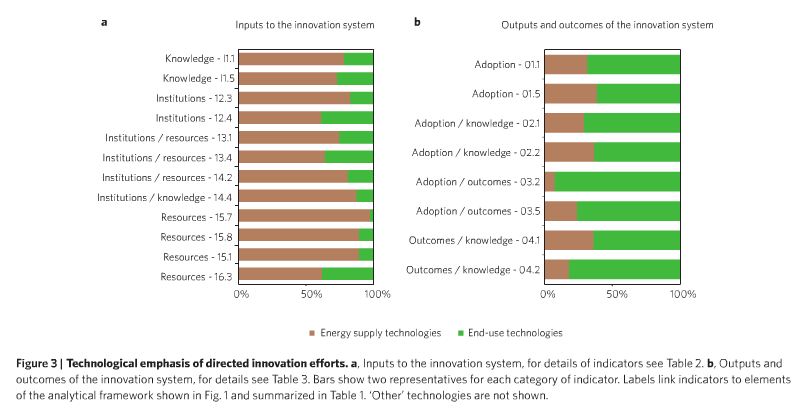 The analysis concludes that there is a pronounced and pervasive asymmetry in the innovation system for energy technologies. As a recent example [Galiana, I. & Green, C. Let the global technology race begin. Nature 462, 570–571 (2009)], proponents of R&D-led climate change mitigation identified six technology options that deserved R&D support. Of the six, five relate to energy supply.
The study also finds that directed innovation efforts are misaligned with their required outcomes. Inputs to the innovation systems fall into categories of analysis and
modelling; technology roadmaps, collaborations, portfolios
and programmes; public research, development and demonstration (RD&D) investments; and niche market investments. Outputs from the innovation system includes market
diffusion, learning and social returns on investment, and mitigation potentials of energy
technologies for climate stabilization. The study finds that whereas the outputs of innovation emphasize
the importance of efficient end-use technologies, inputs focus on energy-supply technologies. For example, the magnitude of the subsidies for fossil-fuel consumption is estimated at about $500 billion, much larger than the estimated $160 billion invested in a post-fossil-fuel energy supply. As another example, renewable electricity supply (wind and
solar PV) and smart grid technologies dominate public
support for R&D. Directed innovation efforts are focussed on energy-supply technologies to mitigate climate change in an aready heavily subsidized energy supply market, effectively marginalizing effcient end-use technologies.
The overall conclusion is
that directed innovation efforts are “strikingly misaligned” with the needs of an emissions-constrained world and that much greater R&D effort is needed to develop the full potential of efficient end-use technologies.

Be the first to comment