
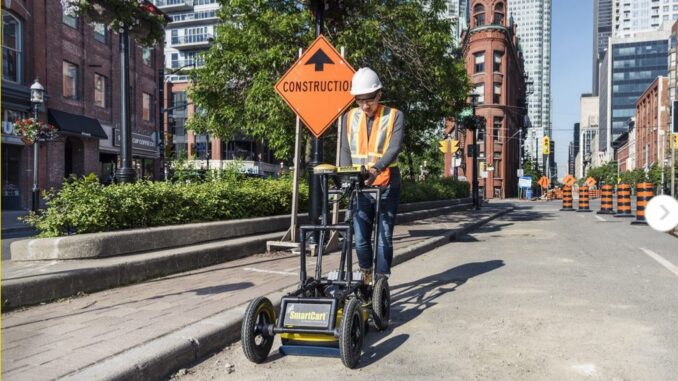
An important risk for virtually any construction project is unforeseen costs, delays and safety issues associated with unknown or poorly located underground utilities and other objects. Currently best practice for locating underground infrastructure in preparation for excavation is walking the site or right of way with electromagnetic wands (EMI) or ground penetrating radar (GPR) pushcarts. In their talk at the SPAR3D / AEC NEXT 2018 event in Anaheim, Michael Twohig and Brent Gelhar described a successful proof of concept in which a rig combining mobile laser scanning and GPR arrays collected data simultaneously above and below ground at roadway speeds of 80 to 90 kilometers per hour.
In the U.S. the number one cause of delays in highway construction projects are unknown or poorly located underground utilities. The current best practice of walking the right of way with an EMI wand or a GPR pushcart and spray painting the location of subsurface infrastructure is not only slow, but on roads with significant traffic it is dangerous for the locate equipment operator and disruptive of traffic.
Recently a major vendor, Leica Geosystems, acquired technology, IDS GeoRadar, that enables towable arrays of GPR sensors to be operated at speeds of up to five or six kilometers per hour. The technology includes hardware, cross polarized radar arrays, and software that assists the operator in tracking radar events across multiple scans. The GPR configuration has even been combined with mobile lase scanning (LiDAR) to capture 3D data above and below ground simultaneously. However, the slow speed is a major limitation that limits the usefulness of the towable array to times when traffic is slow or volumes low.
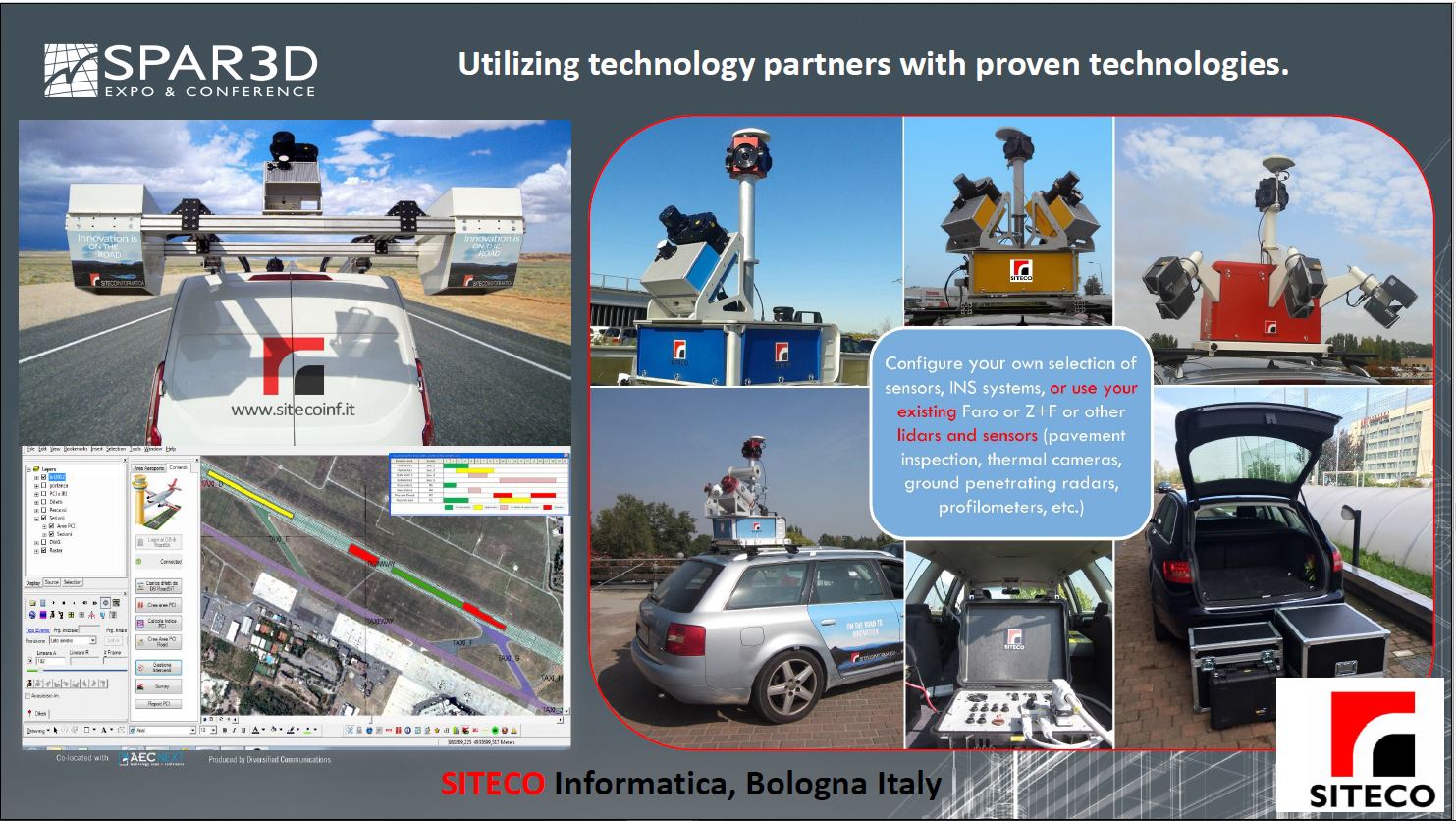 The experiment that Michael Twohig of DGT Associates and Brent Gelhar described involves three arrays of GPR sensor from Sensors and Software incorporated into a towable rig with a SITECO Road-Scanner mobile platform equipped with Faro mobile LiDAR sensors. On the rig the GPR arrays are positioned very close to the road surface. A key feature of the design of the rig is that it prevents damage to the arrays from road debris. Two of the GPR arrays operate at 2.0 GHz, which under the clay soil condition where the experiment was carried out allowed detection of underground infrastructure to a depth of one meter. The third array operated at one GHz with penetration to about two meters.
For the proof of concept the rig was towed 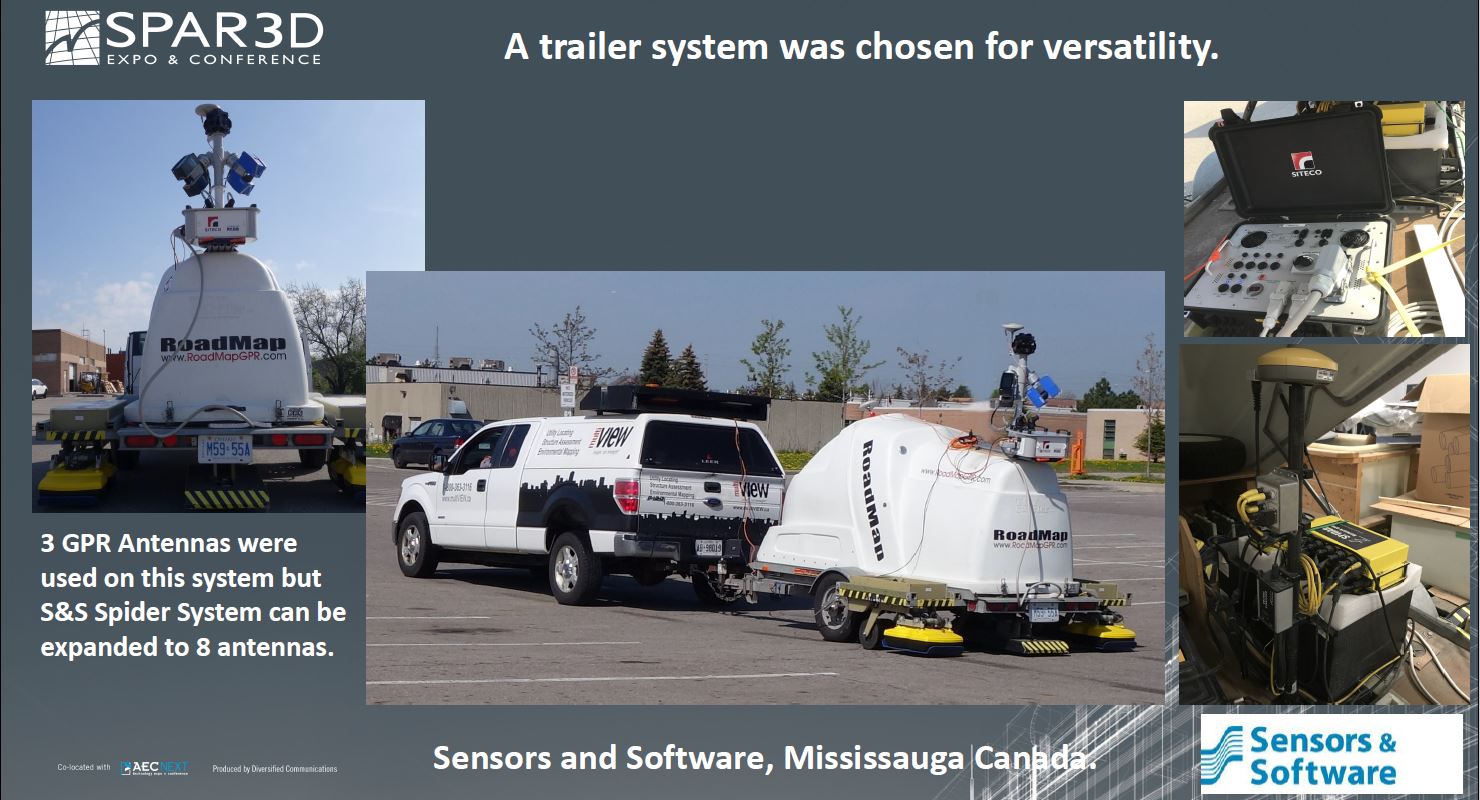 over a distance of 19 km at speeds averaging 80 to 90 km per hour to collect above and below data simultaneously. The practical advantage of being able to operate at this speed means data could be collected a lane at a time with no disruption to traffic and with no boots on the pavement. After the above ground LiDAR and below ground GPR data was collected, the large datasets were post-processed. The semi-automated processing of the GPR scans required six to eight hours. I would expect that having the above ground LiDAR scans would aid in locating below ground utilities, for example, in identifying above ground features that would help identify the type of underground utility. The deliverables are 3D CAD files with underground infrastructure located with an accuracy of 5 – 10 cm. The files are compatible with industry standard GIS software. The experiment was carried out in an area of Mississauga which has been surveyed frequently by Sensors and Software in testing their equipment and thus the location of underground infrastructure was well known.
This experiment and the experience of IDS GeoRadar is a significant step forward in detecting underground infrastructure. That this experiment was carried out under less than ideal soil conditions (clay) is even more encouraging. As Brent and Michael pointed out, this experiment used only three channels and it is technically feasible to expand the configuration to eight. However, the volume of data would be proportionately larger.
I concluded that the experiment showed that the hardware configuration was successful in collecting 3D data of above and below ground infrastructure at roadway speeds. It suggests also that the next challenge is enhancing the software post-processing to better automate the process to enable the handling of large data volumes.
Be the first to comment