
The American Society of Civil Engineers (ASCE) released a study Failure to Act, The Economic Impact of Current Investment Trands in Surface Transportation Infrastructure which assesses the impact of underinvestment in surface transportation infrastructure (highways and transit systems).
The ASCE intends to release four reports on the state of US infrastructure. In addition to this one, reports will be released on water and wastewater, energy transmission, and ports and airports. The ASCE previously released three widely discussed Reports Cards on the state of U.S. infrastructure in 2003, 2007 and 2009, which have motivated similar analyses of infrastructure in other countries.
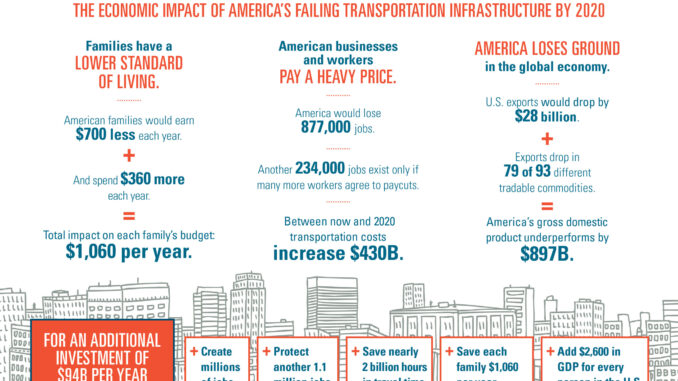
The study concludes that the deteriorating surface transportation infrastructure in the U.S. will cost the U.S. economy more than 876,000 jobs and subtract $897 billion from the Gross Domestic Product by 2020.
In 2010 underinvestment in roads, bridges, and transit systems cost American households and businesses roughly $130 billion,
- $97 billion in vehicle operating costs
- $32 billion in delays in travel time
- $1.2 billion in safety costs
- $590 million in environmental costs
The study also concluded that If investments in surface transportation infrastructure are not made soon, those costs will grow exponentially.
Higher transporation costs
By 2020 U.S. businesses will pay an added $430 billion in transportation costs because the raw materials they buy will cost more and it will cost more to ship goods.
Lower productivity reduced global competitiveness
Poor infrastructure will lower productivity causing businesses to underperform by $240 billion over the next decade, which will increase the prices of goods. U.S. exports will drop in many sectors, with a total impact of $28 billion. The sectors impacted include key technology sectors such as machinery and communications equipment.
Job losses
Almost 877,000 jobs would be lost by 2020, primarily in the high-value, knowledge-based service economy including professional, business and medical sectors.
Lower disposable incomes
Family income would decrease by $700 per each year as a result of increased transporation costs. Household expenditures would also increase by $30 per month because of the increased cost of goods. Each family would have to spend $360 more each year for a net impact on each family’s budget of $1060.
Impact of increased investment in surface transportation
The report estimates that in order to bring U.S. surface transportation infrastructure up to tolerable levels (corresponding to a “C” on the Report Card ), an investment of approximately $1.7 trillion between now and 2020 in highways and transit systems is required. This is commensurate with the total annual spend on all types of construction in the US (over $2 trillion).
Of that total about half or $877 billion has already been budgeted, so that the gap is about $846 billion over the next nine years, or $94 billion per year. The study observes that this is about 60% of what U.S. consumers spend annually on fast food. For this increased infrastructure investment the U.S. would
- Protect 1.1 million jobs
- Save Americans nearly 2 Billion hours in travel time each year
- Deliver an average of $1,060 to each family each year
- Protect $2600 of GDP for every man, woman and child in the U.S.
The ASCE sees the American Jobs Act which according to the ASCE proposes to invest $90 billion in U.S. infrastructure as a first step in the rigth direction.

Be the first to comment