
Intermittent renewable energy sources like solar PV and wind power are being used more and more worldwide, while the market share of conventional power stations is decreasing. Balancing intermiitent power sources and consumer demand becomes a serious challenge when intermittent represent more than 20-30 % of total demand. For example, distributed generation with many small sources of power feeding energy at medium and low voltage levels can reverse the load flows from lower to higher voltage levels. In addition the greater distances between where power is generated and consumed require increased transmission capacities.
All of these changes affect the provision of system services which balance supply and demand. For example, conventional power stations not only provide most of the balancing energy required in the system, but the inertia of their generators also guarantees the provision of instantaneous reserves for immediate frequency support. Other important system services include voltage maintenance, operation management and re-establishment of power supply.
Two world economies that are facing a situation in the near term where electric power from intermittent sources will exceed 20-30% of total generation are Germany and California.
Germany
The decision to shutdown its nuclear power plants in favour of renewable energy (and increased use of coal) is fundamentally changing the supply of energy in Germany. In the first six months of 2012 according to BDEW, Germany produced 67.9 billion kWh of renewable energy, about 25 % of Germany’s total power production.
To address the challenge of balancing generation and demand with increasing intermittent energy sources distributed over larger areas, the Deutsche Energie-Agentur GmbH (dena) – the German Energy Agency – has commissioned a study to be led by Prof. Dr.-Ing. Christian Rehtanz, Technical University Dortmund/ef.Ruhr to determine the scope of grid system services in the context of an increasing supply of intermittent energy. In particular, the study will look into the extent to which distribution grids can contribute to grid stability for the transmission grid, and the role renewable energy systems, storage facilities and demand-side management need to play to esnure grid stability and resilience. The results of the study are expected by the end of 2013.
California
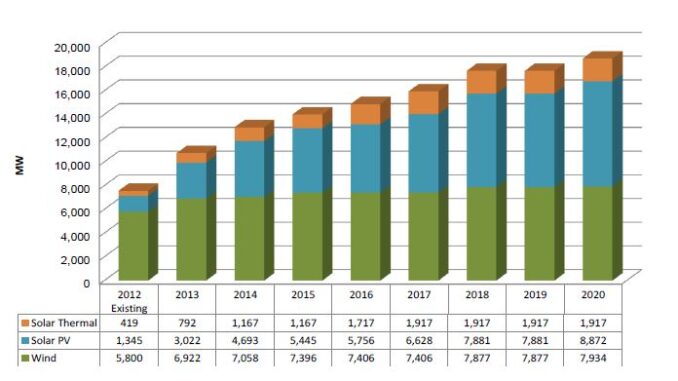
California has mandated a state renewable portfolio standard (RPS) of 33% by 2020 and most of this is intermittent. A recent joint report produced by: the North American Electric Reliability Corporation (NERC) and the California Independent System Operator Corporation (CaISO) addresses the challenge of integrating large quantities of intermittent energy sources also called variable energy resources (VERs), which in California is predominantly wind and solar photovoltaic (PV), into the North American bulk power system. California plans on adding an additional 11 GW of intermittent energy capacity by 2020, most of which are expected to be connected to the CAISO grid.
This requires significant changes to electricity system operations to ensure the continued reliability of the grid. The report focuses on issues that all system operators need to consider in order to integrate significant quantities of intermittent sources into the bulk power system. Because California will be facing this challenge in the next few years, the report identifies some of the measures that CAISO is undertaking including self-scheduling of resources, ramping capability, lower capacity factors for dispatchable generation, inertia and frequency response, active power control, and reactive power control.
For example, currently with centralized power plants meeting demand requires ramping up or down several GW over an extended period. Intermittent sources can increase the frequency and magnitiude and decrease the time in which raming or shedding needs to be completed.
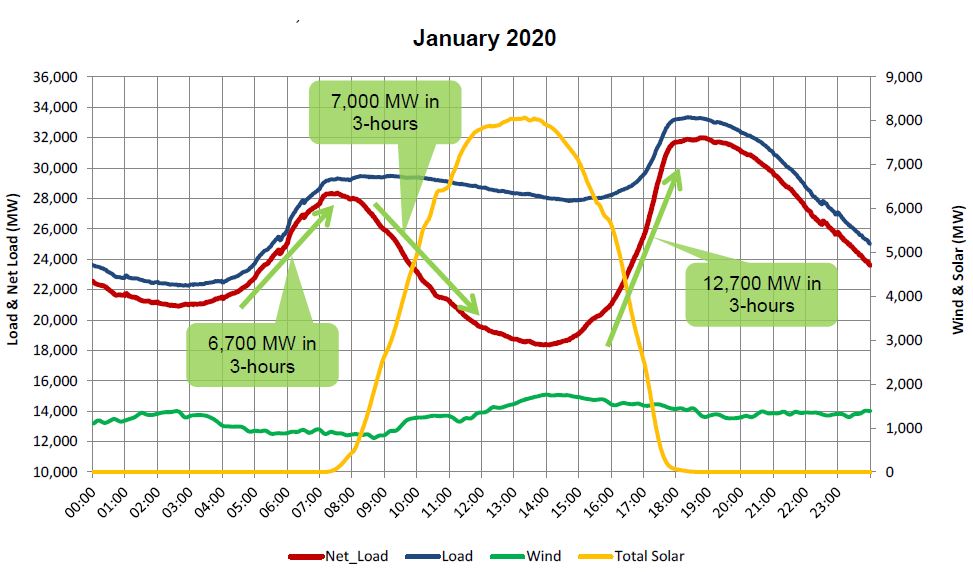
System operators must rely on ramping capability to balance the less predictable energy production patterns of VERs like wind and solar resources. This requires dispatching flexible resources at higher loads. The alternative is when generation exceeds demand and resources need to be ramped down.
The typical CAISO load (blue curve) has ramps that are relatively small and of long duration. However, with more renewable resources, whose maxima do not correspond with system load maxima, the net load (red curve) is the trajectory conventional ramping resources would have to follow. It is a series of ramps of significant magnitude and shorter duration including one up to 13 GW in three hours. Also CAISO may have to cycle resources on and off more frequently which adds to maintenace costs.
As this report points out, CAISO projects current ramping capacity is inadequate and that more flexibility (rapidly dispatchable capacity) will be needed to reliably meet net load and provide nearly 13 GW of continuous up-ramping capability within a three-hour time period. In the California market this means more gas fired turbines. It is estimated that an additional 6.4 GW of new natural gas capacity will be required by 2020.
Be the first to comment