
One of the things I particularly like about Air Canada is the movie/video content because you can find things that you might not otherwise come across. Last Sunday coming back from the UK, I was lucky to find two engrossing documentaries about electric vehicles.
The first was “Who Killed the Electric Car ?” which is the intriguing history of General Motors’ EV1, every instance of which GM ultimately tracked down and destroyed, except for one EV1 in a museum, and even than one GM insisted on disabling. In answer to the question in the title, the film concluded that the American consumer, the automobile manufactureres, and the oil companies were all partially to blame.
The second documentary “The Revenge of the Electric Car” oultined the history of Tesla Motors, the Chevy Volt, and the Nissan Leaf. The claimed range of the Tesla Roadster is 245 miles, the Leaf 100 miles, and the Volt 40 miles (using the electric motor only).
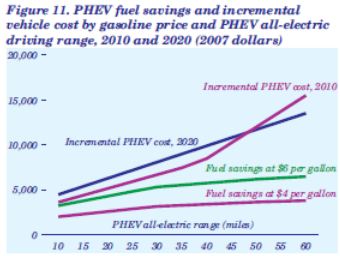
In its 2009 asessment the Energy Information Administration (EIA) identified several key issues that will determine when and if widespread adoption of the electric vehicle occurs
- “A typical consumer may be willing to purchase a PHEV instead of a conventional ICE vehicle when the economic benefit of reduced fuel expenditures is greater than the total incremental cost of the PHEV.
- “PHEVs also face uncertainty with respect to Li-Ion battery life and safety. Future advances in Li-Ion battery technology could address economic, lifetime, and safety concerns, paving the way for large-scale sales and significant penetration of PHEVs into the U.S. LDV fleet. For example, a technological breakthrough could conceivably allow for smaller batteries with the same capacity and power output, thus lowering incremental costs and making PHEVs attractive on a cost-benefit basis.
- “PHEVs could significantly reduce GHG emissions in the transportation sector, depending on the fuels used to produce electricity.
- “PHEVs use less gasoline than conventional ICE vehicles. If PHEVs displaced conventional ICE vehicles, U.S. petroleum imports could be reduced.”
According to a recent report from Pike Research, “hybrid electric vehicles (HEVs) and plug-in electric vehicles (PEVs) combined will represent 3.1% of worldwide auto sales by 2017. Thanks to higher penetration rates in the United States, HEVs and PEVs will account for 5.1% of total U.S. vehicle sales in 2017.”
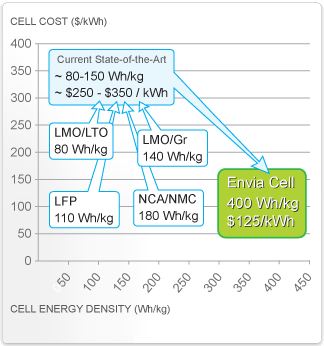 Related to EIA Item 2, at the ARPA-E Energy Innovation Summit, it was reported that independent testing has verified that a new Envia lithium-ion battery achieves 400 Wh/kg compared to 80-150 Wh/kg for current state-of-the-art batteries. It is claimed that the Envia battery would extend the range of a 100 mile EV to 300 miles which based on the EIA’s assessment could significantly change the cost-benefit picture of EVs.

Be the first to comment