
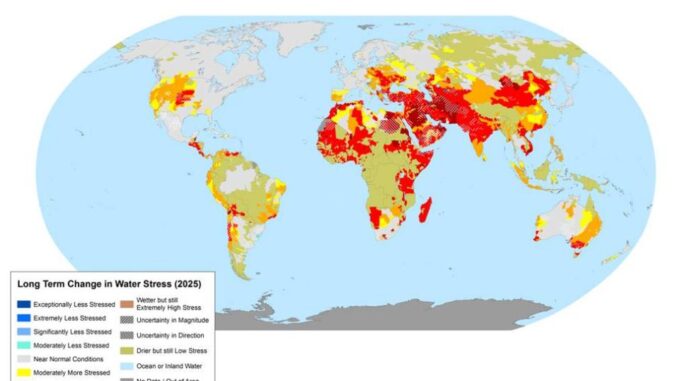
The Aqueduct project is an effort to measure and map water related risks being developed by the World Resources Institute with the support of an alliance founded by General Electric and Goldman Sachs.
Recently Aqueduct asked its hydrological modeling partner ISciences and experts from The Coca-Cola Company to develop and analyze a set of maps that illustrate the complex relationships between water, food, and energy worldwide.
Agriculture and power generation account for the majority of water withdrawals in most developed countries. In the United States 34% of water withdrawn is used for agriculture and about 48% for power generation.
The Food and Agriculture Organization recently estimated that feeding a global population of 9 billion people in 2050 will require a 70% increase in total food production. The World Energy Council has estimated that energy supplies must double by 2050 to meet the energy demand of all households worldwide.
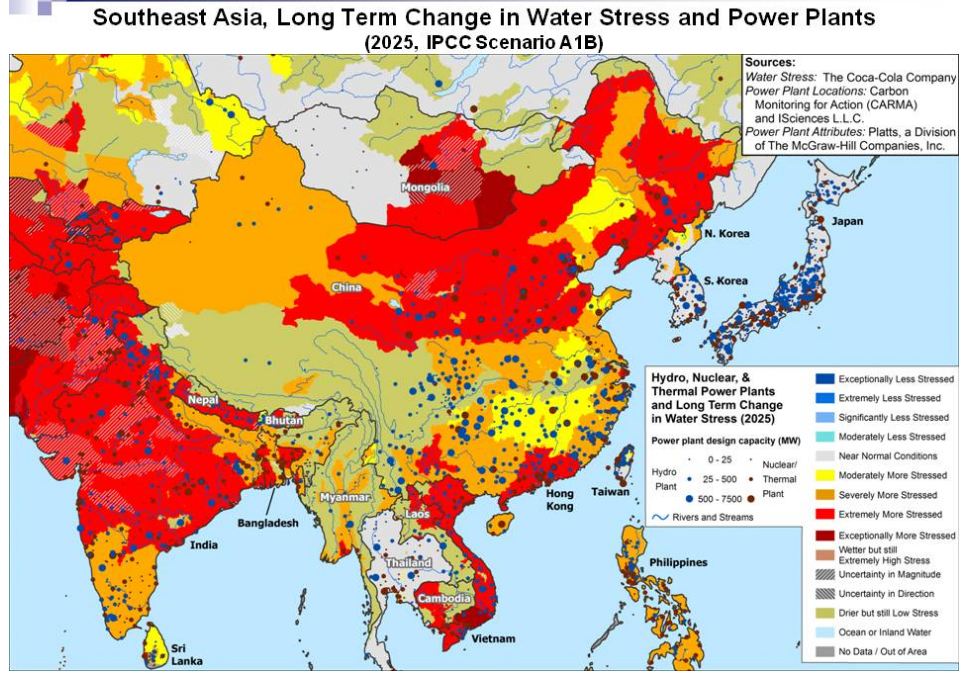 The Coca Cola Company, the World Resources Institute and ISciences L.L.C. overlaid the locations of existing thermal, nuclear, and hydro power plants worldwide on baseline water stress maps for the year 2000. They also created maps showing potential changes in water stress under a variety of climate change scenarios developed by the IPCC through 2025.
Water stress and power generation in 2025
The maps show that 17% of global power plant design capacity on the ground today is located in areas of “medium-high”, “high”, or “extremely high” baseline water stress. By 2025, 29% of today’s global power plant design capacity will see water stress conditions grow “significantly worse”, “extremely worse”, or “exceptionally worse”.
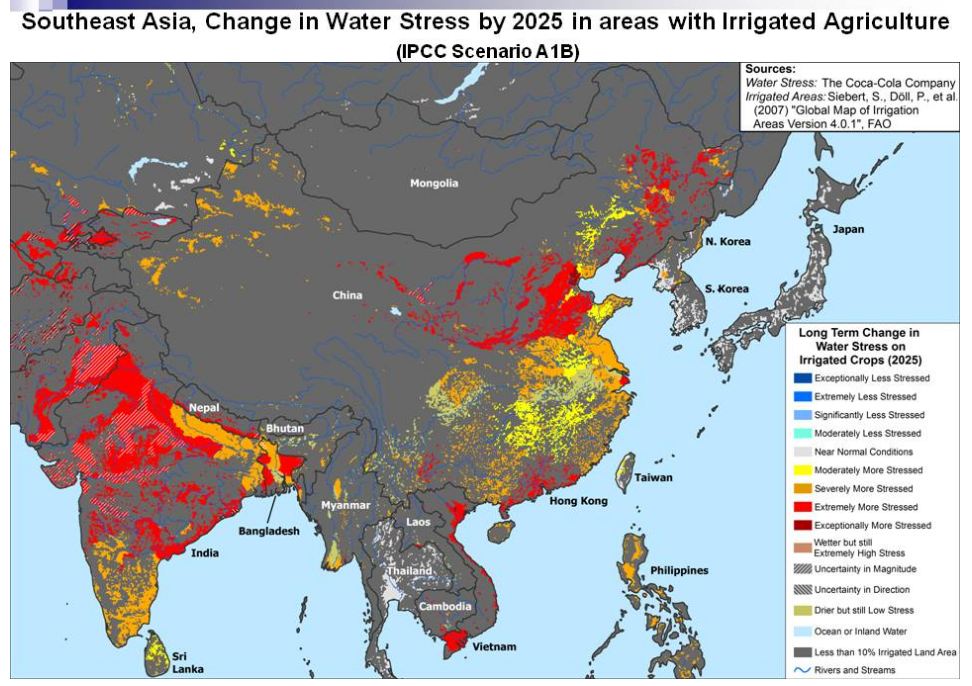 Water stress and food production in 2025
The World Resources Institute and its partners have also created maps overlaying the locations of irrigated crops worldwide onto the same baseline and projected water stress maps in 2025. About 18.5% of total global cultivated crops are irrigated. The maps show that around the year 2000, 40% of global irrigated crops were located in areas of “medium-high”, “high”, or “extremely high” water stress. By 2025, 73% of global irrigated crops could see water stress conditions grow “significantly worse”, “extremely worse”, or “exceptionally worse”.

Be the first to comment