
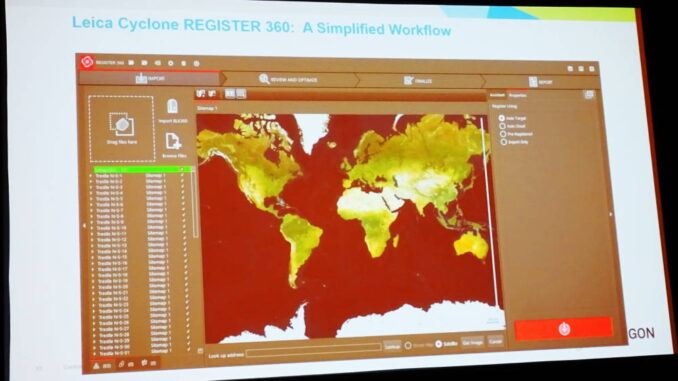
I have already blogged about the Leica BLK360 whose size, capabilities, one button operation and price point promise to revolutionize professional scanning for construction. Anyone who has used a Leica scanner is familiar with Cyclone software and, in particular, with Cyclone Register which is used to register point clouds when carrying out scanning at construction sites. Professional surveyors who have been using Leica P30/P40 and other scanners have learned to navigate the complex Cyclone Register workflow. But what about the people for whom the BLK360 with its one button operation is opening the door to scanning for the first time ? Having to learn Cyclone Register could be a frustrating and potentially showstopping experience.
This is where Cyclone Register 360 comes in. At HxGNLive this morning Greg Walsh, who leads the software design group that developed Register 360, presented an overview of the the thinking, design objectives and implementation behind Register 360, which is just as important as the hardware in BLK360 in revolutionizing the professional use of laser scanning in construction.
Greg described a completely new way to register point clouds from many scans, relate scans to each other, optimize, generate deliverables and report estimated errors for scans involving multiple BLK360s deployed on different floors and in different areas of a construction project. To do this simplified workflow requires new terminology. This will make things easier for people new to laser scanning, but will require learning a new perspective for people with scanning experience. Register 360 is not intended to replace Cyclone Register, so folks who are familiar with the traditional Register can continue to use it.
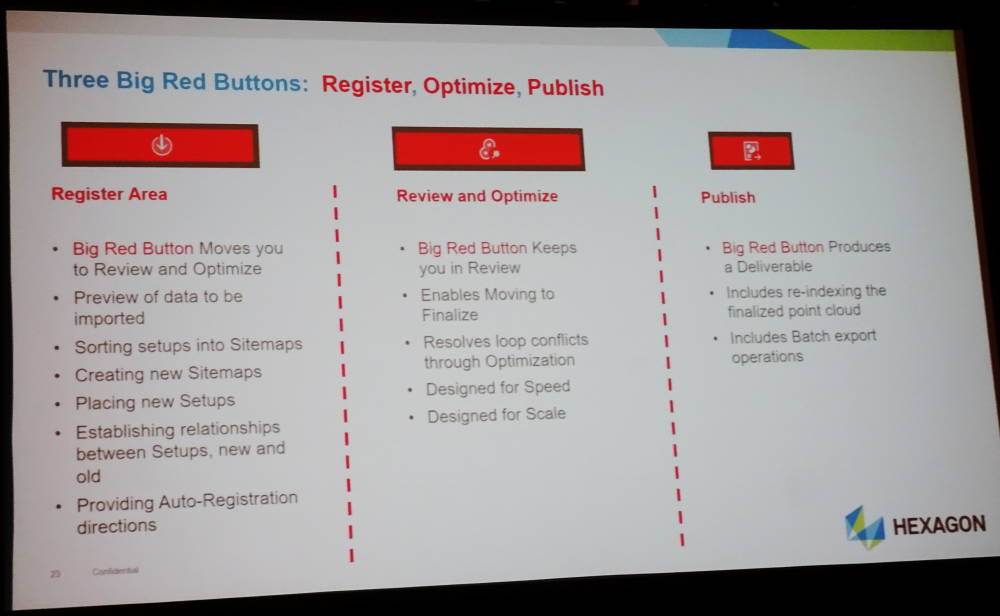 For professionals for whom the BLK360 is their first scanning experience, Register 360 is intended to dramatically simplify the registration experience even for scans of large complex construction sites. Three “big red buttons” analogous to the single button on the BLK360 should enable anyone to register scans, optimize and create finished scans for visualization and analysis using other products such as Revit, TruView and Jetstream. Underneath the covers there is heavy-duty processing going on – we are dealing with billions of points after all, but the software is designed to do the heavy-lifting while you are doing other things such as getting coffee.
Currently Register 360 is intended for terrestrial scanning using BLK360s on tripods. But it is planned to extend it to mobile and other types of laser scanning. For those people who read manuals it comes with a tutorial, but the implication of three red buttons is that the tutorial is optional. The BLK360 is not a consumer device, but with Register 360 it should dramatically extend the professional user community beyond surveyors.

Be the first to comment