
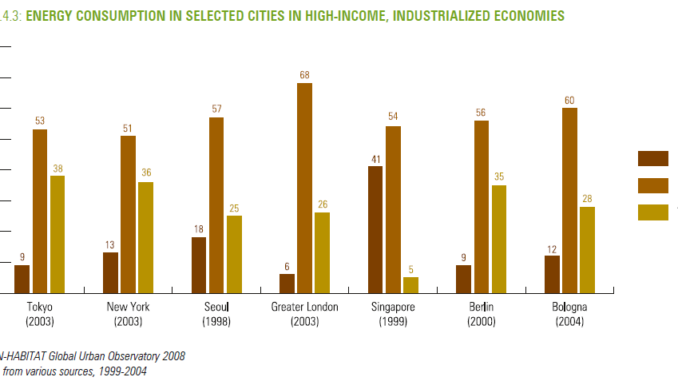
According to the OECD, over half of the world’s population lives in urban areas and
this share is projected to reach 60% by 2030.
Cities consume between 60 and 80% of energy
production worldwide and account for an equivalent share of
global greenhouse gas (GHG) emissions. In OECD cities GHG emissions are
increasingly driven less by industrial activities and more by the energy
services required for buildings (lighting, heating and cooling, electronics use) and transportation.
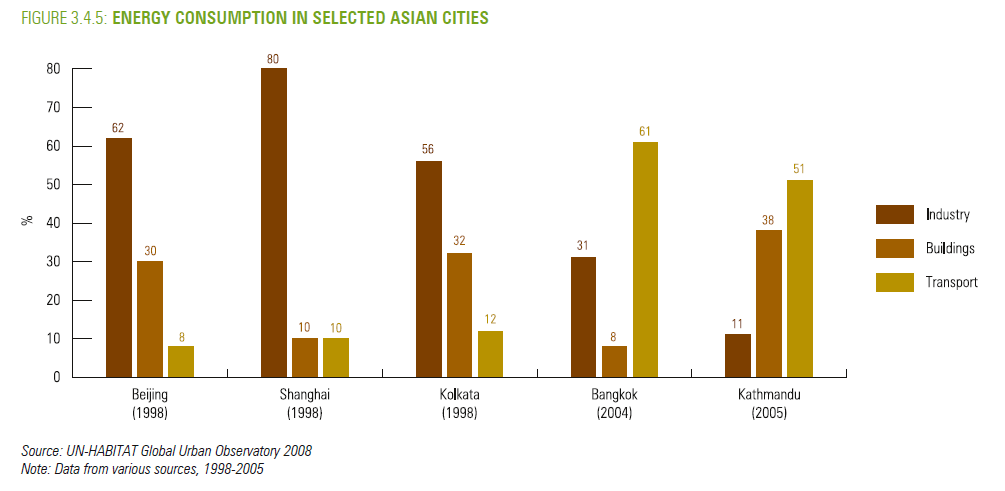 In China in contrast, industry still plays a major role in Chinese
cities’ GHG emissions.
China’s carbon intensity reduction goals
In 2009, China announced that it will cut its carbon intensity – greenhouse gas (GHG) emissions per unit of gross domestic product (GDP) – by 40 to 45 percent below 2005 levels by 2020. China’s Twelfth Five-Year Plan set a goal to reduce the country’s carbon intensity by 17 % by 2015. Municipalities and provinces have been assigned a significant level of responsibility for achieving portions of this target.
China’s national carbon intensity target is being assigned to provinces and then to cities. Already in November 2009, several cities began to develop low carbon action plans in line with the announced national goals.
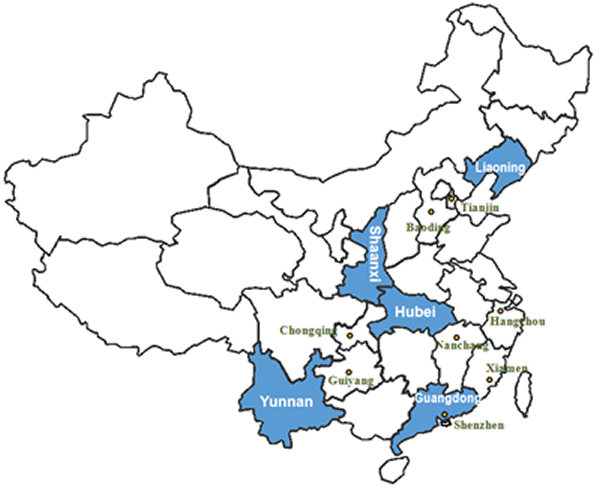 The National Pilot Program on Low-Carbon Provinces and Cities by the National Development and Reform Commission (NDRC) was launched in July 2010 and selected five provinces (Guangdong, Liaoning, Hubei, Shaanxi and Yunnan) and eight cities (Tianjin, Chongqing, Shenzhen, Xiamen, Hangzhou, Nanchang, Guiyang and Baoding) to participate in the pilot program. In particular the cities were directed to establish a statistics and information management system for GHG emissions and to take measures to reduce GHG emissions.
The areas were chosen to be geographically and economically diverse, so that what is learned from the pilot will be applicable to the country as a whole.
Challenges facing municipalities in low carbon planning
These most serious challenges facing municipalities in planning to meet national low carbon goals are how low-carbon city planning realted to other municipal planning processes, how to measure and report greenhouse gas (GHG) emissions at a city level, and how to account for GHG emissions from imported electricity, power that is generated outside the municipalities.
City-level GHG inventories are the foundation for municipal low-carbon planning processes, but these are missing from most current low-carbon development plans in Chinese cities. While city-level GHG accounting methodologies have been developed by ICLEI, these have been found to be difficult to apply in China.
Most Chinese cities get their electricity from generation plants outside municipal boundaries, and most municipal low-carbon plans have so far failed to account for these indirect GHG emissions. The proportion of a city’s emissions due to imported power is typically significant. A GHG inventory In Guiyang found that GHG emissions from imported power were responsible for over a quarter of Guiyang’s total emissions in 2009. If muncipal GHG accounting does not include emissions from externally generated power generation, local governments will not be incented to include electricity efficiency in their low carbon plans.
In additon there are several challenges that are unique to China because of the difference between Chinese and Western cities and because China’s goal is carbon intensity reduction, as opposed to emissions reduction.
While Western cities typically set an absolute emissions reduction target, most Chinese cities represent rapidly developing economies that need to maintain high economic growth rates. Chinese cities have to look at energy intensity, emissions per unity of GDP. For example, moving to higher value industry that may produce the same level or even a higher level of emissions, may be a wise energy intensity reduction strategy for a city.
As mentioned above, Chinese cities’ emission reduction efforts over the next several years will focus on industry, due to the high proportion of GHG emissions from the industrial sector, whereas in Western cities the focus tends to be on buildings.
Another major challenge is that China’s current statistical system focuses only on industrial energy use, and data on the other GHG sources, transportation and building sectors, are not readily available. Setting specific emission reduction goals for these sectors in China is harder than in Western cities.
Standardized carbon accounting and reporting
In China the lack of a standards for carbon acccounting and reporting makes it difficult to compare carbon accounts between cities. Apparently some of China’s municipal low-carbon plans have adopted the IPCC inventory methodology, which was designed for entire countries, while others have employed foreign methodologies that may not be appropriate for Chinese cities. To address this challenge the Program of Energy and Climate Economics (PECE) at Renmin University in China has developed a simplified city level energy-related CO2 inventory methodology which is suitable for Chinese cities. The PECE analytical tools have already been deployed in Guiyang, Qingdao, and other Chinese cities.
The PECE approach to estimating city-level Greenhouse Gas (GHG) accounting is a simplified city-level GHG accounting methodology to calculate energy-related CO2 emissions that takes into account the data availability and statistical capabilities of Chinese cities. It involves four steps and includes estimating GHG emissions for imported electric power. The end result is a city -specific GHG inventory of total CO2 emissions, as well as sector-specific and technology-specific CO2 emissions.
Cost and benefot analysis for low carbin policies
PECE has also adapted the Long-range Energy Alternatives Planning System (LEAP) to make it suitable for municipal low-carbon scenario analysis in China. The model is designed to simulate a city-level energy system. It estmates the energy demand and CO2 emissions of a city as well as the emissions reduction potential of different technical solutions under different assumptions of population, economic growth, economic structure, and energy services demand.
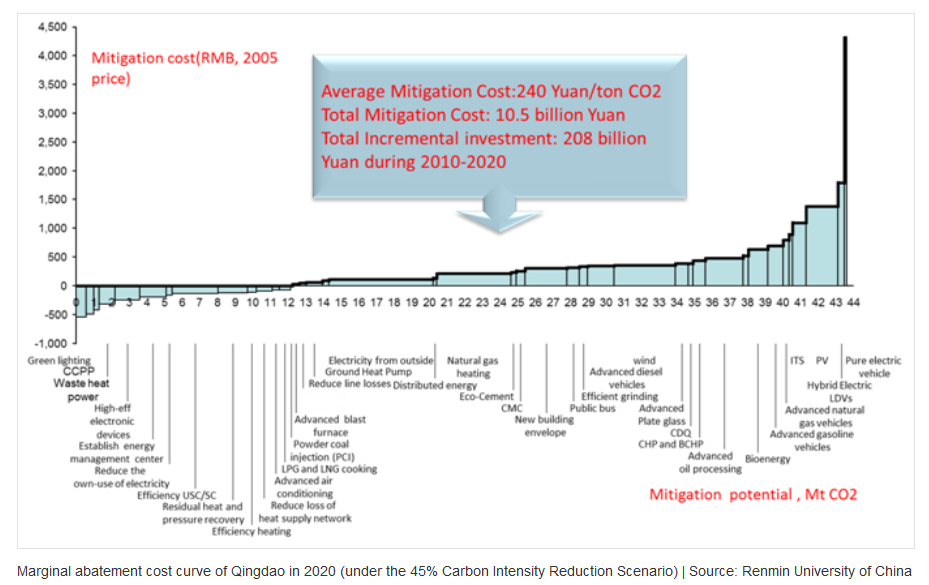 Prioritizing carbon-reduction options
To assist with the development of technology roadmaps, and to promote new technology in municipal low-carbon development planning, PECE has also developed a method for low-carbon technology identification and prioritization called the marginal abatement cost curve (MAC). GHG reduction potentials and mitigation costs are estimated using the LEAP model. From this data, the MAC curve can be used to prioritize technologies according to net costs or benefits.
Taken together the PECE tools are intended to provide Chinese municipalities with a practical, standardized way for city-level carbon accounting and reporting, estimating the costs and benefits of alternative low carbon policies, and prioritizing mitigation measures.

Be the first to comment