
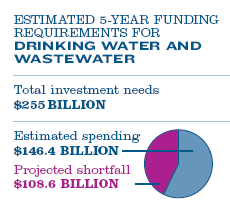
Last week at the GIS in the Rockies annual conference in Denver Elthron Anderson of Southgate Water and Saniation Districts gave a very insightful presentation on the evolution of asset management at a small water and wastewater utility. To set the stage and convey the urgency of what he was gong to present, the first question that Elthron asked the audience is how many of you are aware that there is a crisis with our water/wastewater infrastructure. If you are not aware that there is a crisis, a good place to start to get a feel for it is the ASCE’s Report Card on American Infrastructure, which assigns a grade of D- to America’s drinking water and wastewater infrastructure.
Southgate has followed a fairly typical path for a small utility in the evolution of its ability to manage its assets. Prior to 2007, asset records were in the form of AutoCAD drawings. In 2007-2008 Southgate implemented a GIS to manage asset records and had to deal with CAD/GIS integration issues. In 2009 they implemented a Computer Maintenance Management System (CMMS) and a CCTV pipeline inspection system. In 2010 they installed a flow monitoring system. By 2011 they had many operational systems that were generating a lot of data about their assets.
Prioritizing capital spending
At this point the public utilities board posed a fundamental question, how can we use this information to prioritize spending on infrastructure. It was at this point that Southgate began the development process that resulted in what they refer to as their Infrastructure Optimization (IO) tool, which is designed to help engineers and operators prioritize short and long term captial investment in their infrastucture. It is GIS-based and provides a onfigurable framework for asset
risk assessment and mana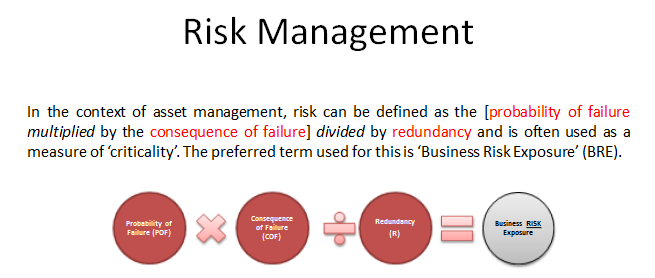 gement. A key financial foundation is baseline replacement costs, which provides an estimated value (replacement cost) for all of their assets. With this tool Southgate is able to perform scenario
based planning for both renewal (replacement) and maintenance.
Business risk exposure
Risk or Business Risk Exposure (BRE) is computed from three factors, probability of failure (POF), consequence of failure (COF), and redundancy.
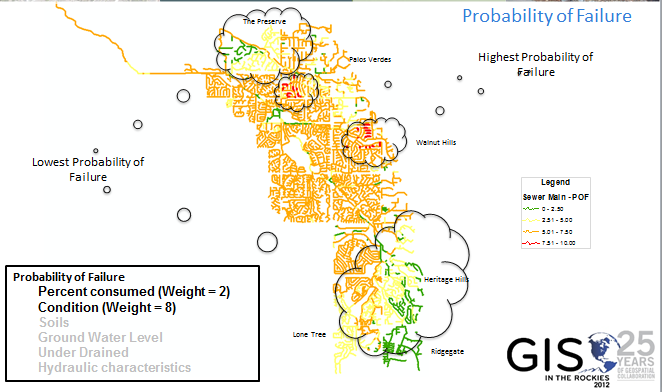 The probabliliy of failure can be estimated from factors such age, condition, operational
/ maintenance history (breakage, leakage, defects), physical
Location (associated soil characteristics, climatic conditions, proximity to
construction activity), and asset
reliability and performance information.
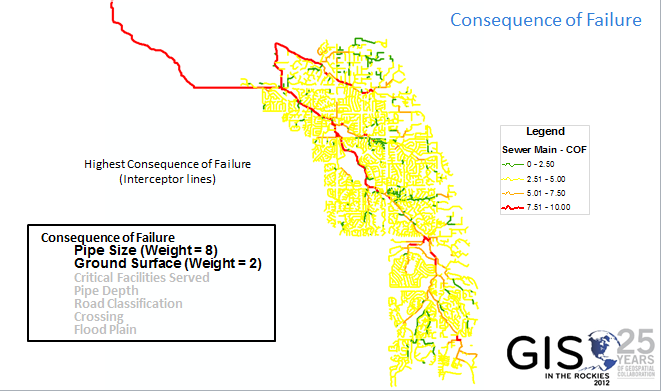 The consequence of failure is estimated from factors such as accessibility to repair, environmental Impacts, critical facilities served such as hospitals, proximity to structures (roads/buildings/lakes/creeks), cost, health and safety concerns, and regulatory Impacts.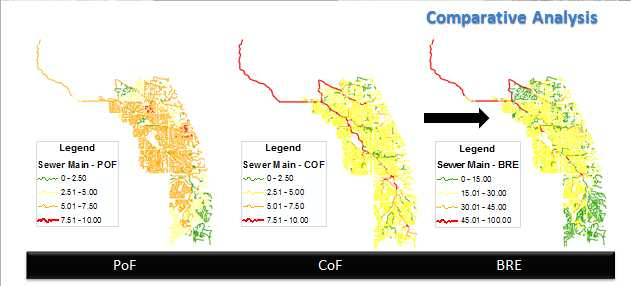
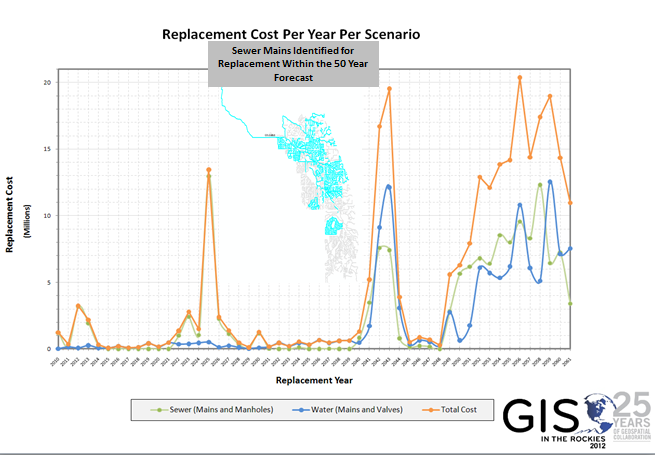 Southgate has done this for 50 years into the future. This allows them to estimate the impact of gaps in current maintenance and capital replacement budgets on future spending.
Be the first to comment