
The global urban population is growing by 65 million annually. More than
half of the world’s population is already living in cities, and these cities generate
more than 80 percent of global GDP. It is expected that urbanization will continue to be one of the biggest drivers of global economic growth. The productivity improvement from urbanization has already delivered substantial economic growth and helped radically reduce poverty in countries such as China and Brazil.
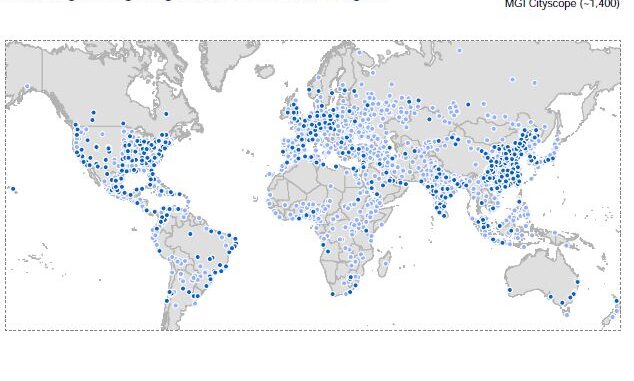
The McKinsey Global Institute (MGI) in a report Urban world:Mapping the economic power of cities (also summarized in Foreign Affairs) has projected the growth of urbanization demographically and economically over the next 15 years. The report is based on a number of assumptions that together represent a possible future scenaio and relies on MGI’s Cityscope database of more than 2,000 cities that coalesces MGI regional research on cities. Together, the 2000 cities of the MGI Cityscope are projected to contribute 75 percent of global GDP growth to 2025.
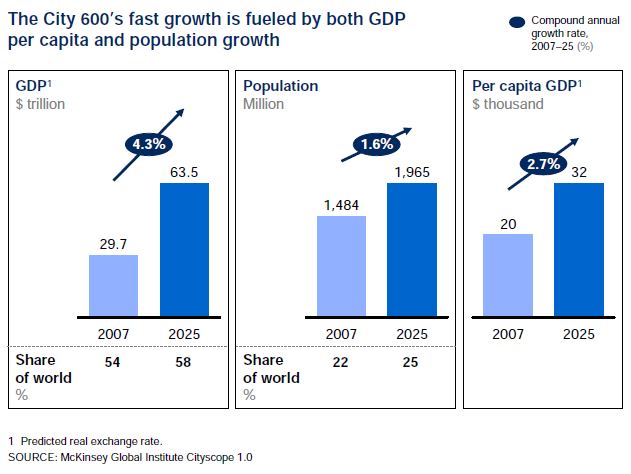 MGI projects that 600 urban agglomerations, representing a fifth of the world’s population, will generate 60 percent of global GDP in 2025.
In this report MGI projects one scenario of how cities will evolve demographically and economically over the next 15 years. There are some surprising conclusions that may change government and companies strategies in how they investment in markets in the future.
Regional distribution
Top cities in 2025 by:
pop gdp gdp_growth
- Tokyo New York Shanghai
- Mumbai Tokyo Beijing
- Shanghai Shanghai New York
- Beijing London Tianjin
- Delhi Beijing Chongqing
- Kolkata Los Angeles Shenzhen
- Dhaka Paris Guangzhou
- Sao Paulo Chicago Nanjing
- Mexico City Rhein-Ruhr Hangzhou
- New York Shenzhen Chengdu
Over the next 15 years, the regional distribution of the top 600 cities will cha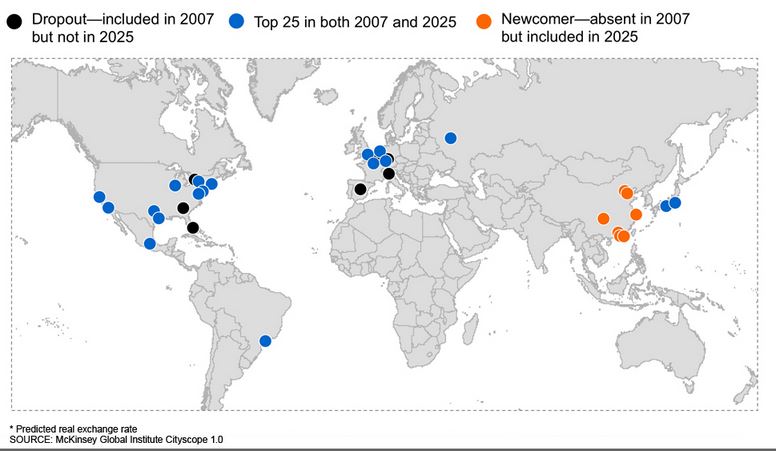 nge. One third of developed cities (developed regions comprise the United States and Canada, Western Europe, Australasia, Japan, and South Korea) will no longer be among the top 600. By 2025, 136 new cities are projeted to enter the top 600, all of them from the developing world. 100 of them are projected to come from from China alone. India is projected to contribute 13 new cities in the top 600 by 2025 and eight will come from Latin America.
Distribution by size
In 2007 developed economies and emerging market megacities (developing cities with populations greater rhan 10 million) together represent 74 % of global GDP in 2007. But according to MGI megacities have not benn driving global growth for the past 15 years and this trend is projected to continue. MGI projects that today’s 23 megacities will cotnribute only about 10% of global growth to 2025.
The economic role of large cities varies among regions. China’s rapid growth de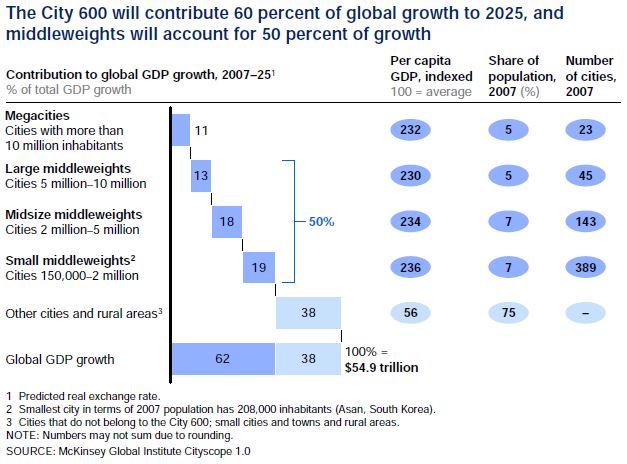 pends on the growth of its megacities and the emergence of new ones. According to MGI India’s urbanization is at a relatively early stage, while in Latin America rapidly growing middleweight cities are contributing more to GDP growth than its largest cities.
MGI projects that 407 emerging market middleweight cities will deliver nearly 40 percent of global growth by 2025, more than the aggregated developed world and emerging market megacities. Of these 13 middleweight cities (Chicao + 12 in emerging markets primarily China) are projected to become megacities by 2025.
Age distribution
MGI project that the 423 cities from developing regions will contribute almost 80 percent of growth in the 65-plus age group in the City 600 over the next 15 years.
Conclusion
MGI’s research suggests that to find opportunities we need shift focus from economies as a whole to cities within them, and from megacities to the rapidly groing middleweights, particularly in emerging markets.
In a nutshell in 2007
- 1.5 billion people live in these 600 cities—22 percent of global population
- They generated $30 trillion of GDP in 2007, more than half of global GDP
- They support 485 million households with average per capita GDP above $20,000
- Of these the top 100 cities generated $21 trillion of GDP in 2007 – 38 % of the global total.
In 2025 according to MGI’s projection
- 2.0 billion people will live in these 600 cities – 25% of the global population
- They will generate $64 trillion of GDP, 60% of global GDP
- They will support 735 million households with average per capita GDP of $32,000, of which 235 million households in developing cities will have income above $20,000 per annum.
Be the first to comment