
In 2007 I listened to an exceptional presentation at a Spatial Sciences Institute Biennial International Conference in Hobart, Tasmania given by Tim Barker and Neale Hooper, of the Queensland Treasury, part of the government of the State of Queensland. The effort within the Queensland government was motivated by the finding of an internal review that within the government licensing is non standard, there are inter-jurisdictional problems, and in many cases it is easier to get geospatial data by buying it from the private sector than to work through the licensing issues to get it from another government agency. What was recommended in Queensland is that all government spatial data would be available under Creative Commons (CC) licenses.
Since that time crowdsourced geospatial landbase data has become competitive in parts of the world with government or commercial geospatial data. The best known crowdsourced data source is OpenStreetMap. Until April 2012 OpenStreetMap data was licenced under Creative Commons (CC-BY-SA 2.0) licensing. But some aspects of the CC license are limiting when used with geospatial data. The two major issues with CC licensing are collective work and that in some jurisdictions geospatial data is not copyrightable. A new license, called the Open Database License (ODbL) has been developed that is specfically tailored for geospatial data. As of April 1st, 2012, all OpenStreetMap data uses the new license. The ODbL license is comprised of an Open Database License (ODbL), a Database Contents License (DbCL) covering the database itself and its contents, and a set of upgraded Contributor Terms covering submissions to the database.
Earlier this week I attended a workshop at the GSDI 13 conference in Quebec City given by the GSDI Legal and Economic Working group, Bastiaan van Loenen and Katleen Janssen (and Graham Vowles who was not able to make the trip to Quebec), specifically aimed at developing a global licensing framework for geospatial data. The objective is to harmonize existing licensing without changing fundamental access policies and funding models and compatible with the diferences in national legal systems. The roadmap for the working group is
- Review existing licensing frameworks.
- Determine the common elements.
- Conduct a workshop to reach preliminary agreement on a limited number of license terms and conditions that might be applied at a global level.
- Draft a licensing framework.
 Review of existing licenses
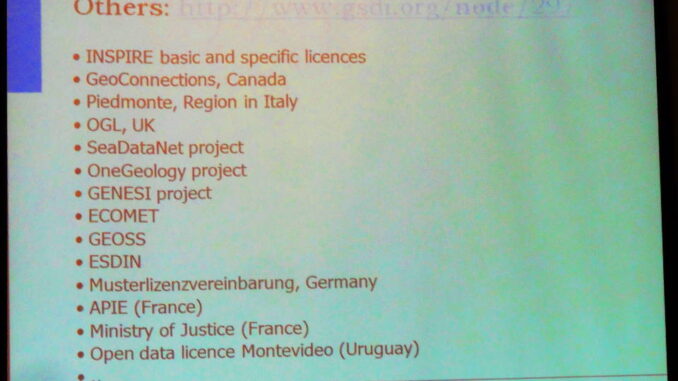
The working group has conducted an extensive review of existing licenses including efforts to standardize licensing of geospatial data such as Geo Shared in the Netherlands, Musterlizenzvereinbarung in Germany, GILF in Queensland, GeoConnections in Canada, and others.
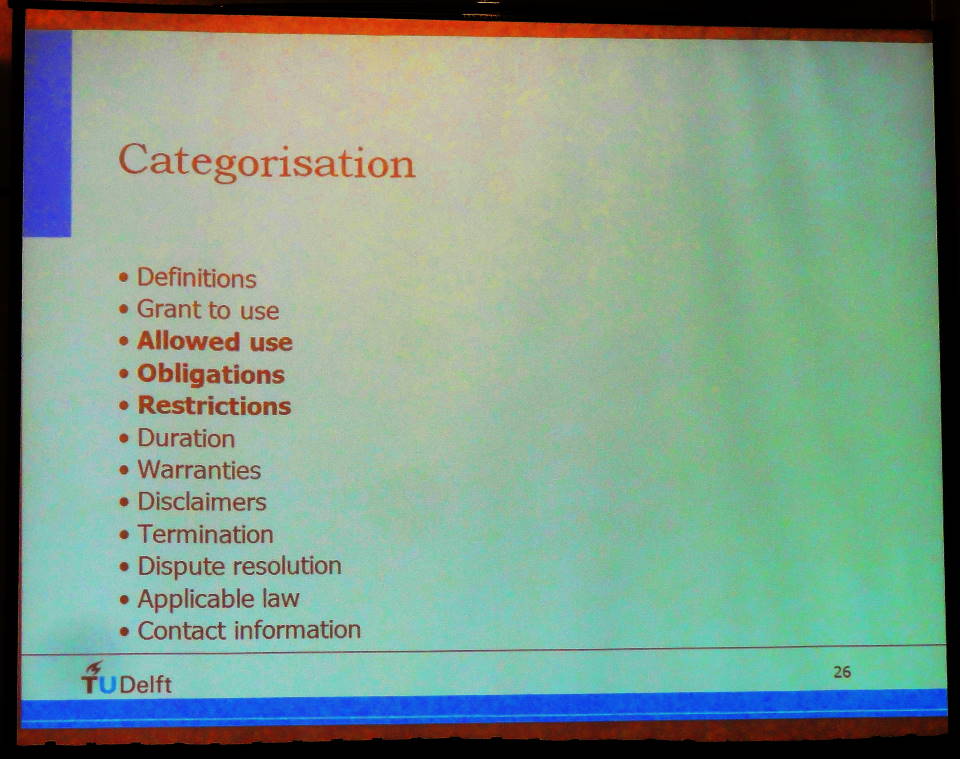
They have found a wide variety of geospatial data licenses which they have organized by category, the most important of which are allowed use, use restrictions, and user obligations.
Allowed use includes things like
- Accessing
- Viewing
- Downloading
- Copying
- Distributing
- Derivative works
- Commercial reuse
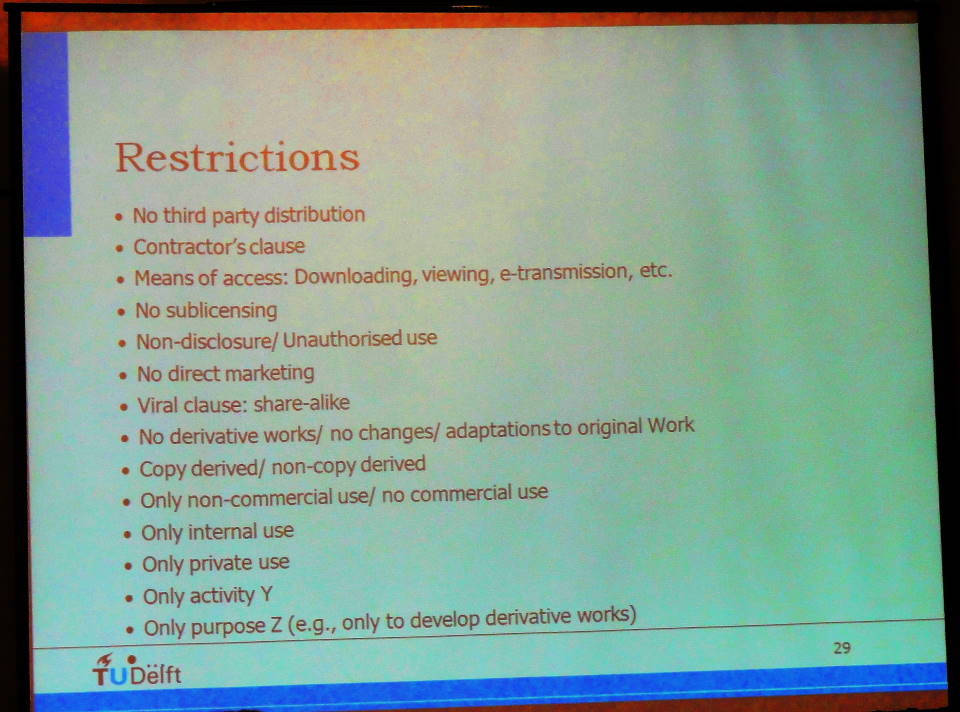 Use restrictions include
- No third party distribution
- No sublicensing
- No direct marketing
- Viral clause: share-alike requirement
- No disclosure th third parties
- Only internal use
- No derivative works
- No changes or adaptations of original data
- Limitation on number of copies, number of views, number of users
- Use restricted to a particular activity
- Use restricted to a particular user group
User obligations include
- No misuse of the data or misrepresentation of the data provider
- No use of any identifiers/trademarks of the data provider
- Attribution
- Obligatory notification of misuse of the data and infringements of the license
- Obligatory reporting of errors in that data
GSDI workshop
The organizers asked the group to discuss which of these should be included in a global licencing framework and which discarded. The ensuing discussion, which was very animated, ranged from those that felt that the U.S. “public domain” model which essentially places no, outside of trademark, restrictions on the reuse of government geospatial data, to those that felt that data should not be free of charge and should have licensing restrictions to prevent it being misused, as countries such as Indonesia and Malaysia are now embodying in legislation. In assessing alternative licensing schemes, there are two important criteria that need to be considered, how is data collection paid for and the economic benefit that flows from opening/restricting access to the data, within the government and to the public.
The next step for the Working Group is, based on the work to date and the GSDI workshop, to draft a proposed global licensing framework.

Be the first to comment