
The Netherlands has also been leading in the development and application of open BIM/geospatial standards in the construction industry including NL/SfB, BS&I, ETIM, CB-NL, IMGeo, CityGML, NLCS, GB-CAS, COINS, IFC, VISI, SALES, National Model BIM Protocol, and National Model BIM Implementation Plan. The Netherlands has created a BIM Loket (BIM Gateway) that is intended to be a national portal for information about BIM and for management of open BIM standards in the Netherlands. It provides a central information centre for open BIM standards including related geospatial standards.
Geospatial
Within government the Environment Planning Act is responsible for a growing focus on the physical environment. There is also a greater desire for an integrated approach to modeling the physical environment. Citizens are asking questions that require accurate 3D modeling, for example, noise, air quality, light and shadow, and viewports.
There have been several initiatives at the national level in the Netherlands.
- 2010 3D pilot exploring possibilities of 3D including IMGeo and CityGML
- 2012 3D pilot exploring Geo-BIM integration
- 2014 “Breakthrough 3D” – application of 3D in many domains
The last “Breakthrough 3D” initiative revealed that 3D technology had matured and that there were many initiatives asking for uniform 3D data.
BIM
The Dutch Building Information Council (BIR) has been encouraging BIM for a long time – I blogged about BIR and BIM in the Netherlands previously. One of my takeways from the recent RICS BIM conference in London was that there is a desperate need for standards, especially to classify the huge amount of date in addition to the 3D geometry that accumulates during a construction project. Much of this data would be useful to the FM folks who are responsible for operating and maintaining the building after construction if it were accessible.
Gap analysis – what’s available vs what’s needed
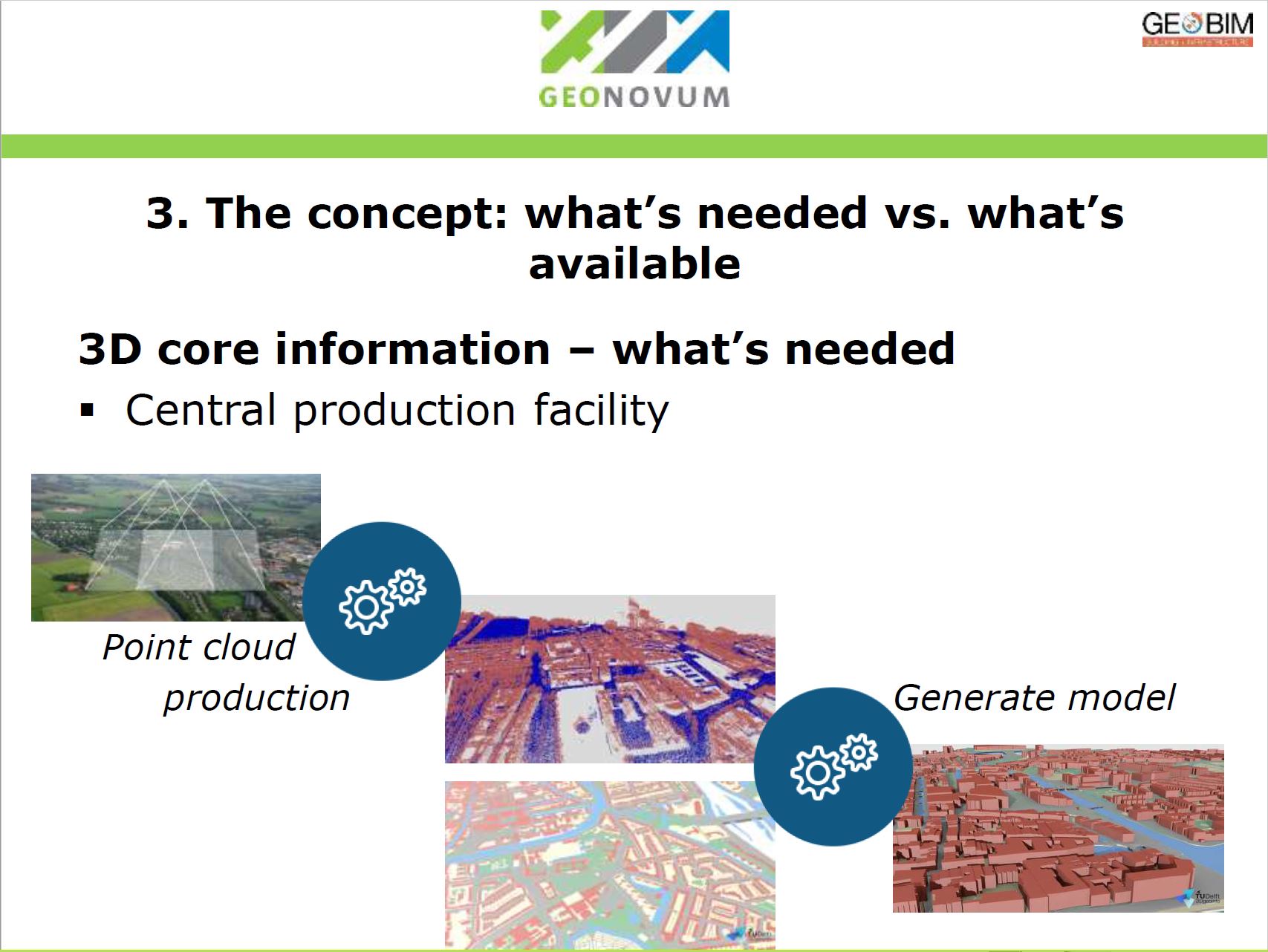 The Netherlands has national 2D core data, large scale topographic data that is open and universally accessible. It has no equivalent in 3D. One way to generate this rapidly are reliable techniques for automating the extraction of buildings, infrastructure and natural features from point clouds.
The Netherlands has a national portal for disseminating 2D data. The national geoportal PDOK has experienced 3-4 billion hits in 2016. For 3D data, PDOK needs to be upgraded to be able to serve 3D data.
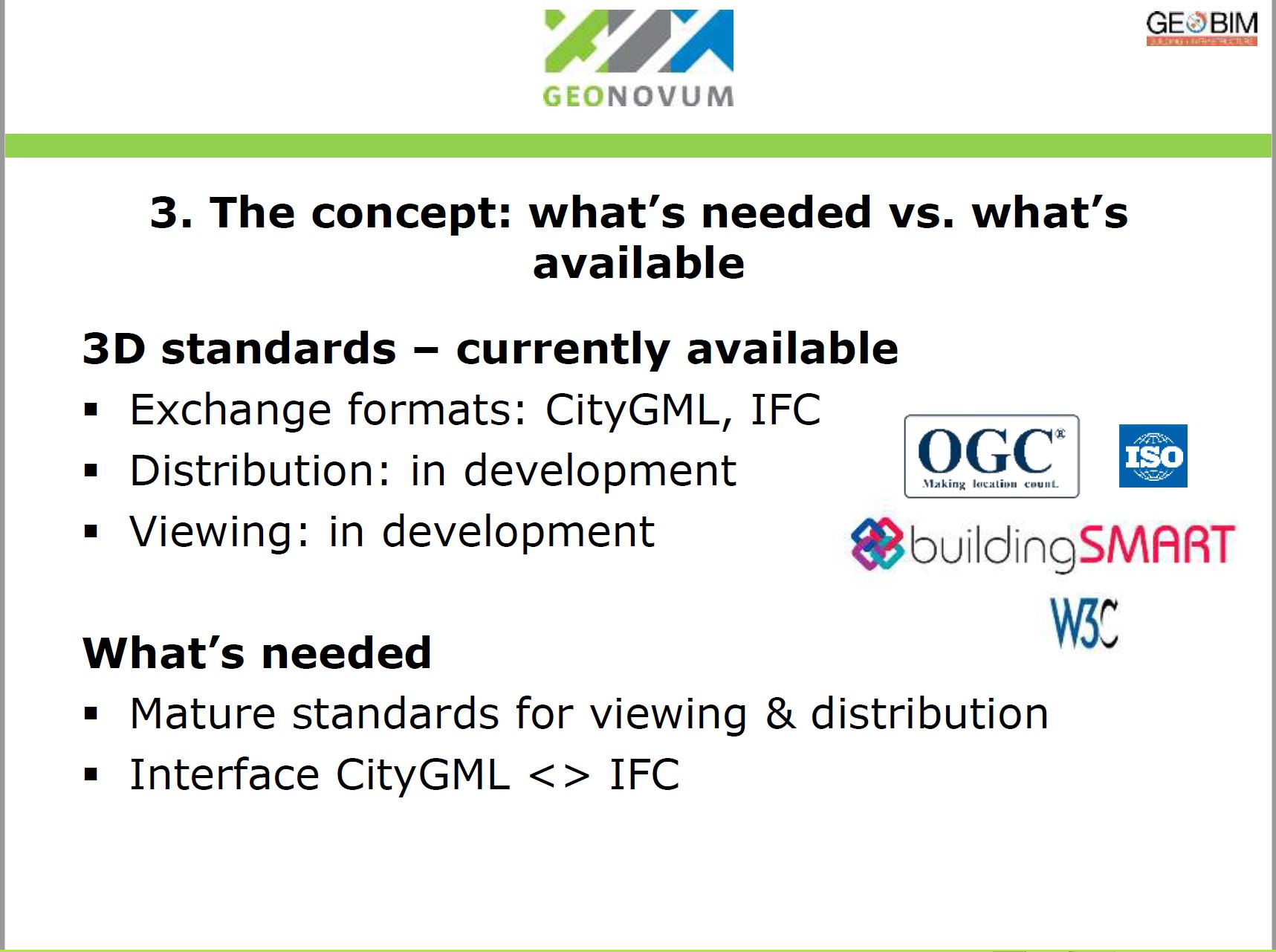 For 3D data there are standards for exchanging 3D data about cities and BIM model such as CityGML and IFC. What’s needed are standards for distributing and viewing 3D data. Another important outstanding challenge is developing an interface between CityGML and IFC.
Rob emphasized that developing a national 3D standard is about identifying and involving stakeholders, understanding user requirements, and realizing the individual components, but more importantly it is about aligning individual initiatives, thus optimizing 3D supply chain.

Be the first to comment