
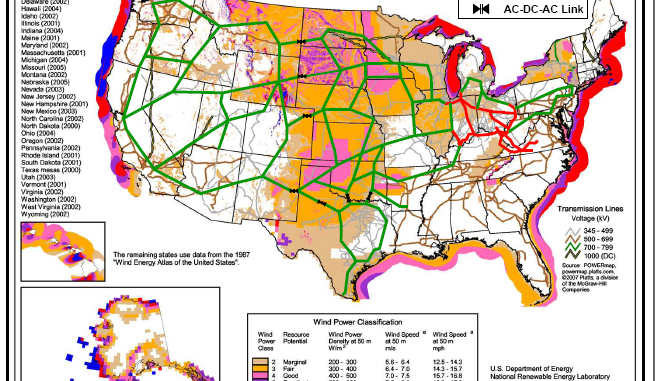
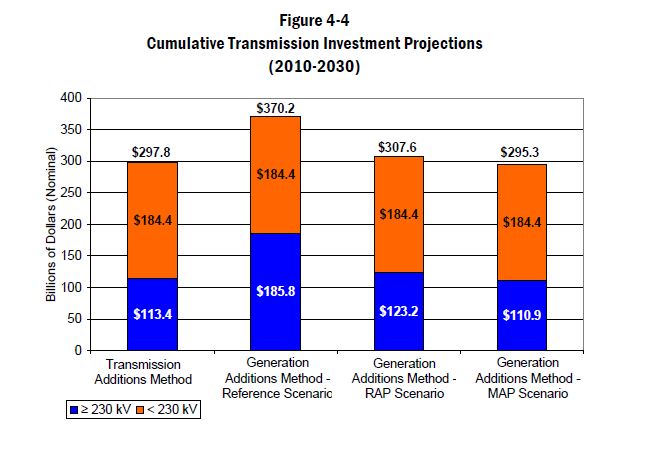
Estimates of the transmission buildout required in the US to bring renewable electric power to market have ranged from 3,000 to 19,000 miles of new transmission lines. The Brattle Group has estimated the total investment in transmission required between 2010 and 2030 to be on the order of $300 billion. Unlike the EU, there is no federally mandated carbon or emissions objective in the US, but 36 states have some form of renewable energy portfolio standards (RPS or RES). Two persistent transmission construction issues have held things back, “Who should plan for new transmission [and] who should pay for new transmission?”
In June of 2010 the Federal Energy Regulatory Commission (FERC) issued a Notice of Proposed Rulemaking on Transmission Planning and Cost Allocation by Transmission Owning and Operating Public Utilities, or a Transmission NOPR for short, which begins the process of resolving these issues.
Transmission Planning
 FERC is proposing that all public utility transmission providers will be required to participate in a regional transmission planning process. The regional transmission planning process is required to take into account state or federal regulations that drive transmission needs, specifically, state renewable energy portfolio standards. FERC also intends to make the transmission market more competitive, by removing advantages that incumbent public utiltiies currently enjoy. Furthermore, each public utility transmission provider will have to enter into an interregional transmission planning agreement with public utility transmission providers in neighboring transmission planning regions.
Transmission Cost Allocation
FERC is also proposing to allocate the costs of new transmission lines in a way that is commensurate with the distribution of benefits, in other word “only those benefitted will pay.” Each public utility transmission provider will be required to have a cost allocation method for new transmission facilities as part of the regional transmission plan and that takes into account neighbouring regions’ plans.
The Transmission NOPR was available for public comment from June through November 12, 2010. I’ve seen a couple of these (ColumbiaGrid and EEI) and this is going to be an exciting debate.

Be the first to comment