
Renewable Energy Drives Investment in Transmission
At the Transmission Summit in Washington DC last week, John Caldwell from the Edison Electric Institute referred to an Edison sponsored 2008 research report Transforming America’s Power Industry, The Investment Challenge 2010-2030 by the Brattle Group (I blogged about this previously) that examines the total investment that would be required to respond to increased energy demand and make US power generation more environmentally gentle by taking advantage of energy efficiency (EE) and demand response (DR) programs.
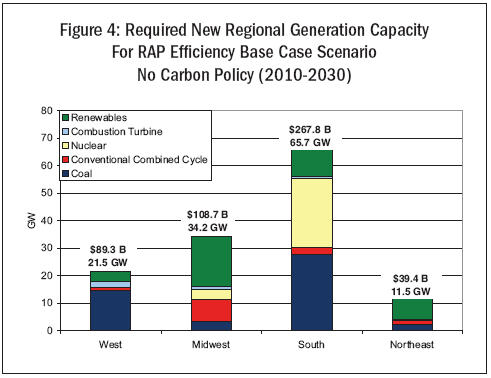
Brattle’s most likely scenario is based on the U.S. Department of Energy’s Energy Information Administration’s (EIA) Annual Energy Outlook (AEO) forecast with the addition of realistically achievable EE and DR programs, but without any new federal carbon policy. It is based on a forecast of likely customer behavior and takes into account existing market, financial, political, and regulatory barriers that are likely to limit the amount of savings that might be achievable through EE and DR programs. Brattle projected that implementation of realistically achievable EE and DR programs by electric utilities would reduce the need for new generation capacity significantly, dropping the AEO-based forecast from 214 GW to 133 GW (38 percent), with an estimated investment cost of $505 billion for 2010-2030.
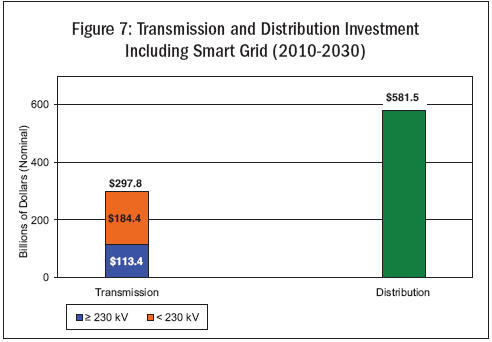 To this will require an investment in transmission and distribution that exceeds the generation investment. Brattle estimated a $298 billion investment for transmission and $582 billion for distribution. These investments will enable the electric power industry to integrate 39 GW of renewable energy mandated under state renewable portfolio standards (RPS) programs and continue the installation of a smart grid. These estimates include at least part of the $160 billion cost of the smart grid (originally called “intelligrid”) as envisaged by EPRI.
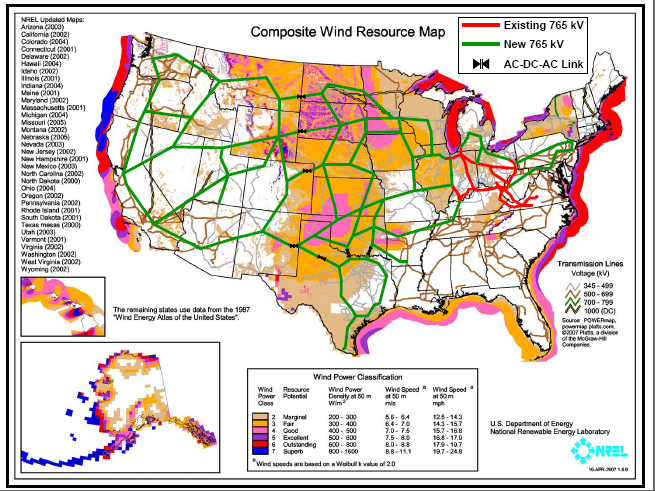 For example, NREL and AEP have proposed a massive national transmission network to bring wind generated power to population centres. The network would mean 19,000 miles of new 765 kV
transmission lines which includes existing
765 kV project proposals. The estimated total cost of this proposal is $60 billion.
Balkanization
Unlike the EU and China where there are strong national goals for renewable generation, in the US weaker state RPS programs are the driving force behind programs to increase the share of renewable generation. The result was described as balkanization by several speakers because each state is developing its own approach to renewable energy, which may not be the lowest cost option. The single biggest issue that I heard over and over again is cost allocation, how the cost of new (interstate) transmission lines is going to be spread among all the stakeholders. However, the Electric Power Act of 2005 requires the Department of Energy to designate National Interest Electric Transmission Corridors where there are significant transmission limitations adversely affecting the public. The Federal Energy Regulatory Commission may authorize federal permits for transmission projects in these regions. To date this has been done in the Northeast and the Southwest.
AC Grids
 Phil Harris of Tres Amigas, who gave the opening keynote, focused on the issues associated with large AC grids. Some of the major disadvantages of the existing AC grids he mentioned are
- changing anything affects everything else
- they are dumb, for example, with the existing grid, it can take from 6 months to a year to analyze a
blackout to determine what happened. - they have to be run below capacity (called “N-1”) to prevent the kind of cascading blackout that occurred in the Northeast in 2003.
New Technology
Power Electronics
Power electronics such as synchrophasors (or PMUs) and other devices enables power system automation or the smart grid. Together these devices enable the real-time monitoring of power flows, situational awareness and control, and the self-managing grid.
HVDC Superconducting Cables
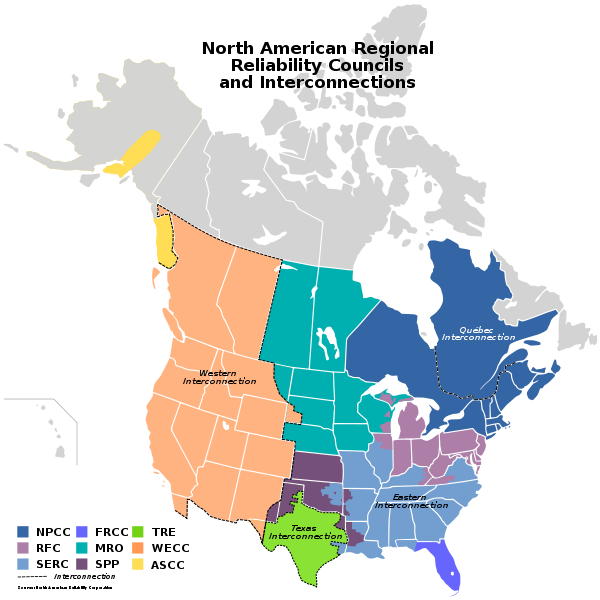
The Eastern Interconnection is the largest alternating current power grid in North America and arguably in the world with about 580 GW or 640 GW including Central Canada (in 2007) of generating capacity. It stretches from Central Canada to the US Atlantic coast (excluding Québec), South to Florida, and West to the Rocky Mountains. (excluding Texas). The other two major AC grids in the US are the Western Interconnection and the Texas Interconnection. Last year the Tres Amigas Project was announced with the intention of interconnecting the Eastern, Western and Texas Interconnections. The technology that is being proposed to do this is underground high voltage direct current (HVDC) superconducting cables each with a capacity of 5 GW. Superconducting HVDC cables can carry high volumes of power over long distances with low loss, approximately 2% for refrigeration that is independent of load and distance. Currently superconducting HVDC cables must be run underground, and as a rule of thumb underground can be up to 10 times more expensive than aerial.
 3D Visualization
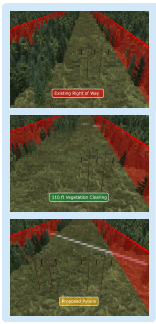
Many speakers emphasized that the single biggest challenge in developing a new transmission line is permitting, getting the necessary approvals from government organizations including state regulators and local permitting agencies. This is so critical and essential that It is difficult to arrange financing until the necessary approvals are in place. The second major challenge is right of way (ROW), which involves negotiating with all of the landowners in the proposed right of way. The speakers emphasized that communication is the most effective way to overcome these hurdles. Truescape, who were present at the conference, provide 3D visualization technology for wind, solar and transmission projects that is designed to involve stakeholders in the design process. Precision 3D simulations reduce doubt and conjecture, help share information about complex projects among the project team and external stakeholders and promote transparency and trust among government regulators and permitting agencies.

Be the first to comment