
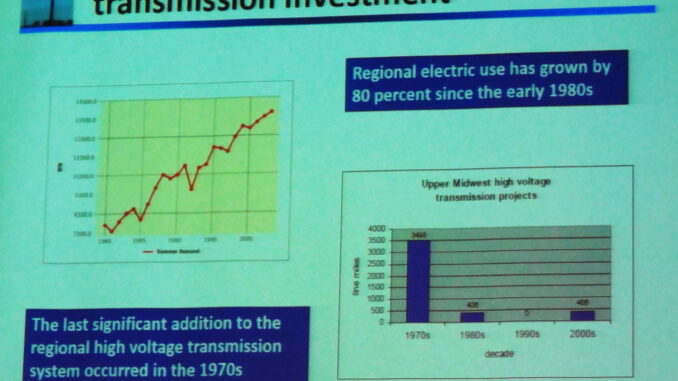
At the Transmission Summit there was a consensus that transmission is no longer the poor cousin of the US electric power industry. It is hard to find anyone in the electric power industry who does not agree that more transmission is required. There was a consensus among investment analysts from John Hancock, Credit Suisse, and Morgan Stanley that there is a “frenzy” in the investment community for transmission. One analyst said it was hard to find a bank that is not interested in investing in transmission, which is recognized as a low risk investment – once the regulatory hurdles are surmounted. There is even interest in combined generation + transmission projects, such as a wind farm and transmission.
The important business drivers for new transmission are reliability, renewable energy and load growth. The US power generation portfolio is changing, driving demand for new transmission. But there is uncertainty about what the US generation portfolio will look like 20 years from now. Fukushima will impact nuclear power development in the short term and drive investment in gas and renewables. It is projected that 40,000 MW of coal fired capacity, mostly plants with less than a 100 MW capacity, will be decommissioned over the next few years, but no one is sure when and where. Renewable energy is one of the major drivers in the US for new generation capacity and new transmission. Wind and solar development occur in regions of the country distant from consumers, and new transmission is required to bring this to market. 31 states have mandatory RPS objectives, and another 6 or 7 have voluntary objectives. The primary way for backfilling variable energy like wind and solar is gas fired generation, to backfill when wind or solar generation drops off, so wind is driving gas fired generation. Wind is now competitive with thermal in some parts of the country, in the range of 3-4 cents/kWh. In the US wind is currently 2% of total generation, whereas in Europe it is 10%. It is projected that wind could become 20% of US power generation. Most of that wind power will require new transmission, as will solar.
Massive Transmission Build-out Projected
Some of the projections for the transmission build-out are startling. Whereas a few years ago the US was averaging 2000 miles/year of new transmission, currently it is averaging 4000 miles/year, 70% of which is in Texas. One forecast suggests that about 50,000 miles of new transmission will be built over the next decade.
- 2011 $11 billion in the pipeline
- 2012 $12 billion
- 2011-2014 20,000 miles
- 2015+ another 19,000 miles
Lauren Azar, a Wisconsin PUC commissioner and president of EISPC, said she was convinced that a “supergrid” will be built in the US, but it will require Federal backstopping, state siting and a streamlined regulatory process.
Regulatory Uncertainty
The fly in the ointment, or better put, the elephant in the ointment is regulatory uncertainty. The “three horsemen” of transmission are planning, siting, and cost allocation. FERC is actively working to address these issues. The recent FERC NOPR addresses regional planning and cost allocation. John Wellinghoff, chairman of FERC, sees the transmission NOPR as another way of furthering his main goal at FERC, which is to boost efficiency. Allowing more transmission to be built lets better generation units serve more load, which cuts cost.
The length of time it takes to develop a new transmission line is clearly a deterrent to rapid transmission build-out. One speaker estimated the time required for the several steps in developing a new transmission line
- Planning 1-2 years
- Cost allocation 6-12 months
- Federal approval 3-5 years
- State approval and siting 3-5 years
- Construction including access roads 2-7 years
Overall, the time required to plan, get regulatory approval, and build a new transmission line is 10-20 years. One of speakers quipped that it was easier to build a new nuclear power plant than a new transmission line.
Innovation
There is a lot of innovation going on in the transmission industry to speed up design and construction, reduce impact on the environment, and to reduce visual impact, for example, HVDC, superconductors, low sag cable, helical piers, caissons, monopoles, and helicopter construction. One speaker said that helicopter construction using caissons or helical piers can leave 98% of the right of way untouched. This not only speeds construction, but reduces the risk of time consuming environmental issues with the regulator and other concerned parties.
As an example, a major new tranmission line (CHPE) using high voltage direct current (HVDC) has been proposed to bring clean energy, hydro and wind power, from Quebec to New York City. HVDC systems not only can deliver a lot of power with low loss, but can minimize the environmental footprint and visual impact. In this case most of the proposed line would be under water, crossing Lake Champlain and then down the Hudson River.
(Image Laureen Ross McCalib, CAPX2020)

Be the first to comment