
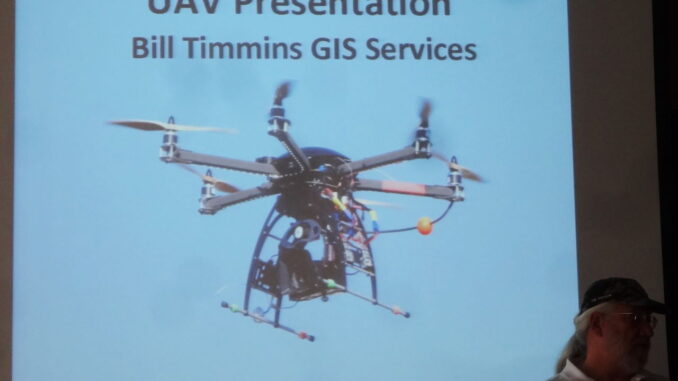
At this year’s GIS in the Rockies, there were very interesting sessions on unmanned aerial vehicles (UAVs) and unmanned aerial systems (UASs). It turns out that Colorado is a hot bed for the development of these devices.
Custom UAVs
Bill Miller is with a company GIS Services that builds customized UAVs, copters with your choice of sensors and cameras for $5,000 to $10,000 depending on your requirements. The copters can fly for a maximum of 20 minutes. They have smart
controls. For example, if you take your hands off the controls, the
copter will hover. It also has a pullback control, which will cause the
copter to return and land where it was launched – you have to be
careful that you haven’t inadvertently stepped into the area where it
took off from, because it will land on you. They also can correct for wind.
He reviewed the legal challenges to flying UAVs, which are restricted to recreational use in the U.S. UAVs are subject to
- Altitude limit – UAVs are limited to a maximum altitude of 400 ft (200 ft if tethered)
- Line of sight – the UAV has to be visible to the operator
- Recreational – can’t be used for commercial purposes – for example, you can not sell imagery collected by the UAV (though you can give it to friends)
It is possible to get special exemptions for emergency monitoring and other purposes.
 UASs
UASs
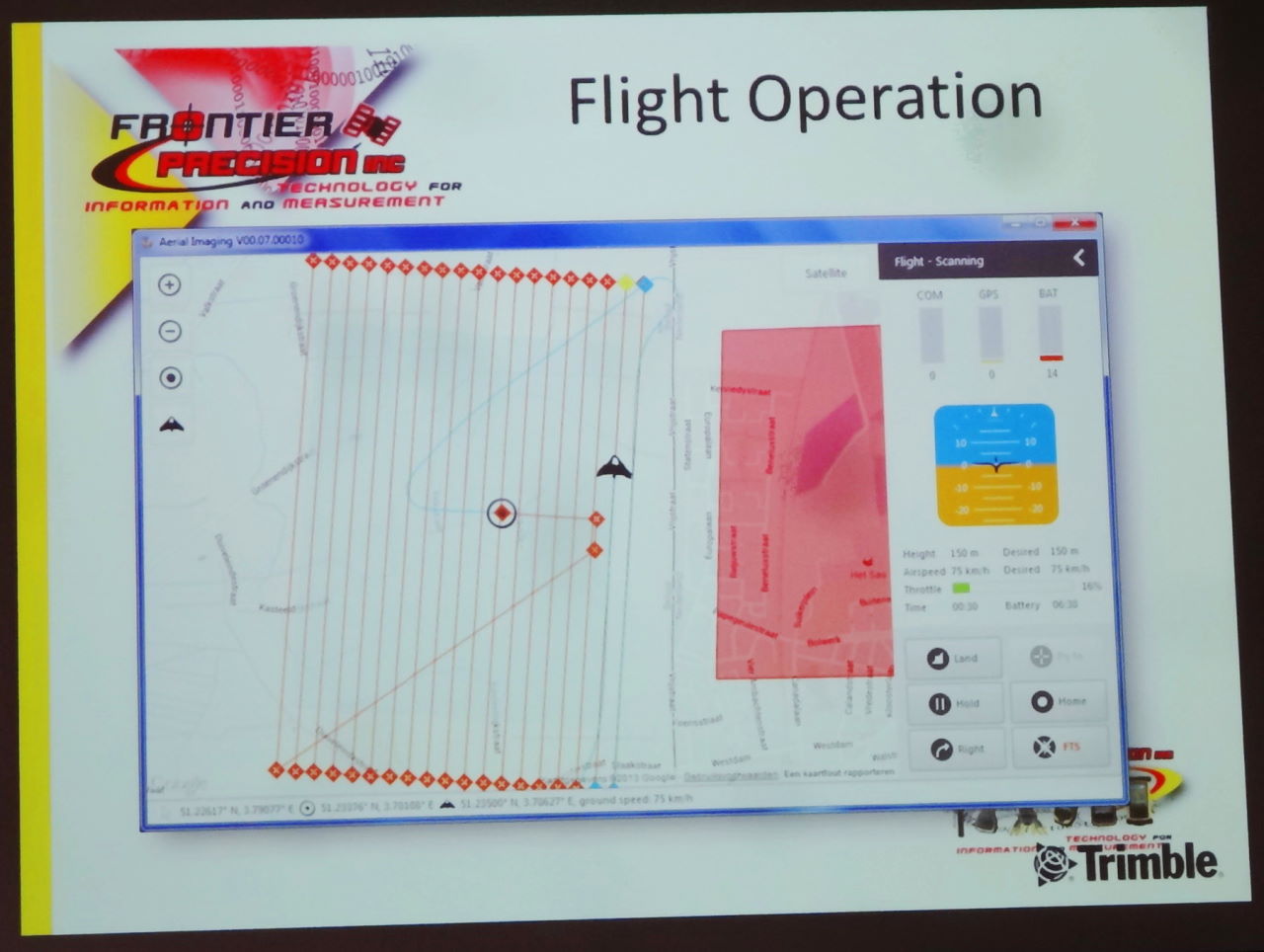
An example of a UAS is Trimble’s fixed wing UX5 (derived from the Gatewing that Trimble acquired a few years ago.) Using this device is a completely automated process. You use software to define the flight path for the device for the area you are interested in. After launch it will follow the plan without any intervention from the operator – including compensating for wind. It flies at up to 80 km/hr for up to 50 minutes. After processing the imagery you will have a orthorectified image and a digital surface model (DSM) of the area. It can cover a square km area in 36 minutes of flying time, taking 1014 overlapping images at a resolution of 3.2 cm. Because of the airspace restrictions in the U.S. this device is not generally available in the U.S. It is being sold in Canada and Europe.
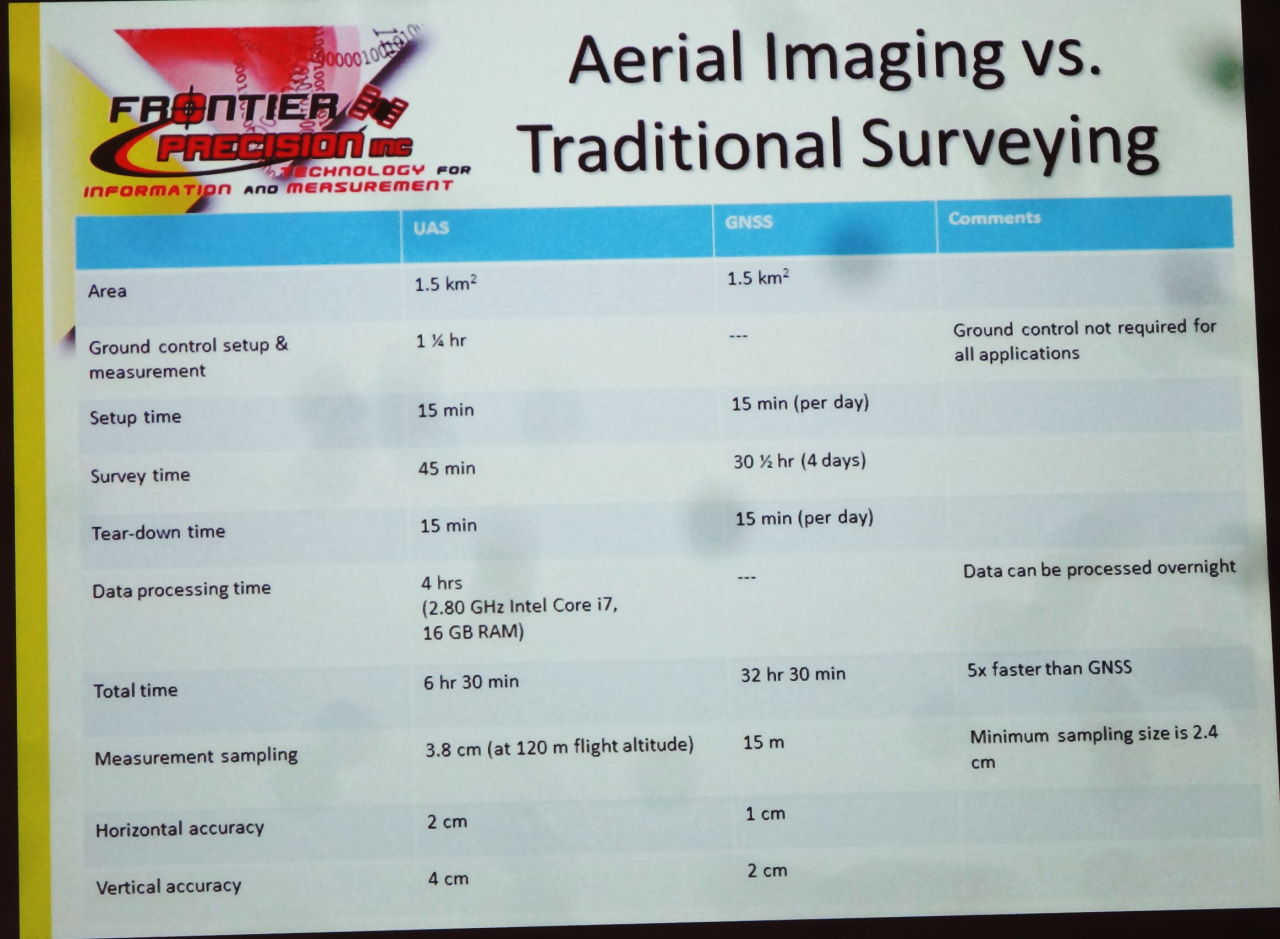 A detalied comparison of the cost of a traditional survey by a surveyor in the field and a survey conducted using the UX5 shows that the the survey can be completed at a comparable level of resolution (horizontal 2 cm and vertical 4 cm vs 1 cm and 2 cm) with many more sampling points (sampling interval of 3.8 cm vs 15 m) in about a fifth of the time (6 hrs 30 mins vs 32 hrs 30 mins) that the traditonal survey requires. This suggests that UAVs are going to be disruptive for this type of survey once the airspace restrictions in the U.S. are resolved.

Be the first to comment